January 10, 2026
gap assessment processcompliance auditISO certificationrisk management
A Modern Guide to the Gap Assessment Process
Master the gap assessment process with our guide. Learn to define scope, gather evidence, create remediation plans, and leverage AI for compliance and audits.
20 min readAI Gap Analysis
A gap assessment is, at its core, a way to figure out where you are versus where you need to be. It’s a systematic review that compares your organization's current performance against a desired standard or goal. Think of it as creating a detailed map that not only shows your destination—like achieving ISO 27001 compliance—but also pinpoints exactly where you're starting from.
This process shines a light on the specific "gaps" in your controls, documentation, or operational processes. It’s not just about ticking boxes on a checklist; it's a deep, evidence-based analysis that gives you a clear path forward.
Why Your Gap Assessment Process Needs a Rethink
When someone says "gap assessment," you might picture a dusty business school textbook from the 80s. While the concept has its roots in old-school strategic planning, the modern gap assessment is the lifeblood of any serious governance, risk, and compliance (GRC) program. It's evolved far beyond high-level goal setting into a meticulous, evidence-driven exercise.
This shift was really pushed by digitalization. As nearly every business process moved online, the proof needed for audits followed suit. The stakes are much higher today. A sloppy assessment can easily lead to a failed certification, expose you to major security vulnerabilities, or land you with some eye-watering fines for non-compliance.
A structured, repeatable process isn't just a nice-to-have anymore. It’s an absolute must for any organization that's serious about:
- Nailing Certifications: You need to systematically prove you meet every single requirement of standards like ISO 9001 or SOC 2.
- Getting Ahead of Risk: It's about proactively finding the weak spots in your systems before an attacker does or before they cause a serious business disruption.
- Making Smart Improvements: You can use hard data to pour resources into the areas that will actually make a difference.
From Planning Tool to Compliance Engine
The formal gap assessment process has been around for a while. You can trace its origins back to business planning methods in the 1960s, when companies started comparing their performance against long-term targets to decide where to invest their money. By the 1990s, this method was baked into quality management frameworks like ISO 9001, which requires you to review process nonconformities for continuous improvement. You can learn more about the history of gap analysis on Shopify's blog.
But today, the process is a different beast entirely. It’s far more rigorous and granular. A compliance manager has to be able to trace every claim of conformity back to a specific policy, record, or piece of documentation. This shift from broad strategy to evidence-based verification demands a much more sophisticated approach than a simple spreadsheet can ever provide.
A gap assessment without traceable evidence is just an opinion. And in an audit, opinions don't count—only documented proof does. This is the fundamental truth modern compliance teams have to build their work around.
This diagram breaks down the core pieces of a typical gap analysis. It shows the journey from figuring out where you are now to putting targeted improvements in place.
What this visual really drives home is that the process is a continuous cycle of finding, analyzing, and fixing problems to close the gap between your reality and your goals. This is exactly why having a repeatable gap assessment process is so critical for modern GRC teams.
Laying the Groundwork for a Successful Assessment
A high-quality gap assessment begins long before you review the first document. I’ve seen it time and again: teams that rush into the analysis phase without proper prep end up with confusing results, wasted time, and a final report that just doesn't hold up. The groundwork you lay here directly determines the quality and reliability of your findings.
First things first, you need to define a crystal-clear scope. Are you targeting a full ISO 27001 certification across the entire organization, or are you focused on a specific quality management system for a new product line? An undefined scope is a direct path to "scope creep," where the assessment balloons uncontrollably, pulling in irrelevant departments and processes. It’s a classic mistake.
For example, an assessment for a medical device manufacturer targeting ISO 13485 would narrowly focus on design controls, production processes, and post-market surveillance. On the other hand, a SOC 2 assessment would center on security, availability, and confidentiality controls related to customer data. Get specific and document the boundaries of your review before you do anything else.
Assembling Your Cross-Functional Team
A gap assessment is never a solo mission. To get a complete picture, you absolutely need insights from the people who live and breathe the processes you're evaluating every single day. Assembling a cross-functional team isn't just a good idea—it's non-negotiable for a thorough review.
Your team should include representatives from key areas relevant to your scope. This usually means pulling in people from:
- IT and Security: They'll speak to technical controls, system configurations, and access management.
- Operations: These folks offer real-world insights into day-to-day production, service delivery, and process execution.
- Human Resources: They can provide evidence for employee onboarding, training records, and competency policies.
- Legal and Compliance: You need them to ensure regulatory requirements are correctly interpreted and addressed.
Once you have your team, creating a Roles and Responsibilities Matrix is crucial to prevent confusion and keep everyone accountable. Everyone needs to know what’s expected of them, from providing documentation to sitting down for interviews.
Roles and Responsibilities Matrix for a Gap Assessment
This matrix is a simple but powerful tool to make sure everyone involved understands their part in the process, preventing overlaps and missed tasks.
| Role | Primary Responsibilities | Key Contributions |
|---|---|---|
| Assessment Lead | Manages the project, coordinates the team, and is ultimately responsible for the final report. | Drives the timeline, clears roadblocks, and ensures consistency in how everything is assessed. |
| Subject Matter Experts | Provide documentation, answer detailed questions, and explain how processes actually work in practice. | Offer deep, practical knowledge of how specific controls are implemented on the ground. |
| Executive Sponsor | Champions the assessment, removes high-level obstacles, and provides the necessary resources. | Secures buy-in from leadership and helps prioritize the remediation efforts that come later. |
Having this clarity from the start saves countless hours of confusion down the road.
Creating a Document Inventory and Framework Map
With your team and scope locked in, it's time to get organized. This means creating a comprehensive inventory of all relevant documentation—think policies, Standard Operating Procedures (SOPs), work instructions, training records, and any previous audit reports. You simply can't assess what you can't find.
But just listing documents isn't enough. The real value comes from framework mapping. This is the critical process of linking each piece of your collected documentation to the specific clauses or controls of the standard you're assessing against. For instance, you would map your "Incident Response Plan" document directly to the relevant incident management clauses in ISO 27001.
This mapping exercise is the secret to an efficient gap assessment. It transforms a chaotic pile of documents into a structured, evidence-based library, making the analysis phase faster and far more accurate.
This isn't just about ticking boxes; it’s about building a solid foundation. The whole gap assessment process has evolved, moving from basic planning to a more dynamic, AI-driven compliance engine.
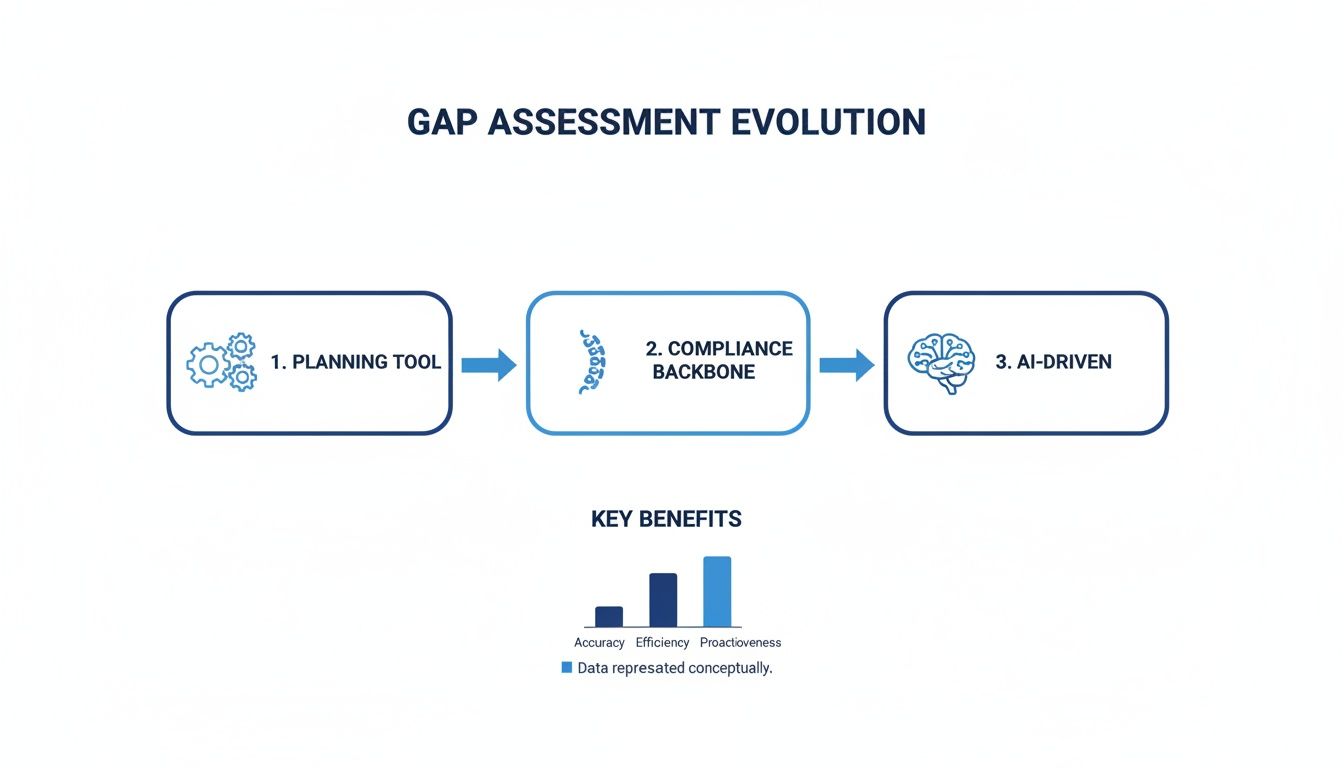
This evolution highlights a critical insight: modern assessments rely on a strong compliance backbone built during this preparation phase, which can be supercharged with technology. Doing this foundational work well enables a far more strategic and less reactive approach to compliance. If you want to dive deeper, you can explore more advanced concepts in our educational resources on AI gap analysis.
Alright, you've done the prep work. You’ve mapped your frameworks and lined up your documents. Now comes the real work—the part where you roll up your sleeves and dig in. This is where you move from theory to practice, gathering the actual proof of how your organization operates.
This phase is all about a systematic, almost forensic, hunt for evidence. You're not just taking someone's word for it; you're finding tangible proof that your processes are alive and well, not just collecting dust in a policy document.
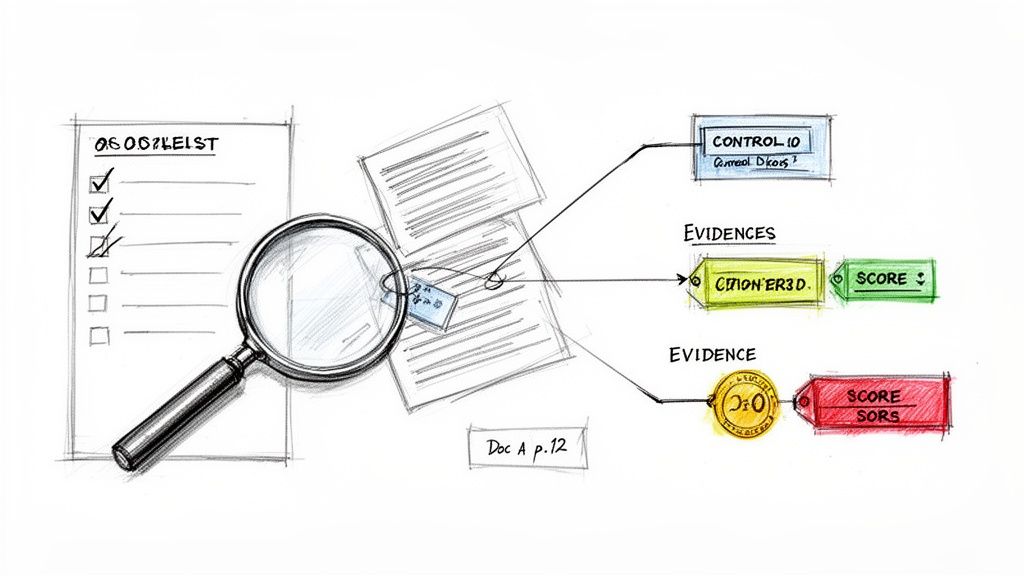
The goal here is simple: get objective evidence for every single control within your scope. A thorough assessment never relies on just one source of truth. Instead, you'll need to use a combination of methods to get the full picture.
How to Collect Evidence That Actually Holds Up
The strongest assessments triangulate findings from multiple sources. This builds a complete and defensible picture of your compliance posture. If you only review documents, you risk getting a false sense of security based on policies that nobody actually follows.
Here are the three pillars of solid evidence collection:
- Document Reviews: This is always your starting point. You'll systematically comb through the policies, procedures, and records you inventoried earlier. Don't just check for existence; look for signs of life—approval signatures, version histories, and evidence of regular reviews.
- Stakeholder Interviews: Documents tell you the "what," but talking to people tells you the "how" and "why." This is where the real insights come from. Speaking directly with process owners and the folks on the ground reveals how closely day-to-day work aligns with written rules and uncovers those informal workarounds that documents never mention.
- Direct Observation: Seeing is believing. This means watching a process as it happens. For a manufacturer, it might be observing the production line. For an IT team, it could be watching an admin perform a system backup. This method gives you unfiltered proof of how things are really done.
The most credible findings are those backed by multiple evidence types. A policy document, an interview confirming its use, and a direct observation of the process in action create an undeniable chain of evidence.
This multi-faceted approach is critical because it ensures what’s written down is what's actually happening. That's exactly what an external auditor will be looking to verify.
Systematically Mapping and Scoring Controls
As the evidence rolls in, you need a system. Each piece of proof must be meticulously mapped back to a specific control in your framework. This is what transforms a pile of notes and files into a structured, useful assessment.
It's not enough to say, "Yep, we have an access control policy." You have to be able to cite the exact document—and even the page number—that satisfies a specific requirement, like control A.9.1.1 from ISO 27001.
Once you’ve mapped the evidence, you need a consistent way to score each control. A simple, well-defined scoring system is what allows you to quantify your gaps and figure out what to fix first.
Common Scoring Models
| Scoring Model | Description | Best For |
|---|---|---|
| Compliant / Non-Compliant | A straightforward binary choice. The control is either fully met or it is not. | Quick, high-level assessments where you just need a "yes" or "no." |
| Maturity Model (CMMI-style) | A scale (e.g., 1-5) rating the maturity of a process from non-existent to fully optimized. | Detailed assessments focused on continuous improvement, not just checking a box. |
| Traffic Light (RAG) | A visual system: Red (major gap), Amber (minor gap), and Green (compliant). | Communicating findings clearly to executives and non-technical stakeholders. |
Pick one model, define what each score means, and stick with it. Consistency is the key to producing reliable and comparable results.
The Critical Importance of Meticulous Documentation
Your final report is only as strong as the evidence you've gathered. Every finding, especially every identified gap, has to be backed by a clear, traceable audit trail. This means citing your sources with surgical precision.
A vague finding like "Non-Compliant" is useless. A strong finding, on the other hand, tells a story: "Control 5.23 - Information security for use of cloud services is partially implemented. The ‘Cloud Services Policy’ (Doc ID: POL-SEC-004, v2.1, page 8) exists, but interviews with IT staff revealed no formal process for vetting new cloud vendors, as required by the policy."
See the difference? This level of detail is non-negotiable. It removes ambiguity, gives the team clear direction for remediation, and proves to any auditor that you’ve done a rigorous job. It's also fundamental to how we handle sensitive information, a commitment detailed in our AI Gap Analysis Privacy Policy.
This analytical mindset is similar to how statistical gap analysis on Amplituderesearch.com quantifies performance. For instance, if 82% of customers say data security is 'extremely important' but only 49% are 'very satisfied,' that 33-point gap is a glaring priority. By treating each control with the same analytical rigor, your assessment becomes less of a checklist and more of a strategic tool for improvement.
Turning Findings Into an Actionable Remediation Plan
An assessment that doesn't lead to action is just a very expensive information-gathering exercise. The real payoff from all that hard work comes now—when you transform your raw findings into a concrete, get-it-done remediation plan. This is where you pivot from identifying problems to actually fixing them.
Honestly, a lot of companies stumble here. They produce a massive, hundred-page report that nobody reads, and it just collects dust. The key is to start with a high-level executive summary that flags the most critical gaps. Then, break down the details for each finding, clearly stating the evidence, the risk it poses, and the specific control it violates.
You Can't Fix Everything at Once
Trying to tackle every single finding at the same time is a recipe for failure. Smart remediation is all about ruthless prioritization. You need to look at each gap through the lens of risk, impact, and urgency, because not all findings are created equal. A missing signature on a training log is a world away from having no disaster recovery plan at all.
To get your priorities straight, ask these questions for every gap you’ve found:
- Business Impact: What’s the worst that could happen? Are we talking about a potential data breach, a product recall, or a full-blown operational shutdown?
- Compliance Deadlines: Is an auditor about to knock on our door? External deadlines can force your hand and make certain fixes non-negotiable.
- Likelihood of Exploitation: For security gaps, how likely is it that a bad actor could actually take advantage of this vulnerability?
- Effort to Remediate: What’s it going to take to fix this? Is it a quick win that can build momentum, or a complex, six-month project?
By scoring each gap against these factors, you can build a ranked to-do list. This moves prioritization from a "gut feeling" to a defensible business strategy that focuses your resources where they matter most.
Building Your Roadmap to Compliance
With your priorities locked in, it's time to build the actual plan. Think of this as a living project plan, not a static report you file away. For every item on your priority list, the plan needs to be crystal clear.
This means breaking down corrective actions into manageable tasks. A vague goal like "Improve data backup process" is useless. A much better, actionable task is: "Implement and test quarterly restoration of critical database backups, with sign-off from the IT Director by Q4." That’s a goal with a clear definition of done.
I’ve seen so many remediation efforts fail because tasks are assigned to a whole department. When everyone is responsible, no one is. Every single corrective action needs a single, named owner—someone who has the authority and accountability to see it through.
That single point of ownership is the secret sauce. It ensures that tasks don't get lost in the shuffle and that there’s always one person who can answer, "What's the status on this?"
Tracking Progress and Making Sure "Done" Is Actually Done
Creating the plan is a great start, but execution and verification are what separate success from failure. You absolutely need a simple tracking system—a shared spreadsheet or a project management tool like Jira or Asana—to monitor progress. This tracker becomes your single source of truth for everyone involved.
Here’s a straightforward template to help your team organize findings, set priorities, and keep track of everything.
Remediation Plan Template
| Gap ID | Finding Description | Associated Risk | Priority | Corrective Action | Owner | Due Date | Status |
|---|---|---|---|---|---|---|---|
| G-001 | No formal vendor review process for cloud services. | High | 1 | Develop and implement a vendor security assessment checklist. | J. Smith | 10/31/2024 | In Progress |
| G-002 | Access control policy not reviewed in over 24 months. | Medium | 2 | Review, update, and secure management approval for the policy. | A. Lee | 11/15/2024 | Not Started |
| G-003 | Three employees missed mandatory security training. | Low | 3 | Schedule and complete makeup training sessions for identified staff. | M. Chen | 10/25/2024 | Completed |
This kind of structured tracking brings much-needed clarity and accountability to the process.
Finally, remember that the job isn't over just because an owner marks their task as "complete." The assessment lead, or even better, an independent party, needs to verify that the fix was implemented correctly and that it actually closes the gap. This final check provides the assurance that your improvements are real and lasting, bringing the entire gap assessment process to a successful conclusion.
How AI Is Changing the Gap Assessment Game
Let’s be honest: manual gap assessments are a nightmare. Anyone who’s been in the compliance trenches knows the pain of staring at a massive spreadsheet, trying to manage version control, fixing broken evidence links, and spending days hunting for one specific sentence in a hundred different documents. That old-school approach is slow, incredibly prone to human error, and just can't keep up anymore.
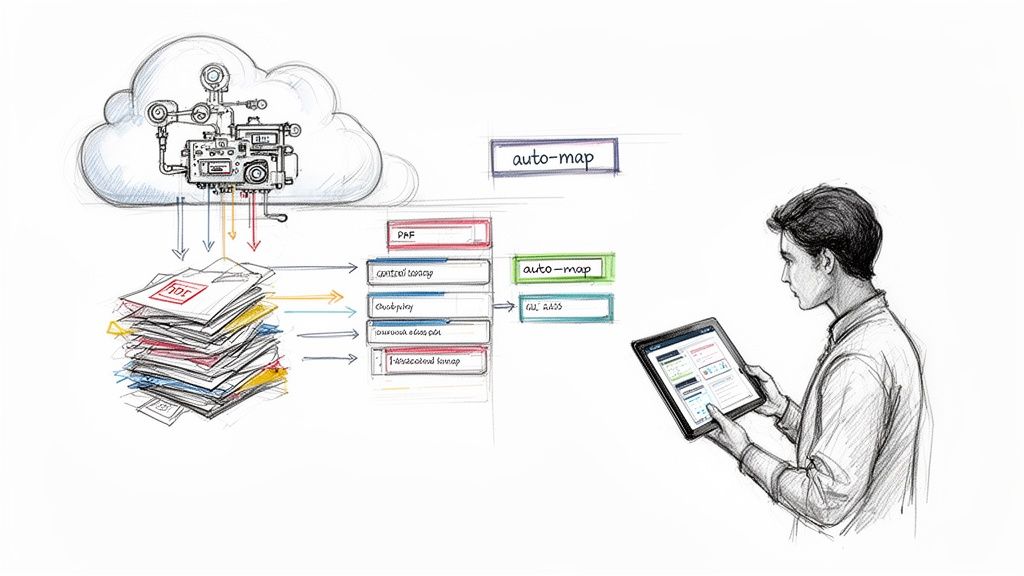
This is where purpose-built AI tools come in. They aren't here to replace compliance experts, but to give them a serious advantage. These platforms automate the most grueling parts of the gap assessment process, turning it from a manual grind into a strategic, high-value activity.
From Manual Mapping to Automated Insight
At its heart, a traditional assessment is a massive reading and cross-referencing project. An analyst has to pour through every policy, procedure, and system record, then mentally connect that information back to a specific control in a framework. It’s a high-stakes job where fatigue and simple oversight can have major consequences.
AI-powered platforms completely change this dynamic. Instead of a person digging for evidence, the system does the heavy lifting.
- Document Ingestion: It all starts with uploading your entire evidence library—hundreds of PDFs, Word docs, and other files—into a secure platform.
- Intelligent Analysis: Using natural language processing, an AI agent then reads and actually understands the content of every single document, identifying key policies, procedures, and control statements.
- Automated Control Mapping: The system automatically maps what it finds against the requirements of your chosen framework, like ISO 27001, showing you exactly where evidence exists and—just as important—where it doesn't.
This level of automation frees up your GRC and quality teams to focus on what they do best: analyzing the findings and building solid remediation plans, instead of just acting as human search engines.
The real game-changer with AI in the gap assessment process is getting instant, evidence-linked answers. When you can ask a question and get a direct quote with a page number in seconds, it fundamentally improves the speed and integrity of your entire compliance program.
A Real-World Scenario: Before and After AI
Imagine a team preparing for an ISO 13485 audit for a new medical device. They're sitting on a mountain of documentation: design history files, risk management reports, SOPs, and validation records, all saved as individual PDFs.
The Old Way
The quality manager would block out weeks to manually read every document, highlighting sections and painstakingly copying text into a gigantic compliance spreadsheet. Every time a document gets updated, the risk of broken links and outdated evidence skyrockets. It's a stressful, high-risk scramble before the audit.
The New Way with AI
The team uploads their entire document library to an AI platform. In minutes, the system has processed everything. Now, the quality manager can simply ask, "Show me where we document our process for design verification."
The AI immediately points to the exact paragraphs in the relevant SOPs, complete with citations and direct links to the page. It also flags every control where no supporting evidence was found, creating an instant, actionable gap list. A job that used to take weeks of manual labor is now done in a few hours. The team can spend its time actually fixing the gaps, not just looking for them.
The gap assessment process is critical for any compliance program. A single framework like ISO 27001:2022 Annex A has over 90 controls, which makes these assessments incredibly demanding. Auditors need a clear, traceable path for every claim, following the chain from a conformity statement all the way back to the original evidence. This is precisely the kind of challenge AI is built to solve. For more on this, check out our other posts on the AI Gap Analysis blog.
Got Questions About Gap Assessments? We’ve Got Answers.
Even the most well-thought-out plan can hit a few snags. It’s only natural for questions to pop up when you're deep in the details of a gap assessment—it's a meticulous process, after all. You might be wondering about timing, common tripwires, or how to best allocate your resources.
Getting these things straight from the start is the key to making sure your hard work pays off with real, actionable insights. Let's tackle some of the most common questions I hear from teams in the trenches.
How Often Should We Be Doing This?
There's no single magic number here. The right cadence really depends on your specific goals and how quickly your industry is evolving. That said, there are definitely some clear triggers and a general rhythm that works for most organizations.
For any major certification like ISO 27001 or ISO 9001, a full-blown gap assessment is non-negotiable before you face the auditors. Think of it as your dress rehearsal—it’s your chance to find and fix the weak spots before they become official findings.
Once you’re certified, the focus shifts to continuous improvement. Here’s what that usually looks like:
- Annually: A smaller, more targeted assessment is a great fit for your internal audit program. It keeps your compliance sharp and helps you spot any new risks that have cropped up over the year.
- Event-Driven: You should absolutely trigger a new assessment whenever there’s a major shift. This could be a new version of a standard being released, a big change in business operations (like a merger), or entering a new market with its own set of rules.
The goal is to get out of the "one-and-done" mindset. A mature compliance program treats the gap assessment process as an ongoing health check, not just a frantic scramble before an audit.
What's the Biggest Mistake People Make?
If I had to pick just one, it's this: rushing into the analysis without doing the prep work. I've seen it time and time again. Teams that don't properly define their scope and get their documentation in order first always end up with a mess of inconsistent findings and a ton of wasted time.
A poorly defined scope is a direct path to chaos.
Another huge pitfall is treating the assessment like a simple checklist. It's not about just finding a document that happens to mention "access control" and ticking a box. You have to dig deeper and verify that the process described on paper is actually working in practice. You need proof.
An assessment without traceable, objective evidence is fundamentally useless in a formal audit. Your findings must be defensible, linking every conclusion back to a specific document, interview, or observation.
Forgetting this turns a powerful strategic tool into a meaningless box-checking exercise. It completely undermines the whole point of the assessment.
Should We Use Our Own Team or Hire a Consultant?
Ah, the classic "build versus buy" dilemma. Honestly, it depends. The right call hinges on your team's current expertise, your budget, and what you’re trying to achieve with the assessment.
Doing it internally is a fantastic way to build up your in-house knowledge and skills. The only downside is that internal teams can sometimes be held back by institutional blind spots or just a lack of deep familiarity with a brand-new standard.
An external consultant brings a fresh set of eyes and a ton of specialized experience. This is especially valuable right before a big certification audit when you absolutely need an unbiased, expert opinion on your readiness.
Here’s a quick breakdown to help you weigh the options:
| Approach | Pros | Cons |
|---|---|---|
| Internal Team | Cost-effective and builds internal expertise. | Can be influenced by internal biases and may lack specialized knowledge. |
| External Consultant | Offers an unbiased, expert opinion and deep framework knowledge. | More expensive and doesn't build long-term internal skills. |
| Hybrid Model | Uses internal teams for routine checks and a consultant for major pre-audits. | Often the best of both worlds, balancing cost and expertise. |
For many, a hybrid approach hits the sweet spot. You can also empower your internal team with modern AI-powered tools that help them perform with the rigor of a seasoned consultant, effectively bridging the gap between the two options.
Ready to transform your manual, spreadsheet-driven process into an efficient, evidence-backed workflow? AI Gap Analysis ingests your documents and delivers audit-ready answers in minutes. Start your analysis today at ai-gap-analysis.com and see how quickly you can close your compliance gaps.