February 13, 2026
iso 9001 internal audit checklistqms auditiso 9001 clausesquality management systemaudit preparation
The Ultimate ISO 9001 Internal Audit Checklist: 8 Core Areas for 2026
Master your next audit with our comprehensive ISO 9001 internal audit checklist. Explore 8 key areas, sample questions, and evidence requirements for 2026.
24 min readAI Gap Analysis
An ISO 9001 internal audit can feel like a high-stakes exam for your entire Quality Management System (QMS). Without a structured approach, auditors can spend weeks chasing documents, leaving teams scrambling to find evidence and stakeholders anxious about the outcome. A well-designed ISO 9001 internal audit checklist transforms this process from a reactive scramble into a proactive strategy, ensuring your QMS is not just implemented but truly effective.
This guide provides a clear, clause-by-clause roadmap, ensuring every requirement is systematically verified, documented, and ready for scrutiny. It moves beyond generic templates to offer a detailed breakdown of the eight essential areas to audit, mapping directly to the standard's core components. For each clause, we will outline:
-
Specific audit questions to ask.
-
Required documents and evidence to collect.
-
Common nonconformities to watch for.
This comprehensive listicle serves as an actionable tool for compliance auditors, quality managers, and operations leaders. We’ll cover everything from the "Context of the Organization" (Clause 4) to "Improvement" (Clause 10), providing practical insights to streamline your audit. We will also explore how to leverage modern tools like AI Gap Analysis to automate evidence discovery, turning a mountain of PDFs into audit-ready findings instantly. Let's build a checklist that ensures you're not just compliant, but confidently in control of your quality processes.
1. Clause 4: Context of the Organization
Clause 4 serves as the strategic foundation of any effective Quality Management System (QMS). It requires an organization to define and understand its unique environment, ensuring the QMS is not a generic template but a system tailored to its specific purpose, strategic direction, and operational realities. For any ISO 9001 internal audit checklist, this clause is the critical starting point, as it verifies that the QMS scope is relevant and aligned with both internal and external factors.
What to Audit in Clause 4
An internal audit of Clause 4 should verify that the organization has a systematic process for determining its context. This includes identifying internal issues (like organizational culture, performance, and resource capabilities) and external issues (such as market competition, technological changes, and legal or regulatory environments).
The audit must also confirm the identification of interested parties (stakeholders) and their relevant needs and expectations. These stakeholders can include customers, suppliers, employees, investors, and regulatory bodies. The evidence should demonstrate a clear link between these identified factors and the defined scope of the QMS.
Audit Questions and Evidence
-
Audit Questions:
-
How does the organization determine external and internal issues relevant to its purpose and strategic direction?
-
Who are the identified interested parties, and what are their relevant requirements?
-
How is the context and stakeholder information monitored and reviewed?
-
Can you demonstrate how the scope of the QMS was determined based on the context analysis?
-
-
Evidence to Collect:
-
Documented context analysis (e.g., SWOT or PESTLE analysis).
-
A stakeholder matrix mapping parties to their specific needs.
-
Management review meeting minutes where context is discussed.
-
The official QMS scope statement.
-
Actionable Tips for Auditing Clause 4
To make this part of the audit more effective, move beyond simple document checks.
-
Link to Strategy: Request business plans or strategic documents and trace how the identified context factors directly influence them. This demonstrates true integration, not just compliance for the sake of it.
-
Use a Stakeholder Matrix: Verify the existence of a stakeholder map. For example, a medical device manufacturer should have a matrix that explicitly links the FDA to specific regulatory requirements (like 21 CFR Part 820) and links key hospital clients to their performance and reliability expectations.
-
Automate Evidence Discovery: Manually sifting through documents to find mentions of regulatory requirements or stakeholder needs is inefficient. Use an AI Gap Analysis tool to automatically scan uploaded policies and compliance documents, flagging all mentions of specific regulations (like ISO 13485) and cross-referencing them against your documented context. This quickly produces evidence-ready findings.
Understanding the full scope of requirements is essential for a successful audit.
2. Clause 5: Leadership and Commitment
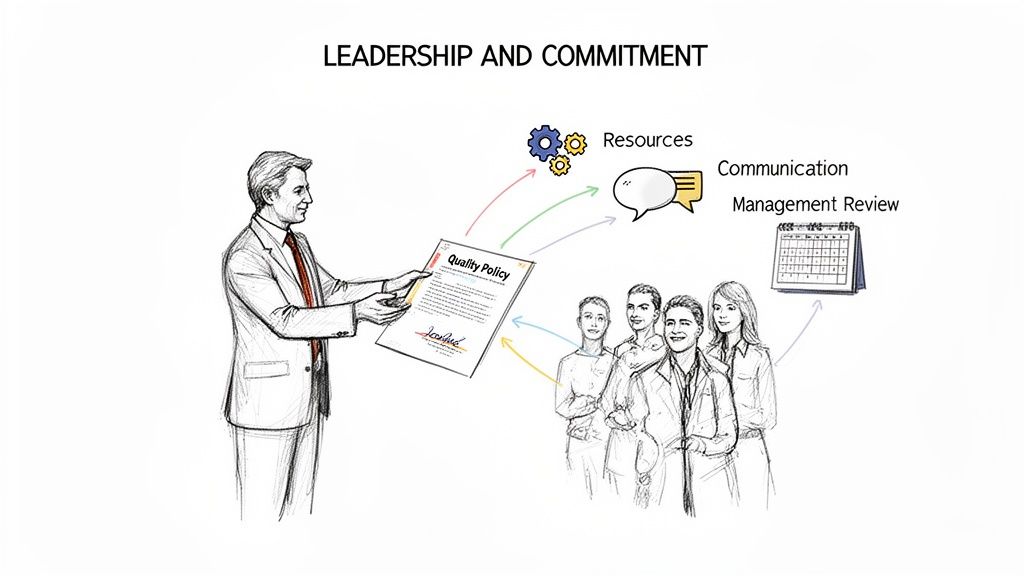
Clause 5 is the linchpin of the Quality Management System (QMS), demanding that top management demonstrates tangible leadership and unwavering commitment. It moves beyond passive approval to active engagement, ensuring that quality is embedded in the organization's culture and strategic direction. A comprehensive ISO 9001 internal audit checklist must rigorously test this clause, as a failure in leadership commitment will inevitably undermine the entire QMS, regardless of how well-documented other processes are.
What to Audit in Clause 5
The internal audit for Clause 5 should focus on verifying top management's active involvement. This includes confirming the establishment of a quality policy and quality objectives that are aligned with the company's strategic goals. Auditors must look for evidence that leadership ensures the QMS is integrated into business processes, promotes a process approach, and provides the necessary resources for its effective operation.
Furthermore, the audit needs to confirm that leadership communicates the importance of quality, engages and directs employees, and takes accountability for the effectiveness of the QMS. Evidence should show a clear cascade of responsibility from the executive level down to individual roles and departments.
Audit Questions and Evidence
-
Audit Questions:
-
How does top management demonstrate and communicate its commitment to the QMS?
-
Is the Quality Policy established, communicated, and understood throughout the organization?
-
How are quality objectives established and linked to strategic business goals?
-
Can you demonstrate how leadership ensures the availability of necessary resources (people, infrastructure, technology) for the QMS?
-
How are roles, responsibilities, and authorities for the QMS defined and communicated?
-
-
Evidence to Collect:
-
A signed and communicated Quality Policy.
-
Minutes from management review meetings showing leadership's active participation and decision-making.
-
Documented quality objectives and evidence of their review (e.g., performance dashboards).
-
Organizational charts and job descriptions that clearly define QMS-related responsibilities.
-
Budget approvals and resource allocation records related to quality initiatives.
-
Actionable Tips for Auditing Clause 5
To truly assess leadership commitment, go beyond reviewing the quality policy.
-
Trace Objectives to Strategy: Obtain the high-level business strategy and show how quality objectives directly support it. For a tech company, an executive goal to "reduce customer churn by 15%" should directly link to a quality objective like "improve first-call resolution rate to 95%," with documented leadership oversight.
-
Create a Responsibility Matrix: Verify that a matrix exists linking each quality objective to a specific leadership role. This accountability chart should clearly define who is responsible for monitoring, reporting, and achieving each target, providing concrete evidence of assigned authority.
-
Automate Policy Consistency Checks: Leadership commitment must be consistent. Use an AI Gap Analysis tool to scan all management-level documents, from the quality manual to strategic plans, and verify that the core tenets of the quality policy are consistently referenced. This tool can flag discrepancies or omissions, providing a fast, evidence-backed way to check for alignment and true integration.
Ensuring your leadership is fully aligned and committed is foundational. You can discover how AI is transforming internal audits by automating these and other tedious verification tasks.
3. Clause 6: Planning
Clause 6 bridges the gap between understanding the organizational context and taking action. It requires an organization to plan for its QMS by addressing risks and opportunities, establishing measurable quality objectives, and creating plans to achieve them. For any ISO 9001 internal audit checklist, this section is crucial as it verifies that the QMS is proactive, goal-oriented, and focused on continual improvement rather than simply reacting to events.
What to Audit in Clause 6
An internal audit of Clause 6 must confirm that the organization has a systematic process for identifying and addressing risks and opportunities derived from its context (Clause 4). This isn't just about a one-time assessment; it involves integrating risk-based thinking into core processes.
The audit should also verify that the organization has established quality objectives at relevant functions and levels. These objectives must be consistent with the quality policy, be measurable, and be supported by concrete plans detailing what will be done, what resources are required, who is responsible, and how results will be evaluated.
Audit Questions and Evidence
-
Audit Questions:
-
How does the organization identify and plan actions to address risks and opportunities?
-
What are the quality objectives, and are they aligned with the quality policy and strategic direction?
-
How are the quality objectives and their associated plans communicated throughout the organization?
-
Can you show the plans for achieving quality objectives, including timelines, resources, and responsibilities?
-
-
Evidence to Collect:
-
A risk and opportunity register or similar documented analysis (e.g., FMEA).
-
Documented quality objectives and the plans to achieve them.
-
Management review minutes discussing progress toward objectives.
-
Departmental KPIs or performance metrics linked to quality objectives.
-
Actionable Tips for Auditing Clause 6
To audit this clause effectively, focus on the practical implementation of plans, not just their existence on paper.
-
Verify Risk Mitigation: Look beyond the risk register. For a medical device manufacturer, if an FMEA identified a risk in a manufacturing process, ask for evidence of the implemented mitigation plan, such as updated work instructions, new equipment calibration records, or enhanced training logs for relevant personnel.
-
Trace Objectives to the Front Line: Quality objectives cannot exist in a vacuum. Connect high-level objectives, like "improve customer satisfaction by 10%," directly to departmental KPIs and individual performance evaluations. This demonstrates true organizational alignment and accountability.
-
Automate Compliance Mapping: Manually connecting every risk to its source (e.g., a specific contractual or regulatory obligation) is tedious. Use an AI Gap Analysis tool to automatically scan all uploaded contracts and policies, identifying specific obligations. This allows you to map these obligations directly to your risk register and quality objectives, ensuring nothing is missed and providing a clear, auditable trail.
Proper planning ensures your QMS drives real business value.
4. Clause 7: Support (Resources, Competence, Awareness, Communication)
Clause 7 is the engine that powers the Quality Management System (QMS), ensuring all necessary operational enablers are in place. It covers the provision of resources, the competence of personnel, employee awareness, and the effectiveness of communication. For any ISO 9001 internal audit checklist, this section is critical for verifying that the organization has allocated sufficient support to not only maintain the QMS but also drive continual improvement.
What to Audit in Clause 7
An internal audit of Clause 7 must verify that the organization provides the resources needed for the establishment, implementation, maintenance, and continual improvement of the QMS. This includes people, infrastructure (buildings, equipment, software), and the operational environment.
The audit should also scrutinize processes for determining necessary competence, ensuring personnel are competent through education, training, or experience, and evaluating the effectiveness of these actions. Additionally, auditors must confirm that relevant persons are aware of the quality policy, objectives, their contribution to QMS effectiveness, and the implications of non-conformance. Finally, the audit assesses whether internal and external communication processes are defined and executed effectively.
Audit Questions and Evidence
-
Audit Questions:
-
How does the organization determine and provide the resources needed for the QMS?
-
What is the process for determining the necessary competence for roles affecting quality performance?
-
How do you ensure employees are aware of the quality policy and their role in achieving quality objectives?
-
What are the established processes for internal and external communication regarding the QMS?
-
-
Evidence to Collect:
-
Resource allocation plans and budgets.
-
Training records, competency matrices, and job descriptions.
-
Records of awareness campaigns (e.g., newsletters, posters, meeting minutes).
-
A documented communication plan or matrix.
-
Actionable Tips for Auditing Clause 7
To ensure support systems are robust and not just paper-based, dive deeper into their practical application.
-
Create Competency Profiles: Move beyond simple training records. Verify the existence of detailed competency profiles for key roles, outlining the specific technical skills, QMS knowledge, and soft skills required. For example, a quality inspector's profile should specify competence in using measurement tools, understanding statistical process control, and communicating nonconformities.
-
Establish a Communication Calendar: Ask for a communication calendar that coordinates internal QMS updates (like audit results), external stakeholder communications (like supplier performance reviews), and awareness campaigns. This demonstrates a planned, strategic approach to communication rather than a reactive one.
-
Automate Competence Verification: Manually checking training records against job requirements is tedious and prone to error. Use an AI Gap Analysis tool to scan all uploaded job descriptions, process documents, and regulatory standards to identify all competence requirements. The tool can then cross-reference this against your training matrix, instantly flagging gaps where personnel lack required training for their specific roles.
5. Clause 8: Operation
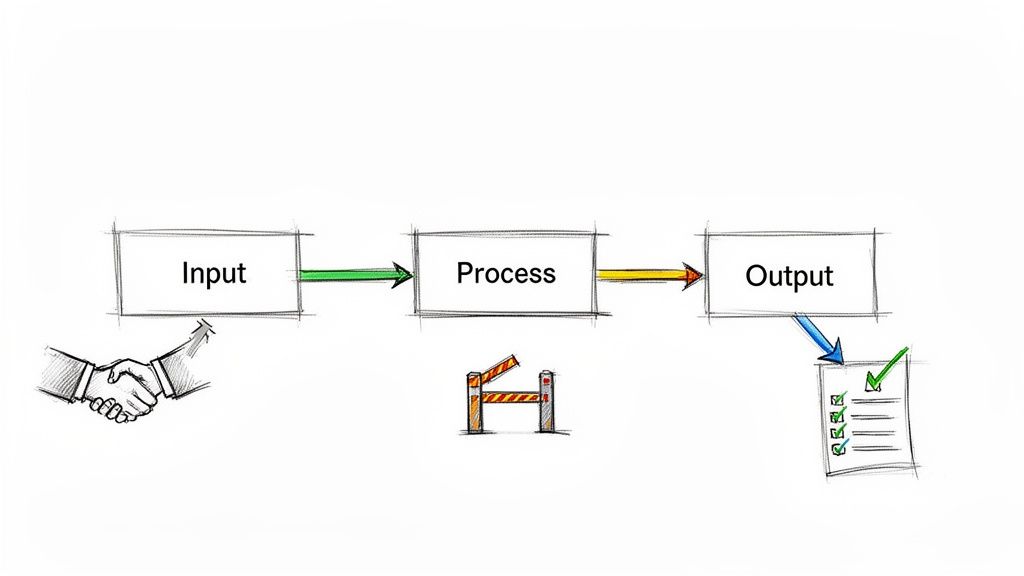
Clause 8 is the engine room of the Quality Management System (QMS), encompassing the core activities that create and deliver an organization's products and services. It requires the organization to plan, implement, and control the processes needed to meet customer and regulatory requirements. An ISO 9001 internal audit checklist must rigorously evaluate this clause, as it directly impacts customer satisfaction and product conformity. The audit verifies that operational processes, from initial customer communication to final product delivery, are consistently executed as planned.
What to Audit in Clause 8
An audit of Clause 8 examines the entire operational lifecycle. This includes verifying that there are clear processes for determining product/service requirements, design and development, control of externally provided processes (supplier management), production, and the release of products. The auditor must confirm that criteria for these processes are established and met.
The audit should also scrutinize how the organization handles nonconforming outputs, ensuring they are identified, controlled, and prevented from unintended use. Evidence should demonstrate that from the initial planning stages to post-delivery activities, every step is managed to achieve the desired outcomes and maintain control over the quality of deliverables.
Audit Questions and Evidence
-
Audit Questions:
-
How does the organization plan its operational processes to meet requirements?
-
What is the process for reviewing and communicating customer requirements?
-
How are suppliers evaluated, selected, and monitored?
-
Can you demonstrate that production and service provision are carried out under controlled conditions?
-
What is the procedure for handling nonconforming products or services?
-
-
Evidence to Collect:
-
Work orders, production plans, and service schedules.
-
Customer contracts and records of requirement reviews.
-
Supplier evaluation records, quality agreements, and performance scorecards.
-
Production records, quality control reports, and calibration records for equipment.
-
Nonconformance reports (NCRs) and records of corrective actions taken.
-
Actionable Tips for Auditing Clause 8
Move beyond checking for the existence of procedures and focus on their effective implementation.
-
Trace a Process End-to-End: Select a recent customer order or project and trace it from the initial inquiry through to final delivery. This "vertical audit" allows you to see how different sub-clauses of Clause 8 interact in a real-world scenario. For a manufacturing firm, this means following a part from raw material receiving (8.4) to final inspection and shipment (8.6).
-
Verify Supplier Controls: Don't just look at the approved supplier list. Review the actual supplier quality agreements for a key supplier. For example, a firm should have records of quarterly audits and performance data (like on-time delivery metrics) that prove ongoing monitoring, not just initial approval.
-
Automate Requirements Mapping: Manually tracing all customer requirements from contracts and specifications to specific process controls is prone to error. Use an AI Gap Analysis tool to automatically extract these requirements and map them to documented process controls, work instructions, and quality checks. This provides instant, verifiable evidence that nothing has been missed and all customer needs are addressed.
6. Clause 9: Performance Evaluation (Monitoring, Measurement, Analysis, Evaluation)
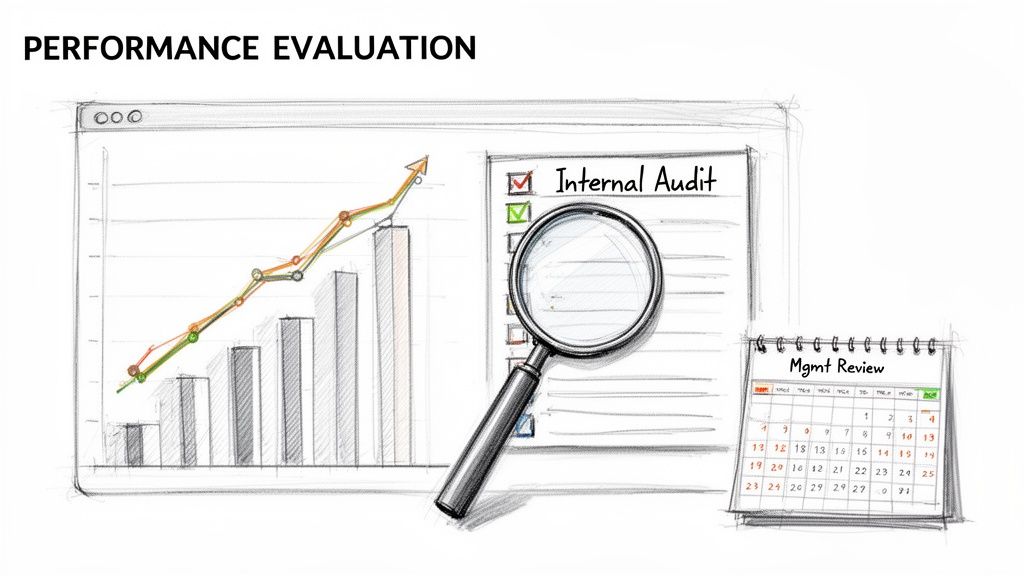
Clause 9 is the feedback loop of the Quality Management System (QMS). It mandates that an organization systematically monitors, measures, analyzes, and evaluates its performance to verify conformity, assess effectiveness, and drive improvement. This clause transforms raw operational data into actionable intelligence through internal audits and management reviews. A crucial part of any ISO 9001 internal audit checklist, this section confirms that decision-making is based on evidence, not assumptions.
What to Audit in Clause 9
An internal audit of Clause 9 must verify that the organization has defined what needs to be monitored and measured, the methods used, and when the analysis should occur. This includes evaluating customer satisfaction, the performance of processes, and the conformity of products and services.
The audit should also scrutinize the internal audit program itself, confirming its objectivity, competence, and adherence to a planned schedule. Finally, the auditor must assess the management review process, ensuring it covers all required inputs (like audit findings and customer feedback) and produces tangible outputs (like improvement actions and resource allocation decisions).
Audit Questions and Evidence
-
Audit Questions:
-
What key performance indicators (KPIs) are used to monitor QMS performance?
-
How is customer satisfaction data collected and analyzed?
-
Can you show the internal audit schedule, auditor qualifications, and completed audit reports?
-
How does management review performance data and drive continual improvement?
-
-
Evidence to Collect:
-
Performance dashboards or reports with trend analysis.
-
Customer satisfaction surveys, feedback logs, and complaint analysis.
-
Internal audit program documentation, reports, and evidence of corrective action follow-up.
-
Management review meeting minutes, agendas, and action registers.
-
Actionable Tips for Auditing Clause 9
To ensure Clause 9 is truly effective, auditors must confirm that evaluation leads to action.
-
Trace the Golden Thread: Select a nonconformity from a past internal audit report and trace it all the way through to its discussion in a management review meeting and the resulting corrective action plan. This verifies the entire feedback loop is functional.
-
Scrutinize Data Analysis: Don't just accept a graph. Ask how the data was analyzed to identify trends or root causes. For example, a logistics company measuring on-time delivery should have documented analysis showing whether delays are linked to specific routes, carriers, or times of day.
-
Automate KPI Monitoring: Use an AI Gap Analysis tool to scan customer contracts and regulatory documents to identify all explicit performance metrics required. The tool can cross-reference these against your internal monitoring systems (like a BI dashboard) to automatically flag any gaps where a required metric is not being tracked, ensuring comprehensive performance oversight.
7. Clause 10: Improvement (Nonconformities, Corrective Actions, Continual Improvement)
Clause 10 is the engine of the QMS, driving it forward by embedding a culture of continuous learning and systematic problem-solving. It requires an organization to react to nonconformities, implement effective corrective actions, and proactively seek opportunities for continual improvement. For any ISO 9001 internal audit checklist, this clause verifies that the organization isn't just maintaining a system but actively evolving and strengthening it over time.
What to Audit in Clause 10
An audit of Clause 10 must confirm that the organization has robust processes for managing nonconformities and implementing corrective actions. This involves checking if nonconformities are not only contained but also thoroughly analyzed to determine their root cause. The audit should assess whether corrective actions address the true root cause rather than just the symptoms, preventing recurrence.
Furthermore, the audit must look for evidence of continual improvement. This goes beyond just fixing problems; it requires verifying that the organization actively reviews its processes, products, and services to identify and implement enhancements. Evidence should show a proactive approach, not just a reactive one, with improvements linked to the organization's strategic objectives and key performance indicators.
Audit Questions and Evidence
-
Audit Questions:
-
How does the organization react to nonconformities, including customer complaints?
-
Can you demonstrate the process for root cause analysis (RCA)?
-
How do you verify the effectiveness of corrective actions taken?
-
What methods are used to identify and implement continual improvement opportunities?
-
-
Evidence to Collect:
-
Nonconformity reports and logs.
-
Completed corrective action requests (CARs) with documented root cause analysis (e.g., 5 Whys, Fishbone diagram).
-
Records of effectiveness reviews for implemented corrective actions.
-
Management review meeting minutes discussing improvement initiatives and their outcomes.
-
Actionable Tips for Auditing Clause 10
To ensure the improvement process is truly embedded, focus on the system's effectiveness.
-
Test the CAPA System: Select a recent, significant nonconformity (e.g., a major customer complaint or production failure). Audit the entire Corrective and Preventive Action (CAPA) trail from initial report to effectiveness verification. This provides a clear view of how the system functions in practice, not just on paper.
-
Look for Proactive Improvement: Don't just focus on corrective actions. Ask for evidence of proactive improvements. For example, a service organization might have an improvement team that holds quarterly reviews of KPIs, leading to documented initiatives like a new CRM workflow that reduced customer response times.
-
Automate Compliance Cross-Checks: Improvement drivers often come from customer feedback and regulatory updates. Use an AI Gap Analysis tool to scan all customer feedback logs and regulatory bulletins, extracting key requirements and potential nonconformities. This automates the process of verifying that your improvement backlog and CAPA system are addressing all critical inputs, ensuring nothing gets missed.
A robust improvement cycle is what separates a static QMS from one that delivers real business value.
8. Information and Documentation Management
While not a standalone clause, effective information and documentation management is the backbone of a functional QMS and is referenced throughout Clauses 4-10. This area covers the control, accessibility, protection, and retention of all documented information required by the ISO 9001 standard and the organization. For any ISO 9001 internal audit checklist, this section is crucial for verifying that the QMS is not just theoretical but is supported by tangible, controlled, and accessible evidence.
What to Audit in Information and Documentation Management
An audit of documented information should verify that the organization has robust processes for managing the entire lifecycle of its quality-related documents and records. This includes procedures for creation, review, approval, distribution, storage, and eventual disposal. The audit must confirm that documents are current, legible, and readily available to relevant personnel while also being protected from unintended alterations or loss.
The audit should also assess the management of records, which serve as evidence of conformity to requirements and the effective operation of the QMS. This includes ensuring that retention periods are defined and met, and that records remain retrievable throughout their lifecycle.
Audit Questions and Evidence
-
Audit Questions:
-
How do you control the creation, review, and approval of documented information?
-
What measures are in place to ensure that personnel have access to the correct versions of documents?
-
How is documented information protected from loss of confidentiality, improper use, or loss of integrity?
-
What are the defined retention periods for quality records, and how is disposal managed?
-
-
Evidence to Collect:
-
Document control procedure.
-
A document master list or equivalent register showing document titles, revisions, owners, and approval status.
-
Evidence of access controls in electronic systems (e.g., screenshots of user permissions).
-
A records retention schedule or policy.
-
Examples of archived or disposed records, with documented authorization.
-
Actionable Tips for Auditing Information and Documentation Management
To ensure this audit is thorough, focus on the practical application of document control principles.
-
Test the System Live: Instead of just reviewing the document control procedure, pick a critical work instruction on the factory floor or a key policy on the company intranet. Verify that the version in use matches the master list. This simple test quickly reveals gaps between procedure and practice.
-
Verify Retention and Disposal: Ask for a record that is close to its disposal date according to the retention schedule. For example, if training records are kept for three years, ask to see a record from two and a half years ago. Then, ask for evidence of a record that was recently and properly disposed of.
-
Centralize Audit Evidence with AI: Manually collecting and organizing evidence from disparate systems is a major audit bottleneck. Use an AI Gap Analysis tool to centralize all audit evidence. By uploading procedures, reports, and records, the platform can automatically identify and cross-reference evidence against specific ISO 9001 requirements, creating an organized, audit-ready repository that drastically reduces preparation time.
A well-managed documentation system is fundamental to demonstrating compliance. You can learn more about ISO 9001 certification requirements to ensure your information management processes are robust and audit-proof.
ISO 9001 Internal Audit: 8-Point Clause Comparison
| Item | 🔄 Implementation complexity | ⚡ Resource requirements | ⭐ Expected outcomes | 📊 Key advantages / Impact | 💡 Ideal use cases / Tips |
|---|---|---|---|---|---|
| Clause 4: Context of the Organization | Moderate — requires structured analysis of internal/external factors | Medium — stakeholder engagement, research, documentation effort | Strategy-aligned QMS scope and traceable stakeholder needs | Clarifies scope, early compliance identification, risk-informed decisions | Use for initial QMS scoping, quarterly context updates; create stakeholder matrix |
| Clause 5: Leadership and Commitment | Low–Moderate — policy and governance activities; cultural change needed | Medium — management time, communication, review processes | Visible top-down commitment and sustained resource allocation | Establishes accountability, improves resource support and alignment | Apply when embedding QMS into strategy; use responsibility matrix and visible leadership actions |
| Clause 6: Planning | Moderate — systematic risk assessment and objective setting required | Medium–High — risk tools, planning sessions, measurable targets | SMART objectives and documented risk treatment plans | Proactive prevention, better resource allocation, clearer accountability | Ideal for translating context into targets; maintain a risk register and quarterly reviews |
| Clause 7: Support (Resources, Competence, Awareness, Communication) | Moderate — ongoing competence and communication programs | High — training systems, LMS, infrastructure, staffing | Workforce competence and reliable support systems for QMS execution | Reduces execution errors, improves engagement, supports scalability | Use LMS and competency profiles; centralize communication calendar and training records |
| Clause 8: Operation (Planning & Control of Processes) | High — extensive process design, supplier controls, documentation | High — process mapping, supplier management, document control systems | Consistent product/service delivery meeting requirements | Prevents defects, ensures traceability, controls external providers | Best for operations-heavy orgs; implement process flow diagrams and supplier scorecards |
| Clause 9: Performance Evaluation | Moderate — measurement systems, audits, data analysis frameworks | Medium–High — BI tools, audit resources, calibration, reporting | Data-driven insights, trend identification, management review outputs | Enables continuous improvement, early detection of issues, objective decisions | Deploy KPIs aligned to objectives, automate data collection, implement root-cause methods |
| Clause 10: Improvement (Nonconformities, CAPA) | Moderate — requires structured RCA and corrective action processes | Medium — tracking systems, improvement teams, verification resources | Reduced recurrence of issues and documented continual improvement | Closes feedback loop, drives innovation, increases reliability | Use CAPA tracking dashboards, mandatory structured RCA, visible leadership follow-up |
| Information & Documentation Management | Moderate — policy + systems for document lifecycle and access control | High — EDMS, backups, cybersecurity, storage and retention processes | Accurate, current, accessible evidence and audit-ready records | Improves compliance, reduces search time, preserves audit trails | Centralize repository aligned to clauses, implement version control and retention schedules |
Turn Your Checklist into a Competitive Advantage
Navigating the intricacies of an ISO 9001 internal audit can feel like a monumental task. The detailed, clause-by-clause checklist provided in this guide is your comprehensive roadmap, designed to demystify the process and transform it from a mandatory chore into a strategic driver of organizational excellence. We've journeyed through every critical component of the standard, from establishing the Context of the Organization (Clause 4) and ensuring robust Leadership (Clause 5) to meticulous Planning (Clause 6) and providing essential Support (Clause 7).
The true power of this framework, however, is realized in its application. By diligently assessing your operational controls (Clause 8), evaluating performance (Clause 9), and fostering a culture of continual improvement (Clause 10), you move beyond simply "passing" an audit. You begin to build a resilient, efficient, and customer-focused Quality Management System (QMS) that actively contributes to your bottom line. The iso 9001 internal audit checklist is not the end goal; it is the tool that sharpens your operational edge.
From Compliance Obligation to Strategic Insight
The most common pitfall for organizations is viewing the internal audit as a reactive, compliance-driven exercise. This limited perspective misses the immense value hidden within the process. An effective audit doesn't just identify nonconformities; it uncovers opportunities for innovation, process optimization, and risk mitigation.
Think of each checklist item not as a box to be ticked, but as a question that prompts deeper strategic thinking:
-
Is our leadership's commitment truly visible and felt throughout the organization?
-
Are our quality objectives aligned with our broader business goals?
-
Do we have the right resources and competencies to not only meet but exceed customer expectations?
Answering these questions honestly and backing them up with objective evidence is where the transformation begins. This is how a simple checklist evolves into a dynamic feedback loop, continuously fueling progress and embedding quality into your company’s DNA.
Key Takeaway: The ultimate goal of an internal audit is not to achieve a perfect score, but to gain a clear, evidence-based understanding of your QMS's health. This clarity empowers you to make informed decisions that strengthen processes, reduce waste, and build a more robust organization.
Actionable Next Steps: Mobilizing Your Audit Strategy
With a comprehensive iso 9001 internal audit checklist in hand, your path forward is clear. The next steps involve moving from planning to execution and, most importantly, to action.
-
Customize and Communicate: Adapt the general checklist to reflect your organization's specific processes, risks, and objectives. Ensure the audit scope is clearly defined and communicated to all relevant stakeholders to foster collaboration rather than apprehension.
-
Embrace Technology: Manually sifting through documents, policies, and records is the most time-consuming part of any audit. Leverage modern tools to automate evidence discovery and link it directly to checklist items. This frees your auditors to focus on high-value analysis and strategic recommendations.
-
Focus on Root Cause Analysis: When a nonconformity is found, resist the urge to apply a quick fix. Use methodologies like the "5 Whys" or fishbone diagrams to dig deep and identify the root cause. A corrective action that addresses the source of the problem is infinitely more valuable than one that merely treats a symptom.
-
Translate Findings into Improvements: The audit report is not the final step; it is the starting point. Develop a clear action plan for every finding, assigning ownership, setting deadlines, and establishing a process for verifying the effectiveness of the implemented corrective actions.
By following these steps, you ensure your internal audit program becomes a catalyst for meaningful, sustainable improvement. It ceases to be an event and becomes an integral part of a cycle that drives your organization forward, turning quality management from a cost center into a powerful and undeniable competitive advantage.
Ready to supercharge your audit process and eliminate manual evidence hunting? AI Gap Analysis uses advanced AI to automatically scan your documentation, identify relevant evidence, and map it directly to ISO 9001 requirements, turning your iso 9001 internal audit checklist into an efficient, evidence-ready action plan. Discover how much time you can save by visiting AI Gap Analysis today.