January 23, 2026
iso 9001 certification requirementsISO 9001:2015 ClausesQMS CertificationISO Audit GuideQuality Management System
Mastering ISO 9001 Certification Requirements A Practical Guide
Unlock the ISO 9001 certification requirements. Our practical guide demystifies each clause with actionable steps for a successful QMS audit.
22 min readAI Gap Analysis
The ISO 9001 certification requirements aren't a rigid checklist to be ticked off. Instead, think of them as a flexible framework for building a truly effective Quality Management System (QMS). At its heart, the standard asks you to define your processes, monitor their effectiveness, and continuously improve them to consistently meet customer and regulatory needs. This entire structure is built on foundational ideas like customer focus, leadership commitment, and risk-based thinking.
Unpacking The ISO 9001 Framework
Getting started with ISO 9001 can feel like learning a new language, full of clauses and technical jargon. But the standard is far more practical than it first appears. It doesn't tell you how to run your business; it gives you a powerful blueprint for building quality into everything you do. Look at it less as a set of restrictive rules and more as a proven recipe for achieving operational excellence and customer satisfaction.
Its universal appeal is why the ISO 9001 market is thriving. Valued at $3.74 billion for the 2015 version alone, it's projected to skyrocket to $16.16 billion by 2034. This growth isn't just a number—it’s driven by real-world adoption in manufacturing, healthcare, and tech, where principles like continual improvement are absolutely essential for staying competitive.
The Guiding Principles Of Quality
The ISO 9001 certification requirements are anchored by seven Quality Management Principles. These are the core beliefs and values that guide the entire standard. Grasping them is the first real step toward building a QMS that works.
- Customer Focus: Your primary goal should always be to meet and exceed customer expectations.
- Leadership: Top management can't just sign off on this; they must be actively involved and committed to the QMS.
- Engagement of People: Competent, empowered people at all levels are the key to making the system succeed.
- Process Approach: When you manage activities as interconnected processes, you get far more consistent results.
- Improvement: The organization must make continuous improvement a permanent objective, not a one-time project.
- Evidence-Based Decision Making: Decisions need to be based on the analysis of real data and information, not just gut feelings.
- Relationship Management: Managing relationships with key interested parties, like suppliers, is vital for long-term success.
The Engine Of Continual Improvement
These principles are brought to life through the Plan-Do-Check-Act (PDCA) cycle. This simple, iterative four-step model is the engine that drives your QMS forward. It's what ensures your system doesn't just collect dust on a shelf but actually evolves and adapts over time.
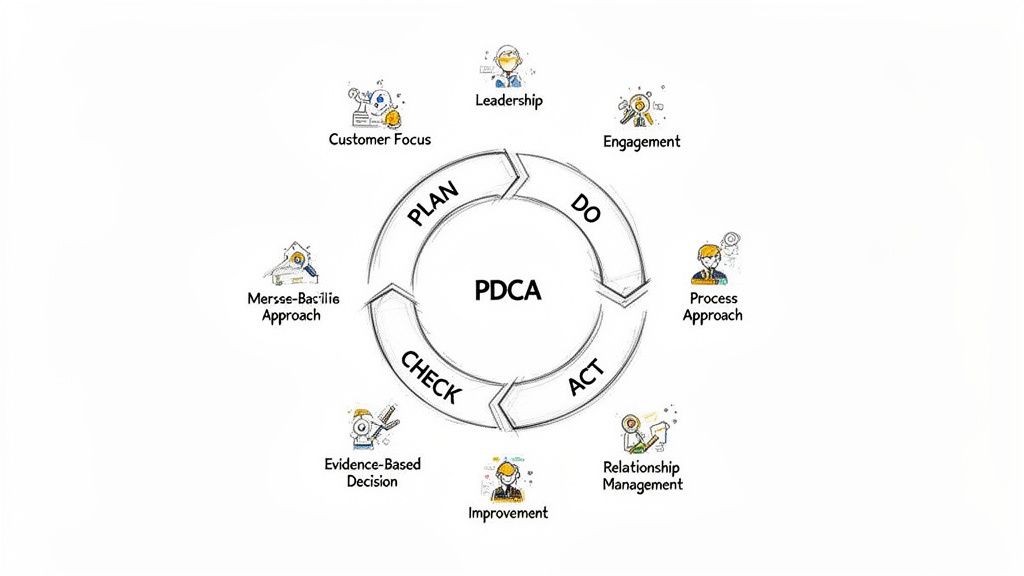
The PDCA cycle is woven throughout the standard's ten clauses, turning the certification requirements into a dynamic tool for growth rather than a static, bureaucratic exercise. Preparing for this cyclical process involves a detailed review, and our comprehensive audit readiness checklist can help you structure your approach.
To make this clearer, let's look at how the ten clauses of ISO 9001 fit neatly into the PDCA framework. This table shows you the high-level structure at a glance.
The 10 Clauses of ISO 9001 Mapped to the PDCA Cycle
| Clause Number | Clause Title | Corresponding PDCA Stage | Core Focus |
|---|---|---|---|
| 1 | Scope | N/A | Sets the scope and applicability of the QMS. |
| 2 | Normative References | N/A | References other essential standards. |
| 3 | Terms and Definitions | N/A | Provides definitions for key terms used in the standard. |
| 4 | Context of the Organization | Plan | Understanding the organization, its stakeholders, and the scope of the QMS. |
| 5 | Leadership | Plan | Defining leadership's role, commitment, and quality policy. |
| 6 | Planning | Plan | Planning for risks, opportunities, quality objectives, and changes. |
| 7 | Support | Do | Providing the resources, competence, awareness, and communication for the QMS. |
| 8 | Operation | Do | Planning and controlling the processes needed to create products and services. |
| 9 | Performance Evaluation | Check | Monitoring, measuring, analyzing, and evaluating the QMS performance. |
| 10 | Improvement | Act | Addressing nonconformities and continually improving the QMS's effectiveness. |
As you can see, the first three clauses set the stage, while clauses 4 through 10 walk you directly through the cycle of planning your system, executing your processes, checking your performance, and acting to make improvements. This structure is the secret to ISO 9001's power—it’s a self-correcting loop designed for sustainable success.
Building Your QMS Foundation: Clauses 4 Through 7
If your Quality Management System (QMS) were a house, Clauses 4 through 7 would be the concrete foundation and the structural frame. Before you can even think about the day-to-day operations—the plumbing and electrical—you have to get this core structure right. These initial clauses ensure your QMS is built on a solid understanding of your business reality, championed by leadership, planned with foresight, and backed by the right resources.
Nailing these four clauses is non-negotiable. It’s what makes a QMS robust enough to withstand the pressure of an audit and the chaos of the real world.
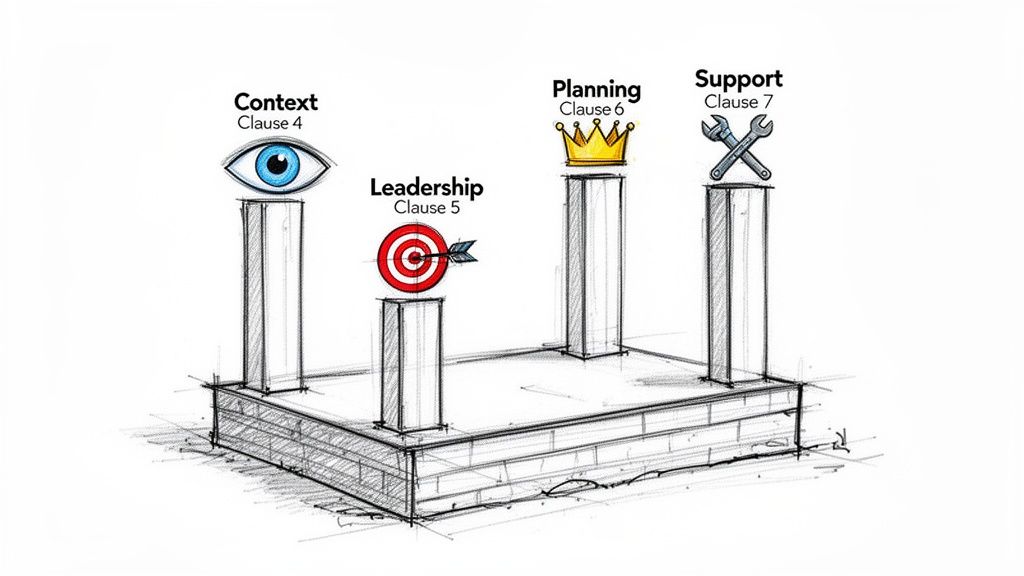
Think of it this way: this is the part where you pour the slab, erect the support beams, and map out where everything will go. It’s the foundational work that makes everything else possible.
Clause 4: Understanding the Context of Your Organization
Before you can build a system to manage quality, you have to understand the world it will operate in. Clause 4 forces you to look both outward at the market and inward at your company. It’s all about getting a handle on the internal and external factors that could help or hinder your ability to achieve your quality goals.
This is where you also identify your "interested parties"—essentially, anyone who has a stake in your success. This goes far beyond just your customers. We’re talking about employees, suppliers, regulators, and even your local community. What do they need and expect from you? Figuring this out is the first critical step in defining the scope of your QMS.
A SWOT analysis (Strengths, Weaknesses, Opportunities, Threats) is a classic and highly effective tool here. It’s a simple framework that helps organize your thinking around what you do well and where the market is headed.
- What Auditors Look For: They’ll want to see documented proof of this analysis. This could be a formal SWOT document, minutes from meetings where you discussed stakeholders, and a clearly defined scope statement for your QMS.
Clause 5: The Critical Role of Leadership
Let's be blunt: a QMS without genuine leadership commitment is just a binder of documents collecting dust on a shelf. Clause 5 puts the responsibility for quality squarely on the shoulders of the executive team. This isn't a job you can just delegate to a "quality manager" and forget about.
Top management must show their commitment in real, tangible ways. That starts with establishing a quality policy—a short, powerful statement that acts as a north star for the entire organization. But it can't just be a poster on the wall; it needs to be communicated, understood, and applied by everyone.
An auditor’s first stop is often an interview with top management. They want to hear leaders speak fluently about the quality policy, objectives, and key risks. If the CEO can't articulate these things, it’s an immediate red flag that the commitment is only skin-deep.
Leaders are also responsible for clearly defining roles and responsibilities related to the QMS. Everyone needs to know exactly what part they play in delivering quality.
- What Auditors Look For: A signed quality policy is a must. They’ll also ask for minutes from management review meetings, organizational charts, and any evidence that shows leaders are actively promoting a culture of quality.
Clause 6: Planning for Risks and Opportunities
The modern version of ISO 9001 is built on a cornerstone of risk-based thinking. Clause 6 requires you to proactively identify what could go wrong (risks) and what could go right (opportunities) within your QMS. This is a massive shift from the old days of simply reacting to problems.
Instead of just fixing things after they break, you need to anticipate them. What events could prevent you from delivering a quality product? On the flip side, what opportunities could you jump on to delight your customers even more? This doesn't mean you need a convoluted, bureaucratic risk management process. It’s about embedding a forward-looking mindset into your everyday planning.
A Risk and Opportunity Register is a fantastic, practical tool for this. It’s a simple document where you can:
- Identify: List potential risks and opportunities.
- Analyze: Figure out how likely they are to happen and what the impact would be.
- Plan Actions: Decide what you're going to do to reduce risks or chase opportunities.
- Assign Responsibility: Make it clear who owns each action.
You also need to set measurable quality objectives. Vague goals like "improve customer satisfaction" won't cut it. A much better objective is something specific, like "Reduce customer complaints by 15% in the next fiscal year."
Clause 7: Providing the Necessary Support
Finally, Clause 7 is all about the resources needed to make your QMS a reality. A brilliant system design is worthless without the right support structure. This clause covers the nuts and bolts: people, infrastructure, communication, and documentation.
This requirement breaks down into a few key areas:
- Resources: Do you have the right people for the job? What about the infrastructure—the buildings, equipment, and software? Is the work environment suitable?
- Competence: Are your employees competent to perform their roles? You need to ensure this through training, education, or experience, and you must keep records to prove it.
- Awareness: Does everyone in the company understand the quality policy, how their work contributes to it, and what happens when things go wrong?
- Communication: Who needs to know what, when, and how? This covers everything from internal team meetings to external customer updates.
- Documented Information: This is about managing the paperwork—both the documents required by ISO 9001 and any others your organization needs. You have to have a system for creating, updating, and controlling them.
In short, Clause 7 ensures your team has the tools, skills, and information they need to succeed within the QMS. Without this crucial support, even the best-laid plans from Clauses 4, 5, and 6 will inevitably fall flat.
Putting Quality Into Action With Clause 8
Welcome to the operational heart of your Quality Management System. If the previous clauses were about planning and support, Clause 8 is where the rubber meets the road. This is the "Do" phase of the Plan-Do-Check-Act cycle, where all your quality promises are finally put to the test.
Think of it like a master chef running a busy kitchen. The earlier clauses were about designing the menu (Clause 6), hiring a great team (Clause 7), and knowing what your diners love (Clause 4). Now, Clause 8 is the actual cooking—following the recipe exactly, every single time, to deliver a perfect dish. This section covers all the hands-on processes for creating and delivering your products or services.
Operational Planning And Control
Clause 8.1 is the launchpad for all your daily operations. It demands that you plan, implement, and control the processes needed to meet what your customers expect. In simple terms, you need to define how work gets done and make sure it happens that way every time.
This means setting the criteria for your processes and products, getting the right resources in place, and implementing controls to keep everything on track. Consistency is everything here. The goal is to build a system so solid that quality becomes the natural outcome, not just a lucky accident. This level of operational control is a major reason why companies pursue ISO 9001—it gives them the muscle to compete on a global stage.
Determining Customer Requirements
You can’t deliver quality if you don’t know what quality means to your customer. Clause 8.2 is all about how you communicate with customers, figure out what they need, and review those needs before you promise to deliver anything.
This goes way beyond just taking an order. It involves a few key steps:
- Customer Communication: Having clear, established channels for inquiries, orders, and feedback.
- Defining Requirements: Capturing not just what the customer explicitly asks for, but also any unspoken needs or regulatory rules that apply.
- Reviewing Requirements: Before you agree to the job, you have to confirm you can actually do it. This simple check prevents you from overpromising and under-delivering.
A common pitfall here is simply assuming you know what the customer wants. An auditor will be looking for proof of a formal review process—like a signed contract, an order confirmation email, or meeting minutes—that shows you verified the requirements before kicking off the work.
Design And Development Of Products And Services
For any organization that designs what it sells, Clause 8.3 is a huge part of the ISO 9001 certification requirements. This section lays out a structured roadmap for taking an idea and turning it into a finished, validated product. It’s like a mini-PDCA cycle nested within your larger QMS.
The standard breaks the process down into distinct stages, each needing its own controls:
- Planning: Defining the stages and controls for the entire design journey.
- Inputs: Figuring out the functional, performance, and legal requirements that will guide the design.
- Controls: Building in reviews, verifications, and validations at key milestones to make sure the design is on the right track.
- Outputs: Creating documented information—like drawings, blueprints, or specifications—that clearly defines the final product.
- Changes: Managing any design changes in a controlled way to avoid unintended problems down the line.
Each step is designed to add rigor and strip out ambiguity, making sure the final product does what it’s supposed to do, reliably.
Control Of Externally Provided Processes Products And Services
Very few companies operate in a silo. Clause 8.4 tackles how you manage your suppliers and any outsourced processes. The principle is simple: you are ultimately responsible for the quality of anything you buy that becomes part of your final product or service.
You need a process to evaluate, select, and monitor your suppliers based on their ability to meet your standards. This isn't about chasing the lowest price; it's about finding partners you can count on. The level of control you apply should be based on the risk they pose. A supplier providing critical components will need far more oversight than the company that sells you office stationery.
More and more companies worldwide are tightening their supplier controls to meet these requirements. The top countries for ISO 9001 certifications show this trend, with Italy holding 99,419 valid certificates in 2023, India at 57,658, and South Korea surging with 38,041 after adding 10,886—the highest growth in the world. Core requirements like operational planning (Clause 8) and managing non-conformities (Clause 10.2) make this possible, allowing even smaller businesses to compete internationally. You can dive into a full analysis of these global ISO 9001 certification trends on oxebridge.com.
Production And Service Provision
This is where it all comes together. Clause 8.5 covers the actual creation and delivery of your product or service. It requires you to carry out your work under "controlled conditions" to ensure things turn out right.
These controls include things like:
- Availability of Documented Information: Making sure people have the instructions they need to do their jobs correctly.
- Use of Suitable Equipment: Having the right tools for the job and ensuring they work properly.
- Monitoring and Measurement: Implementing checks, tests, and inspections at the right stages of the process.
- Identification and Traceability: Knowing what a product is and where it's been, which is critical if you ever need to do a recall.
- Property Belonging to Customers: Taking proper care of any materials, tools, or data a customer gives you.
- Post-Delivery Activities: Managing your responsibilities after the sale, like warranties, installation, or technical support.
Ultimately, this clause ensures that the day-to-day execution of your core business is consistent, controlled, and capable of producing the quality you’ve promised, time and time again.
Measuring Success and Driving Improvement: Clauses 9 and 10
You’ve designed and built your Quality Management System. You’ve planned the processes and put them into motion. Now what? The big question every auditor—and every leader—should be asking is, "Is it actually working?"
This is where Clauses 9 and 10 come in. They represent the "Check" and "Act" stages of the Plan-Do-Check-Act cycle. This is the feedback loop that transforms your QMS from a static set of documents into a living, breathing engine for growth. Without these two final steps, even the most perfectly designed system is just flying blind.
Clause 9: Performance Evaluation
Think of Clause 9 as the dashboard for your QMS. It’s where all the gauges, meters, and warning lights are that tell you about the health and performance of your quality processes. This isn’t about collecting data for the sake of having it; it’s about turning raw numbers into meaningful insights that you can act on.
The standard requires you to monitor, measure, analyze, and evaluate your QMS performance. In simple terms, you need to decide what matters, figure out how to track it, and then make sense of the results. The ultimate goal is to get a clear, evidence-based picture of how well you’re hitting your quality objectives and keeping customers happy.
Key activities you'll need to demonstrate include:
- Customer Satisfaction: You can't just assume customers are happy. You have to actively find out by gathering and analyzing their feedback on your products and services.
- Analysis and Evaluation: This means systematically looking at the data you've collected to spot trends, confirm everything is working as it should, and pinpoint areas that need attention.
- Internal Audits: Think of these as regular health check-ups for your QMS, conducted by an objective internal team to ensure you're following both your own rules and the ISO 9001 standard.
- Management Review: This is where leadership gets involved, regularly reviewing the QMS to make sure it’s still relevant, sufficient, and effective for the business.
The Power of Internal Audits
Let’s be honest, internal audits are often seen as a necessary evil. But when done right, they are one of the most powerful tools in your ISO 9001 toolkit. A good internal audit uncovers issues before they become major problems—and long before an external auditor finds them.
For an internal audit program to be effective, it needs to be well-planned, impartial, and carried out by people who know what they’re doing. It’s absolutely critical to document the findings and ensure any fixes are made promptly. This process doesn't just keep you compliant; it builds a rock-solid foundation of evidence for your certification audit. For a deeper look, you can learn more about how to conduct a thorough audit risk assessment in our detailed guide.
Conducting Meaningful Management Reviews
The management review is where leadership’s commitment to quality is put on full display. This isn’t just another status meeting. It's a strategic session where top management digs into the performance of the QMS and makes critical decisions about its future.
An auditor will always ask to see the minutes from your management reviews. They are looking for concrete proof that leadership is engaged. These records need to show real discussion on topics like customer feedback, audit results, and process performance, complete with clear decisions and assigned action items.
This meeting is a cornerstone of the ISO 9001 certification requirements, directly connecting the day-to-day operations of the QMS to the company's overall strategic goals.
Clause 10: Improvement
Clause 10 is where the PDCA cycle completes itself and starts all over again. This is the "Act" phase. It’s all about taking what you learned from your performance evaluation (Clause 9) and using it to get better. This isn't just about fixing what's broken; it's about fostering a culture where everyone is always looking for ways to improve.
This requirement really boils down to two key parts:
- Nonconformity and Corrective Action: When something goes wrong—a product fails, a service gets a complaint—you can't just patch the immediate problem. ISO 9001 demands a process to dig down to the root cause and take corrective action to make sure it never happens again.
- Continual Improvement: Your organization must be in a constant state of improving the QMS. This isn't about massive, disruptive changes. It’s about making small, steady, incremental gains over time that add up to big results.
A strong corrective action process always follows a few key steps:
- React to the problem and get it under control.
- Evaluate if you need to take deeper action to eliminate the root cause.
- Implement the corrective actions you've identified.
- Review the actions to make sure they were actually effective.
- Update your risk assessments based on what you've learned.
By following this process, every mistake or problem becomes a powerful learning opportunity. This is how a great QMS makes a company more resilient, efficient, and better at serving its customers—turning the principles of quality into real, tangible business results.
Your Practical Roadmap to ISO 9001 Certification
Knowing the clauses is one thing, but actually getting certified is a whole different ball game. Let’s walk through a practical workflow that will take your organization from the starting line all the way to a successful audit. Think of this less as a rigid checklist and more as a project plan built from real-world experience.
The entire journey hinges on one critical first step: getting genuine buy-in from your leadership team. This isn't just about getting a budget approved. It’s about making sure top management truly understands their role in championing the Quality Management System (QMS). Without their active support, even the most perfect plans will eventually stall out.
Kicking Off Your Certification Journey
With leadership fully on board, it's time to roll up your sleeves. These initial steps are all about discovery and planning, and they lay the foundation for everything to come.
- Conduct a Gap Analysis: The very first question to answer is, "Where are we now?" A gap analysis is simply a structured comparison of your current processes against the ISO 9001 certification requirements. This isn't just a formality; it's the essential first step for building a realistic project plan.
- Develop QMS Documentation: Armed with the findings from your gap analysis, you can start creating or updating the necessary documents. This includes things like your Quality Policy, process flowcharts, and any procedures required to keep things consistent. A common mistake here is creating a mountain of paperwork. The goal is clarity and usefulness, not just volume.
- Train Your Team: A QMS is only as good as the people running it. You have to make sure everyone, from the front-line staff to the C-suite, understands why the QMS exists and what their specific role is.
Validating and Finalizing Your System
Once your QMS is implemented and your team is trained, it's time to put it to the test. This is where you gather the hard evidence that proves your system is both working and compliant.
A huge part of this is conducting internal audits. Treat these as dress rehearsals—they help you find and fix problems before the official auditors show up. After the internal audit, you'll hold a formal management review to dig into the system's performance and decide on any needed tweaks. This continuous loop is the very heart of quality improvement.
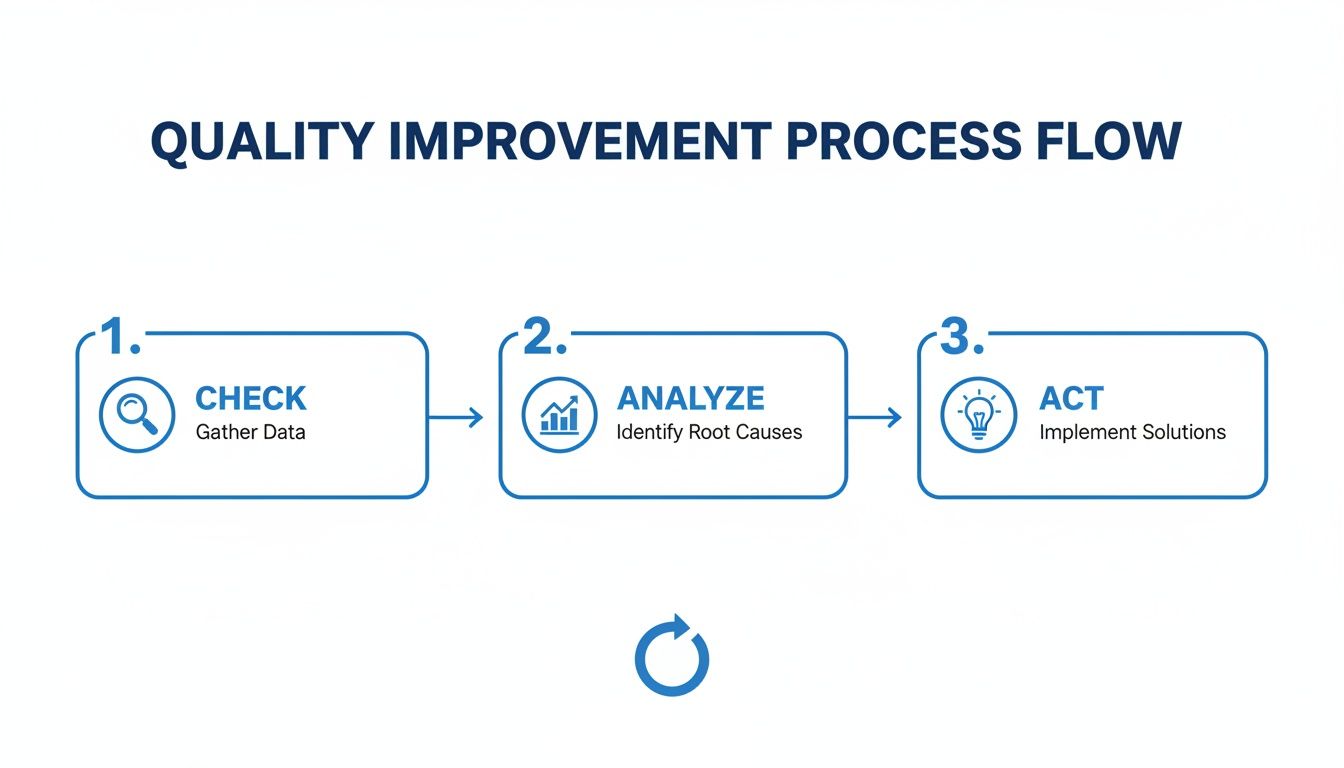
This simple cycle—Check, Analyze, and Act—is the engine that drives a successful QMS. Once you’ve gone through these steps, you’ll be ready to pick an accredited certification body and get your audit on the calendar.
The standard's lasting power is undeniable. In 2023 alone, there were 837,052 valid ISO 9001 certificates worldwide. For both auditors and managers, it’s a clear signal that a company is serious about quality and risk-based thinking. Modern tools can really speed this up by automating evidence mapping from PDFs and pinpointing where you fall short. You can explore more of the latest global trends in ISO management systems on certiget.eu.
Platforms like AI Gap Analysis are built to make this process faster, turning the manual slog of evidence collection into an automated, precise workflow. They help you get audit-ready with far more confidence and clarity. To dive deeper into that critical first step, check out our guide on the gap assessment process.
Frequently Asked Questions About ISO 9001 Requirements
Getting into the weeds of ISO 9001 often brings up a lot of practical questions. It's one thing to understand the clauses, but it's another to know what the certification journey actually looks like in terms of time, resources, and scope. This is where the theory meets the road.
Think of this section as a conversation with a seasoned consultant. We'll tackle the most common questions we hear from organizations just like yours, giving you straight answers to help you plan your next steps.
How Long Does It Take To Get ISO 9001 Certified?
This is the classic "how long is a piece of string?" question. The timeline for getting your ISO 9001 certificate really depends on your company's size, how complex your operations are, and, most importantly, what quality processes you already have in place.
For a typical small to medium-sized business starting from square one, you're likely looking at a journey of six to twelve months. That timeline gives you enough room to build your Quality Management System (QMS), roll out the new processes, let them run for a bit to gather performance data, and then go through the formal two-part external audit.
Of course, if you already have solid quality practices, you could certainly speed things up. Using tools to run an initial gap analysis can also give you a major head start by showing you exactly where you stand and what needs to be done from day one.
What Is The Main Difference Between ISO 9001 And ISO 27001?
The biggest difference boils down to their core mission. ISO 9001 is all about quality. Its entire focus is on making sure your products and services are consistent and that you're always working to make your customers happy.
On the other hand, ISO 27001 is all about information security. Its goal is to help you protect your organization's sensitive data and information from all kinds of threats.
While they both use a similar framework (called Annex SL) and share concepts like risk management and internal audits, their end goals are worlds apart. It’s very common for a company to get certified for both, often merging them into a single, efficient Integrated Management System.
Do We Need A Full-Time Quality Manager To Implement ISO 9001?
Absolutely not, especially for smaller companies. The standard is very clear that someone needs to have the responsibility and authority for the QMS, but it doesn't say that has to be their only job.
The key is that whoever takes on this role has the genuine backing of top leadership and knows enough to steer the ship. Many small and medium-sized businesses do just fine by assigning this responsibility to a capable existing employee, sometimes with the help of an external consultant to get things off the ground. The ultimate aim of the standard isn’t to create a new job title, but to weave quality into the very fabric of your company culture.
How Much Documentation Is Actually Required For ISO 9001?
The 2015 version of the standard is a breath of fresh air compared to older, more rigid versions. The key phrase now is "documented information," which is a flexible term that covers everything from formal procedures to simple records of what happened.
While the standard specifically calls for documented information in a few key areas, it largely leaves it up to you to decide what else you need to document to keep your QMS running smoothly.
A great rule of thumb is this: if a process needs to be done the same way every time to get the right result, you should probably document it. The goal is to build a practical system that adds real value, not to create a dusty shelf of binders that nobody ever looks at.
Ready to fast-track your path to certification? AI Gap Analysis automates the tedious work of evidence collection and mapping. Upload your documents, and our AI agent will instantly highlight gaps against ISO 9001 requirements, providing clear answers with citations to the exact page. Stop searching and start improving. Discover how we can streamline your audit preparation at https://ai-gap-analysis.com.