January 16, 2026
cybersecurity risk assessmentrisk managementNIST frameworkISO 27001cyber threats
Your Guide to Cybersecurity Risk Assessment
Master cybersecurity risk assessment with our guide on frameworks like NIST and ISO 27001. Learn the steps to identify and mitigate threats.
21 min readAI Gap Analysis
A cybersecurity risk assessment is the process of finding, analyzing, and sizing up potential threats to your company's digital crown jewels. It’s a structured way to get a real handle on your vulnerabilities so you can focus your security efforts—and your budget—on protecting what actually matters.
Why a Risk Assessment Is Your Digital Foundation
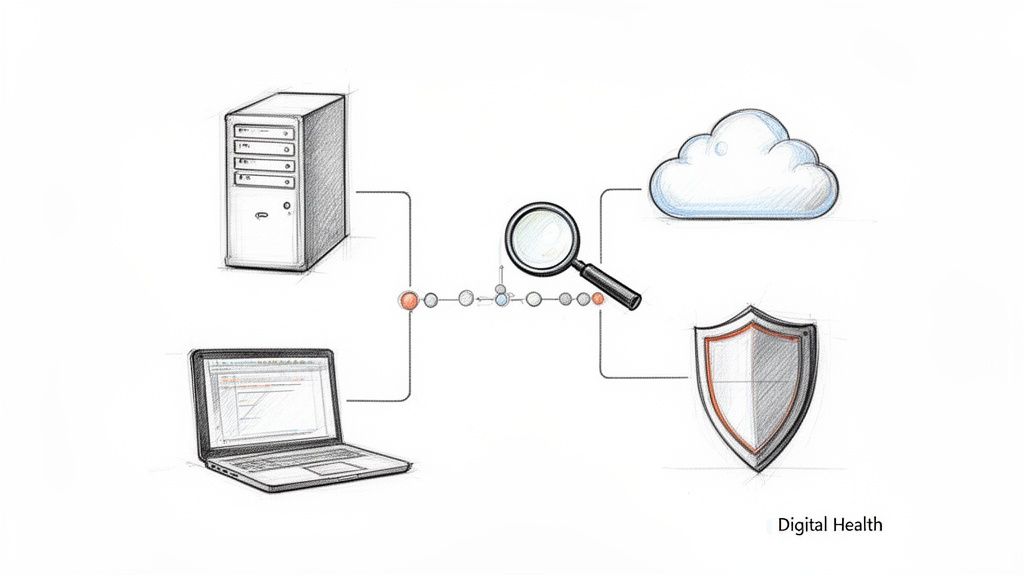
Think of a risk assessment as a comprehensive health check-up for your company's technology. This isn’t some abstract IT exercise you can ignore. It’s a core business process designed to find the cracks in your armor before a real threat turns them into a full-blown crisis. It's all about answering the tough questions every organization is wrestling with right now.
And that proactive mindset has never been more critical. The World Economic Forum's Global Cybersecurity Outlook 2025 found that a staggering 72% of organizations have seen cyber risks jump significantly in the last year alone. This isn't just noise; it’s driven by a very real surge in cybercrime, including a 33% increase in cyber-enabled fraud.
Beyond Technical Jargon: The Business Value
A well-executed risk assessment does one thing exceptionally well: it translates technical jargon into plain business sense. It shifts the conversation from "what-if" scenarios to the real-world impact on your revenue, your brand's reputation, and your ability to stay compliant. The whole point is to make sure your security strategy is perfectly aligned with your business goals.
For GRC specialists, auditors, and C-suite leaders, the assessment creates a shared language for talking about risk. It provides an evidence-based, defensible plan for making tough decisions.
A thorough risk assessment is the single most effective way to reduce long-term costs by preventing or reducing security incidents. It ensures that your security resources—money, time, and personnel—are strategically aligned with your most critical business assets and regulatory requirements.
The table below breaks down the key objectives of a risk assessment and connects them to tangible business outcomes.
Key Objectives of a Cybersecurity Risk Assessment
| Objective | Business Impact |
|---|---|
| Identify Critical Assets | Pinpoints the data, systems, and processes essential for operations and revenue. |
| Uncover Vulnerabilities | Reveals gaps in technology, policies, and human processes before attackers can exploit them. |
| Evaluate Plausible Threats | Assesses likely attack vectors and their probability, enabling proactive and targeted defense. |
| Justify Security Investments | Links security spending directly to mitigating specific, high-priority risks, making it easier to secure budget. |
| Achieve and Maintain Compliance | Generates the evidence needed to satisfy standards like HIPAA, SOC 2, and ISO 27001. |
As you can see, each objective directly supports a stronger, more resilient business. Understanding these requirements is a critical first step. You can learn more about how an ISO 27001 gap assessment can help kickstart this process.
Ultimately, getting a firm grip on your specific risks helps you build a security posture that not only protects your brand but also ensures you can keep the lights on and grow, no matter what comes next.
Choosing the Right Risk Assessment Framework
Picking a cybersecurity risk assessment framework is a lot like choosing a blueprint before you build a house. The plan for a skyscraper is completely different from the plan for a single-family home, and for good reason. The right framework gives your organization the specific structure it needs to build a security program that can stand up to real-world threats, all while fitting your industry, goals, and regulatory pressures.
These frameworks aren't just glorified checklists. They're strategic guides that give everyone a common language and a proven method for wrangling risk. They help you shift from a chaotic, fire-fighting mode to a structured, repeatable process that your leadership can actually understand and get behind.
Without a solid framework, security teams are often left guessing. They struggle to prioritize what to fix first, fight to justify their budgets, and have a hard time proving to auditors or partners that they're doing their due diligence. A good framework is the roadmap you need to cut through the noise.
NIST Cybersecurity Framework: The Flexible Blueprint
The NIST Cybersecurity Framework (CSF) is pretty much the gold standard, and for good reason. It’s incredibly adaptable. It was originally built to protect critical infrastructure in the U.S., but its practical, no-nonsense approach has made it a favorite in just about every industry. Think of the NIST CSF as a master architectural plan that you can easily adapt for any kind of structure.
Its core is simple and logical, built around five key functions:
- Identify: What do we have, and what risks are we facing?
- Protect: What safeguards do we need to put in place?
- Detect: How will we know when something bad happens?
- Respond: What’s the plan when an incident is detected?
- Recover: How do we get back to business as usual?
What makes the NIST CSF so powerful is that it focuses on outcomes, not specific tools or technologies. This gives organizations of all sizes the breathing room to implement it in a way that truly fits their risk appetite and budget. It’s an outstanding starting point for anyone looking to build a mature security program from the ground up.
ISO 27001: The International Standard for Certification
If NIST is the flexible blueprint, then ISO/IEC 27001 is the official plan you need to get a globally recognized building permit. This is the international standard for creating, running, and continuously improving an Information Security Management System (ISMS).
An ISMS isn't just about tech; it's a holistic system that brings together people, processes, and technology to keep sensitive information safe. Getting certified for ISO 27001 is a formal, audited process. It’s how you prove to the world—customers, partners, and regulators—that you take security seriously.
For companies that do business globally or manage sensitive client data, ISO 27001 certification isn't just a nice-to-have; it's often a deal-breaker. It’s a powerful way to build trust and can open doors to new opportunities that would otherwise be closed.
The road to certification takes real commitment and investment, but the result is a well-documented, comprehensive security program that can withstand intense scrutiny.
CIS Controls: The Prioritized Action Plan
The Center for Internet Security (CIS) Controls take a different angle. Instead of a full-blown architectural plan, think of them as a punch list of the most critical tasks that give you the biggest bang for your buck. The CIS Controls are a tightly focused set of 18 high-priority actions designed to defend against the most common cyberattacks we see in the wild.
These controls are smartly broken down into three Implementation Groups (IGs). This allows organizations to focus their limited time and money on the safeguards that will make the biggest difference, starting with the basics and building from there. For small businesses or teams just starting out, the CIS Controls offer a clear, actionable, and incredibly effective path forward.
Your 5-Step Risk Assessment Methodology
A cybersecurity risk assessment isn't some abstract, theoretical exercise. It's a structured, repeatable process for figuring out what you need to protect and the smartest way to do it. Think of it less like a scary audit and more like a logical workflow that turns a massive task into a manageable project.
This five-step methodology ensures you don’t miss any critical assets or ignore major threats. Each stage builds on the one before it, giving you a clear path from discovery to a solid, defensible security plan.
Step 1: Asset Identification
It’s simple: you can't protect what you don't know you have. The first, most crucial step is to build a complete inventory of every valuable asset in your organization. This goes way beyond just servers and laptops. We're talking about data, systems, and even people.
An asset is anything that your business needs to operate and has value. Your job here is to map out your entire digital and physical ecosystem.
Key asset categories to look for include:
- Data Assets: Think customer records, your company's secret sauce (intellectual property), financial reports, and employee information.
- Hardware Assets: This includes all the physical gear—servers, employee laptops, phones, and networking equipment like routers and switches.
- Software Assets: From SaaS platforms like Salesforce to custom-built applications and operating systems.
- People: Certain employees are assets, too, especially those with specialized knowledge or high-level access.
- Intangible Assets: Don't forget things like your brand's reputation and the trust your customers have in you.
For every asset you identify, note down who owns it, where it is, and how important it is to the business. This list becomes your single source of truth for the rest of the assessment.
Step 2: Threat and Vulnerability Analysis
Okay, you know what you're protecting. Now it's time to figure out what could go wrong. This is where you identify the specific threats that could come after your assets and the vulnerabilities that would let them in.
It's a classic pairing: a threat is the potential danger (like a hacker), while a vulnerability is the weakness they exploit (like an unpatched server).
To do this well, you have to think like an attacker. What are all the ways someone—or something—could cause harm? Brainstorm everything from a targeted cyberattack to an employee clicking a bad link or even a natural disaster. This mindset helps you build a realistic picture of the dangers you face.
Ground your analysis in reality by looking at current threat data. For example, recent cybersecurity stats show ransomware is now a factor in a staggering 44% of data breaches worldwide. At the same time, risks from third-party vendors have doubled as attackers find weak spots in supply chains. Keeping an eye on trends like these ensures your assessment is based on real-world evidence, not just guesswork.
Step 3: Impact and Likelihood Evaluation
With a list of potential problems, the next move is to figure out how bad it would be if something actually happened (impact) and how likely it is to happen (likelihood). This is where you move from a simple list of worries to a prioritized analysis of what really matters.
- Impact is all about the damage. How severe would it be? We often rate this on a scale from insignificant (a minor headache) to catastrophic (a potential business-ending event). You need to consider financial losses, damage to your reputation, operational downtime, and any legal fines.
- Likelihood is the probability of a threat actually occurring. Is it rare, or is it almost certain to happen at some point?
Assigning a score to both impact and likelihood gives you a way to objectively compare different risks. It’s no longer about gut feelings; it’s about data.
The flowchart below shows how well-known frameworks like NIST, ISO, and CIS provide structured paths to guide you through this kind of evaluation.
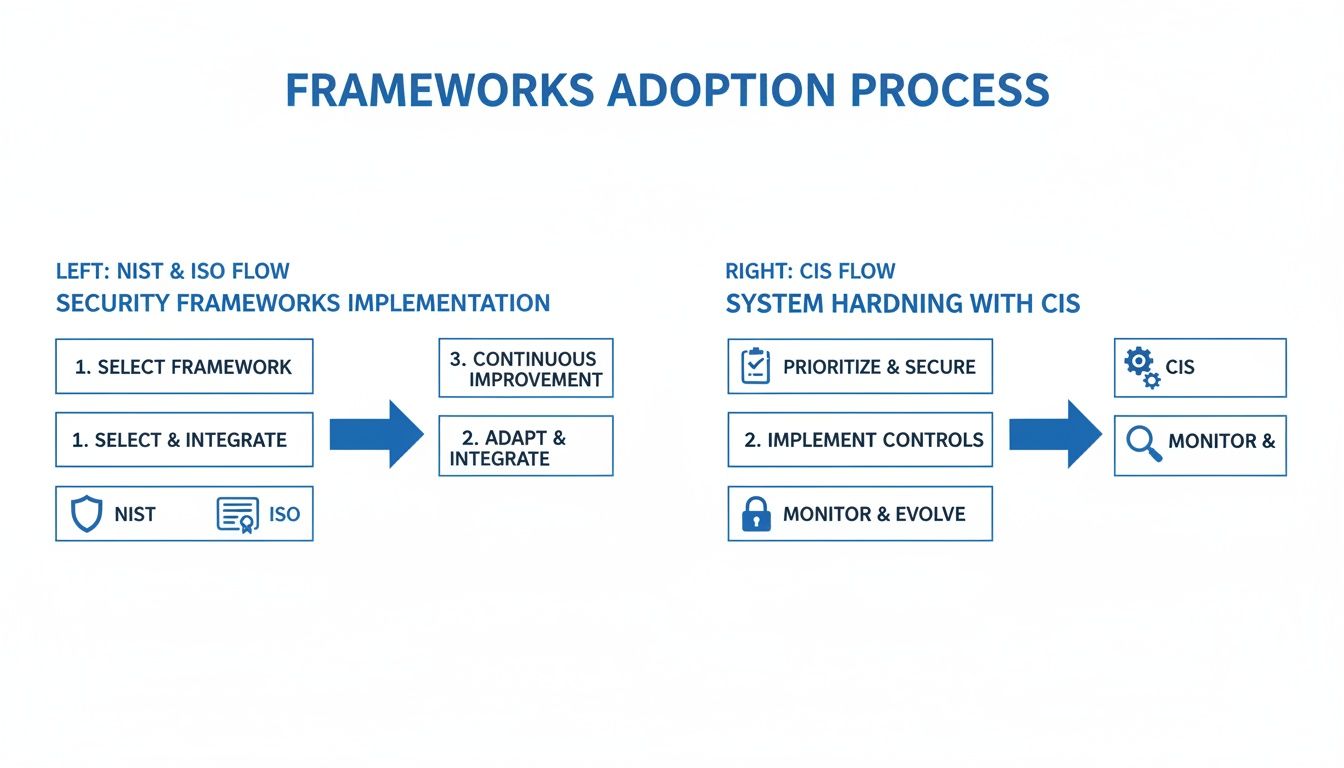
These frameworks are essentially proven blueprints. They help you stay organized and ensure your assessment is both consistent and thorough.
Step 4: Risk Prioritization
Now we get to the payoff. You take the impact and likelihood scores from the last step and use them to calculate an overall risk level for each threat. A simple and common way to do this is to just multiply the two scores: Impact x Likelihood = Risk Score.
This calculation gives you a prioritized to-do list, with the highest-scoring risks right at the top. This is absolutely critical for using your resources wisely. Instead of trying to fix everything at once—which is impossible—you can focus your team's time, money, and energy on the threats that pose the biggest danger.
A risk matrix is a fantastic visual tool for this. It plots likelihood against impact, making it immediately obvious which risks are critical and need attention now.
A risk matrix is a visual tool that helps teams quickly understand and prioritize threats. By mapping the likelihood of a threat against its potential impact, you can see at a glance which risks are low-level concerns and which are critical emergencies requiring immediate action.
Example Risk Assessment Matrix
| Likelihood / Impact | 1 (Insignificant) | 2 (Minor) | 3 (Moderate) | 4 (Major) | 5 (Catastrophic) |
|---|---|---|---|---|---|
| 5 (Almost Certain) | Medium (5) | High (10) | High (15) | Critical (20) | Critical (25) |
| 4 (Likely) | Low (4) | Medium (8) | High (12) | High (16) | Critical (20) |
| 3 (Possible) | Low (3) | Medium (6) | Medium (9) | High (12) | High (15) |
| 2 (Unlikely) | Low (2) | Low (4) | Medium (6) | Medium (8) | High (10) |
| 1 (Rare) | Low (1) | Low (2) | Low (3) | Low (4) | Medium (5) |
This matrix instantly translates your scores into clear priorities, helping you decide where to focus your efforts first.
Step 5: Risk Treatment
The final step is deciding what you’re going to do about each prioritized risk. This is your risk treatment plan—an actionable list of how you'll handle your biggest threats. There are generally four ways to deal with a risk:
- Mitigate: This is the most common strategy. You implement security controls to lower the likelihood or impact of a risk. Things like patching software, turning on multi-factor authentication, or running security awareness training for employees all fall under mitigation.
- Transfer: Here, you shift the financial fallout of a risk to someone else. The classic example is buying a cybersecurity insurance policy to cover the costs of a data breach.
- Avoid: Sometimes the best move is to stop doing the risky thing altogether. If an old, vulnerable application is causing too much trouble, you might just decide to decommission it and eliminate the risk entirely.
- Accept: For some low-impact, low-likelihood risks, you might decide to simply accept them and do nothing. This is only a good idea when the cost to fix the problem is far greater than the potential damage.
This risk treatment plan is your roadmap for getting more secure. If you're aiming for a formal certification, this documentation is also a critical piece of evidence. You can see how this plays out in our guide on getting ready for ISO 27001 audits.
Common Risk Assessment Pitfalls to Avoid
Even a risk assessment with the best intentions can go off the rails. Knowing the common tripwires ahead of time is like having a map of dangerous terrain—it helps you steer clear of trouble and keep your project moving forward. Sidestepping these mistakes is the difference between getting meaningful, actionable results and just spinning your wheels on a resource-draining exercise.
Make no mistake, a botched assessment has real consequences. It can lull you into a false sense of security, send your budget in the wrong direction, and leave glaring holes in your defenses that attackers will happily exploit. Let's walk through the most common mistakes I see and, more importantly, how to avoid them.
Treating the Assessment as a One-Time Project
Perhaps the most dangerous mistake is treating a risk assessment like a checkbox to be ticked off once a year. Teams do a deep dive, generate a beautiful report, and then promptly shelve it until the next audit cycle. This "set it and forget it" approach simply doesn't work when threats change by the minute.
Think about it: your business is never static. You bring new systems online, your teams adopt new software, and attackers are constantly cooking up new ways to break in. A risk assessment from six months ago might as well be from another decade.
A risk assessment isn't a snapshot; it's a motion picture. It needs to be a living, breathing process that keeps pace with your business, new threats, and changes in technology. If you treat it like a static document, it’s guaranteed to become useless.
To get this right, you have to build a rhythm of regular reviews—at the very least, once a year. For your most critical systems, you should be checking in more often. And you absolutely must trigger a fresh assessment after any major change, like deploying a new ERP system, acquiring another company, or when a major industry vulnerability like Log4j hits the news.
Conducting a Shallow Asset Inventory
You can't protect what you don't know you have. A flimsy, incomplete asset inventory is a faulty foundation that will bring the whole assessment crashing down. Too often, teams just list the obvious stuff—servers, laptops, firewalls—and completely miss the assets that are most valuable and most vulnerable.
This usually happens when security teams fail to look beyond officially sanctioned IT. The reality is that "shadow IT" is everywhere. Your marketing team probably signed up for a dozen SaaS tools you've never heard of, and your finance department might be using a cloud storage service without an official blessing. These are the blind spots where attackers thrive.
To build an inventory that actually means something, you need to dig deeper. Focus on these often-missed asset categories:
- Data Is an Asset: Start by figuring out where your most sensitive information lives. This includes customer PII, trade secrets, and financial data. The data is almost always worth more than the computer it's stored on.
- SaaS Platforms & Cloud Services: Go on a hunt for every third-party application and cloud environment that touches your company's data. This can be an eye-opening exercise.
- Intangible Assets: Don't forget to include things like your brand's reputation and the trust you've built with customers. A data breach can damage these just as badly as it can your servers.
The only way to get a complete picture is to talk to people. Sit down with department heads from across the business to uncover what they're using. Their insight is essential for building a 360-degree view of what you truly need to protect.
Overlooking the Human Element
Another classic mistake is getting tunnel-vision on technology while completely ignoring people. I've seen assessments that meticulously detail firewall configurations and server patch levels but say nothing about the fact that an employee is still the easiest way into a network.
Study after study shows that human error is a root cause in a huge percentage of security incidents. Phishing, weak passwords, and accidentally sharing sensitive data are threats that no firewall can completely stop. Your risk assessment has to account for the people and processes that interact with your tech every day.
Make sure your analysis looks at questions like these:
- Security Awareness Training: Is it actually working? Do your employees know how to spot a phishing email, or are they just clicking through the training to get it over with?
- Access Controls: Is the principle of least privilege actually being followed? Do employees who left the company three months ago still have active accounts?
- Insider Threats: Are you considering the risk from both malicious insiders and well-intentioned employees who make honest mistakes?
By bringing the human element into your assessment, your risk treatment plan becomes infinitely more effective. You'll end up with a strategy that blends essential technical controls with the training and processes needed to back them up.
Using AI and Automation to Streamline Assessments
Let's be honest: the old-school approach to cybersecurity risk assessments is broken. It often involves a mountain of manual work, with teams spending countless hours sifting through documents, chasing down stakeholders for interviews, and painstakingly mapping evidence to hundreds of controls.
This process isn't just slow and expensive; it’s dangerously prone to human error.
By the time you finish a manual assessment, the findings are often already stale. For growing organizations facing increasingly complex compliance demands, this reactive approach just doesn't cut it anymore. Fortunately, technology is finally offering a way out of this cycle.
The Rise of Intelligent Automation
Modern GRC (Governance, Risk, and Compliance) platforms are starting to bake in AI and automation, and it’s completely changing the game. The assessment process is shifting from a purely manual slog to a true human-machine partnership.
Think of automation as a force multiplier. It handles the mind-numbing, repetitive tasks that eat up most of a security analyst's time.
This frees up your skilled GRC and security pros to focus on what they do best: strategic analysis, critical thinking, and making smart decisions about risk. Automation doesn’t replace human expertise; it elevates it.
By automating the grunt work of evidence collection and analysis, organizations can slash audit prep time, get more accurate findings, and gain real, evidence-backed insight into their security posture. It turns the assessment from a dreaded obligation into a continuous, strategic advantage.
This is a huge deal, especially for teams that are already stretched thin. The cybersecurity skills gap is a real and pressing problem.
According to ISACA's 2025 State of Cybersecurity Report, a staggering 55% of cybersecurity teams are understaffed, and 65% report struggling to fill open positions. AI-powered tools directly address this by automating evidence discovery and mapping gaps to frameworks, letting understaffed teams focus on high-judgment tasks instead of paperwork. You can see the full findings on the challenges facing cybersecurity teams on ISACA's website.
How AI Actually Streamlines Evidence Collection and Mapping
So, how does this work in practice? One of the most powerful uses of AI in a risk assessment is its ability to read and understand massive amounts of documentation. Imagine feeding an AI platform your entire library of policies, procedures, and system configurations.
The system can then do in minutes what would take a human analyst weeks or even months.
- Automated Evidence Discovery: AI can scan thousands of pages to pinpoint specific evidence tied to a control, like finding the section in your business continuity plan that covers data backups.
- Instant Framework Mapping: The platform automatically cross-references the evidence it finds against controls in frameworks like ISO 27001, NIST CSF, or SOC 2.
- Gap Identification with Citations: If evidence for a control is weak or missing entirely, the system flags it as a gap and tells you exactly which requirement isn't being met.
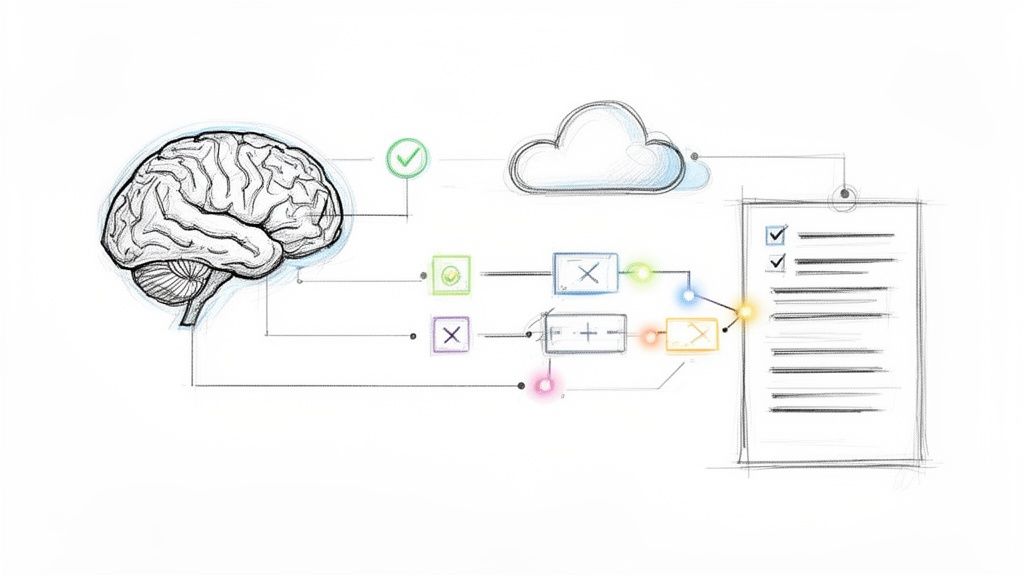
This screenshot from a platform like AI Gap Analysis shows how it can take uploaded documents and instantly connect them to specific compliance requirements.
This automated mapping gives you a clear, evidence-backed starting point. It allows auditors and compliance managers to quickly verify findings and get straight to fixing the actual problems.
The Benefits of an Automated Approach
Bringing AI and automation into your risk assessment workflow delivers real-world benefits that go far beyond just saving time. It makes the entire process faster, smarter, and more strategic.
- Increased Speed and Efficiency: Cut your assessment time from months down to weeks or even days. This means you can run them more often and keep a current view of your risk posture.
- Enhanced Accuracy and Consistency: Automation removes the human error and subjective guesswork that can creep into manual assessments, giving you more reliable and defensible results.
- Improved Focus on Strategy: When your team isn't buried in spreadsheets, they can focus on analyzing risk, creating effective treatment plans, and talking to business leaders.
- Continuous Compliance Readiness: An automated system helps you maintain an "always-on" state of audit readiness. The stressful annual fire drill becomes a manageable, ongoing process.
If you want to dig deeper, our guide on the relationship between an audit and risk assessment explains how these automated processes support both functions. Ultimately, using AI turns the cybersecurity risk assessment from a static chore into a dynamic, intelligent part of your security program.
Frequently Asked Questions
When you start digging into cybersecurity risk assessments, a lot of questions pop up. It’s natural. Here are straightforward answers to some of the most common ones I hear from security pros and business leaders, designed to clear things up as you get ready to tackle your own assessment.
How Often Should We Run a Cybersecurity Risk Assessment?
The standard answer is at least once a year. That’s the baseline. But honestly, you can't just set it and forget it.
A cybersecurity risk assessment should be a living part of your business rhythm. You absolutely need to kick off a new one anytime there's a major shift in the company. Think big changes like bringing in a major new tech platform, going through a merger, or even when a new, nasty threat starts making headlines in your industry. Regular, smaller check-ins between the big annual reviews will keep you from getting blindsided.
What’s the Real Difference Between Qualitative and Quantitative Risk Analysis?
This one trips people up all the time. Both are ways to size up risk, but they do very different jobs. Knowing when to use each is crucial.
- Qualitative Analysis is all about using descriptive labels like "High," "Medium," and "Low." It's your quick and dirty method. You're not getting bogged down in numbers; you're using scenarios and experience to quickly sort your risks into buckets. It’s perfect for getting a fast, big-picture view of your main threats.
- Quantitative Analysis gets down to dollars and cents. Here, you're putting a hard number on risk, like calculating an "Annualized Loss Expectancy of $150,000" for a specific threat. It takes a lot more data and effort, but it gives you concrete financial figures to build a business case for security spending.
Most teams I work with start qualitatively to identify the big fish. Then, they switch to a quantitative approach for those top-tier risks to justify the budget needed to fix them.
How Do I Get Leadership to Actually Care About a Risk Assessment?
You have to speak their language, and that language is business. Forget talking about CVE scores and unpatched servers. Executives want to know how this affects revenue, customer loyalty, and the bottom line.
Frame the risk assessment as a business enabler, not an IT cost. Show them it's about protecting the company’s ability to make money and grow. Use real data to contrast the potential cost of a breach with the much smaller investment in proactive security. It’s not about fear; it’s about smart, strategic management of uncertainty.
Can a Small Business Really Use the Same Frameworks as a Huge Corporation?
Yes, and they should. Frameworks like the NIST Cybersecurity Framework or the CIS Controls are built to be flexible for a reason. A ten-person company isn’t going to implement them the same way a Fortune 500 giant would, and that’s the point.
The trick is to adapt the framework to fit your reality. Don't try to boil the ocean. A small business should focus on the controls that tackle their biggest, most likely threats first. The goal isn't to check off every box in a 100-page document; it's to meaningfully reduce your unique risks.
Tired of wrestling with spreadsheets to manage your compliance efforts? AI Gap Analysis can automate the heavy lifting of evidence collection and instantly map what you have to frameworks like ISO 27001 and SOC 2. You can get clear, actionable insights in a fraction of the time it takes to do it manually.
See how our AI-powered platform can simplify your next cybersecurity risk assessment. Visit AI Gap Analysis to learn more.