February 6, 2026
how to perform a gap analysiscompliance gap analysisiso 27001 auditrisk managementprocess improvement
How to Perform a Gap Analysis A Practical Guide for Compliance
Learn how to perform a gap analysis with this practical guide. Move beyond checklists to build an evidence-backed, audit-ready compliance strategy.
20 min readAI Gap Analysis
A gap analysis is all about figuring out where you are versus where you need to be. You’re essentially mapping your current operations against a specific compliance framework to see what’s missing. Think of it less like a checklist and more like creating a strategic, actionable roadmap to shore up your defenses, especially for rigorous standards like ISO 27001 or SOC 2.
Why a Gap Analysis Is Your Strongest Compliance Asset
Before we get into the nuts and bolts, let's be clear on why this is so important. A proper gap analysis turns vague compliance goals into tangible, measurable tasks. You stop guessing where your vulnerabilities might be and instead get a clear, evidence-backed picture of what actually needs fixing.
This structured approach pays off in some very real ways. When you proactively identify your issues, you can:
- Minimize Audit Failures: Spotting and fixing non-conformities early means you walk into audits with confidence, not anxiety. You know exactly where you stand.
- Reduce Unnecessary Costs: A clear gap analysis helps you steer clear of expensive, last-minute fire drills and the hefty fees consultants charge for emergency remediation.
- Accelerate Certification: With a prioritized action plan, you can focus your team’s energy and budget on the most critical gaps, which dramatically shortens the time it takes to get certified.
The Shift from Manual Effort to AI Precision
For years, a gap analysis was a necessary evil—a painfully slow, manual process that was incredibly prone to human error. A 2025 PwC survey found that these manual assessments take teams an average of 6-12 months per audit cycle. For a small or mid-sized business, that can cost upwards of $500,000 in consultant fees and lost productivity. It's no wonder that 87% of businesses are now looking to AI to make operations like this more efficient. You can discover more AI adoption statistics to see how different industries are making the shift.
A gap analysis doesn't just show you where you are; it illuminates the most efficient path to where you need to be. It turns compliance from a reactive burden into a proactive strategy for organizational improvement.
This is where modern, AI-driven tools are completely changing the game. They take on the tedious, soul-crushing work of sifting through documents and mapping controls. This frees up your team to focus on strategic decisions instead of mind-numbing data entry. You can learn more about how this fits into a broader strategy by exploring our guide to building an effective compliance program. This level of efficiency makes comprehensive compliance not just possible, but sustainable for any organization.
Defining Your Scope and Gathering Critical Evidence
Any good gap analysis starts with a rock-solid scope. If you don't set clear boundaries from the beginning, you’ll end up with a scattered assessment that burns through time and resources without giving you any real answers. A precise scope is what focuses your efforts and leads to findings you can actually act on.
Think of it this way: you wouldn't start a road trip by just driving. You'd pick a destination first. Ambiguity is the enemy of a successful gap analysis, so let's get specific.
Establishing Clear Project Boundaries
First things first, you need to decide exactly what you're assessing. Are you zeroing in on a single business process, a specific department, or an entire compliance framework like ISO 27001? The answer here sets the stage for everything that follows.
For example, a medical device startup might limit its scope to the product development lifecycle, measuring it against the ISO 13485 standard. On the other hand, a large financial institution might need to look at the entire organization’s data handling practices to meet SOC 2 criteria.
To really nail down your scope, ask yourself these questions:
- Which business units or departments are we looking at? (e.g., Engineering, HR, IT)
- What specific processes are under review? (e.g., employee onboarding, software deployment, incident response)
- Which compliance framework or standard is our benchmark? (e.g., HIPAA, GDPR)
- Who are the key people we need to involve? (e.g., department heads, system owners, legal counsel)
Writing this down gives you a clear project charter and helps you fight off "scope creep"—that all-too-common problem where a project's goals expand uncontrollably. Everyone involved will know the project’s limits and goals right from the start. To see how these principles apply to a specific framework, check out our detailed guide on conducting an ISO 27001 gap assessment.
Building Your Centralized Evidence Library
With your scope locked in, it's time to gather your evidence. The goal isn't just to find a few documents; it's to build a comprehensive, centralized library that acts as the single source of truth for your entire analysis.
This is the step that turns a gap analysis from a theoretical exercise into an evidence-backed assessment that can stand up to scrutiny.
An analysis without evidence is just an opinion. A strong evidence library is what makes your findings defensible, verifiable, and ultimately, audit-ready.
Start by identifying the kinds of documents you'll need. This list will change depending on your scope, but it usually includes a mix of formal policies, operational records, and technical proof.
Here are some common types of evidence to pull together:
- Policies and Procedures: Official company rules, like your Information Security Policy or Data Retention Policy.
- Process Documentation: Flowcharts, work instructions, and standard operating procedures (SOPs) that show how work actually gets done.
- System Configuration and Audit Logs: The technical proof, showing how systems are configured and what users have been doing.
- Training Records and Materials: Proof that your team has been trained on the policies and procedures you have in place.
- Meeting Minutes and Reports: Notes from key meetings (like risk management committees) or internal audit reports.
The journey from manual chaos to AI-powered clarity really begins with this structured approach to gathering evidence.
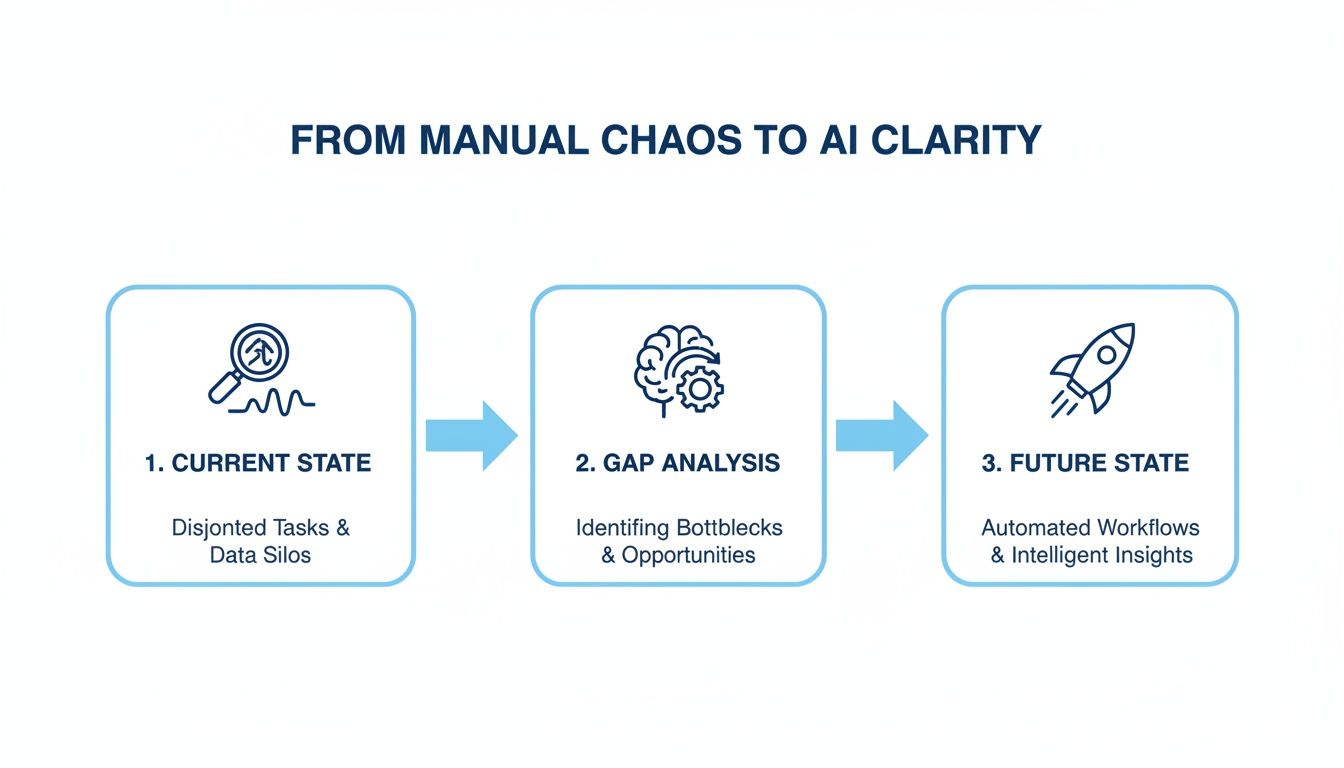
As you can see, a thorough gap analysis is the bridge connecting where you are now to where you need to be.
The old-school way of doing this means manually digging through shared drives, messy email chains, and a dozen different systems—it's a nightmare. Modern tools, however, let you ingest all of these documents into one place. This not only gets you organized but also preps your evidence for automated analysis, which can dramatically speed up the entire project and save you from that last-minute scramble when the auditors show up.
Leveraging AI for Precision Gap Identification
Once your evidence is gathered and the scope is clear, the real work begins. This is the moment of truth where you meticulously compare your documentation against every single requirement in your chosen compliance framework. For years, this meant being chained to a spreadsheet, manually cross-referencing hundreds of controls. It was a tedious process, to say the least, and one that was wide open to human error.
Thankfully, there's a much smarter way to do this now. Modern AI-driven platforms are built to cut through this complexity, turning what was once a monumental task into a focused, manageable process.
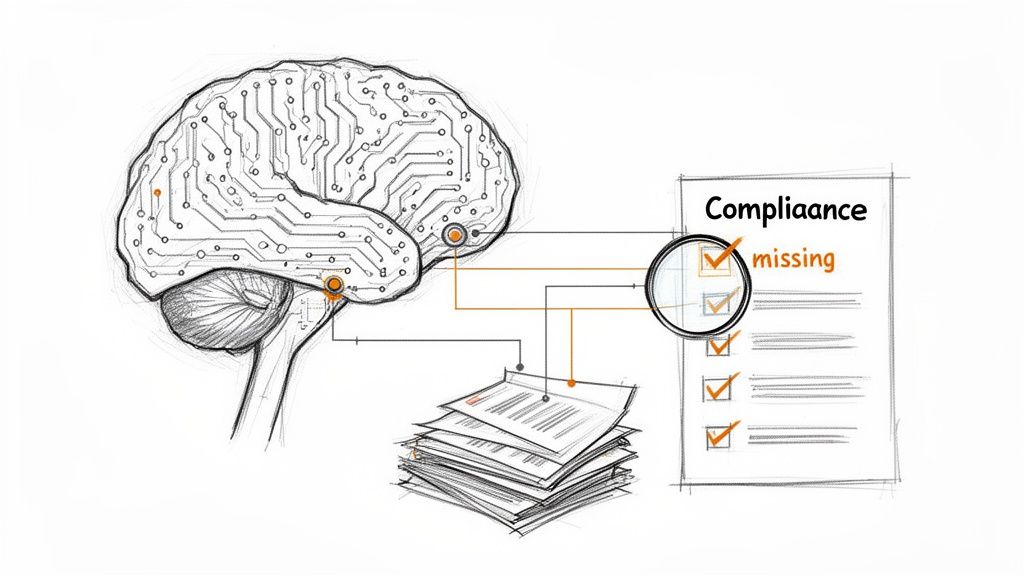
Instead of a person manually ticking boxes, an AI agent can read and process thousands of pages of your technical and policy documents in just a few minutes. It intelligently maps what's in your evidence to the framework's requirements, instantly highlighting where you're falling short.
How AI Automates Control Mapping
Let's walk through a real-world scenario. Say you're a medical device company aiming for ISO 13485 certification. You've uploaded all your critical documents—the Quality Manual, dozens of Standard Operating Procedures (SOPs), and your complete design history files.
The AI doesn't just do a simple keyword search; it actually understands the context. It reads your SOP for risk management and analyzes its content against the specific demands laid out in clause 7.1 of the standard.
If the AI sees that your procedure correctly details risk identification and evaluation but finds no mention of a process for post-market risk monitoring, it flags this as a gap. But here's the crucial part: it also links that finding directly to the specific document and page number, giving you an immediate, verifiable citation. This takes all the guesswork out of the equation and builds a solid audit trail from the start.
The real power of an AI-driven gap analysis isn't just speed; it's the verifiable link between every finding and the concrete evidence. This makes your results defensible, your remediation focused, and your path to being audit-ready significantly shorter.
This automated mapping is a total game-changer. An analysis that would have taken a team weeks of painstaking manual review can now be done almost instantly and with far greater accuracy. The AI can digest enormous amounts of unstructured data—from dense policy documents to technical system logs—and turn it all into clear, actionable findings.
From Manual Tedium to Intelligent Insights
The difference between the old way of identifying gaps and the new, AI-assisted method is night and day. Let's compare the two approaches side-by-side to see just how much has changed.
Manual vs AI-Powered Gap Analysis: A Practical Comparison
This table contrasts the key stages of a gap analysis, showing how platforms like AI Gap Analysis have modernized a traditionally painful process.
| Analysis Stage | Manual Approach (The Old Way) | AI-Powered Approach (The New Way) |
|---|---|---|
| Evidence Review | Manually reading through hundreds of documents, often requiring multiple team members and weeks of effort. | AI ingests and reads all documents in minutes, understanding content and context across the entire evidence library. |
| Control Mapping | Using complex spreadsheets to manually track which document covers each control requirement. Highly prone to human error and omissions. | AI automatically maps existing controls described in your documents to the specific clauses of the compliance framework. |
| Gap Identification | Gaps are identified subjectively based on an individual's interpretation and memory of the evidence they reviewed. | Gaps are flagged objectively when the AI finds no supporting evidence for a specific control, with direct links to the relevant requirement. |
| Verification | Findings require a manual, time-consuming process of re-reading documents to confirm the gap and find supporting evidence. | Every finding is instantly verifiable with a single click, linking you directly to the exact page and paragraph in the source document. |
This shift does more than just save time. It liberates your team from low-value administrative work, allowing them to focus on what really matters: understanding the risks behind each gap and building smart remediation plans. For a deeper look at this transformation, check out our guide on using AI for regulatory compliance.
The Growing Need for AI in Compliance
The pressure to find more efficient ways to manage compliance is only increasing, especially in heavily regulated industries. For companies in medical devices and healthcare, a gap analysis against ISO 13485 or ISO 27001 can be the deciding factor for market access. Manual efforts just can't keep up.
Deloitte's 2026 predictions point to a persistent "AI gap," and this divide is even more pronounced in the compliance field. While only 13% of organizations treat AI as a non-priority, the healthcare AI market is set for explosive growth, showing just how urgent the need for smarter tools has become.
Ultimately, using AI to perform a gap analysis is about achieving precision and confidence. You go from a state of, "I think we're compliant here," to "I know we're compliant, and here is the exact evidence to prove it." That level of certainty strengthens your entire compliance program, making it more robust, efficient, and always ready for an audit.
From Findings to Fixes: Building Your Remediation Roadmap
Okay, so you’ve meticulously identified every compliance gap. That’s a huge accomplishment, but it's only half the battle. An analysis sitting in a folder is just an academic exercise; its real value comes when you turn those findings into a concrete, prioritized roadmap for improvement.
This is where you build the bridge from knowing what's wrong to actually making it right.
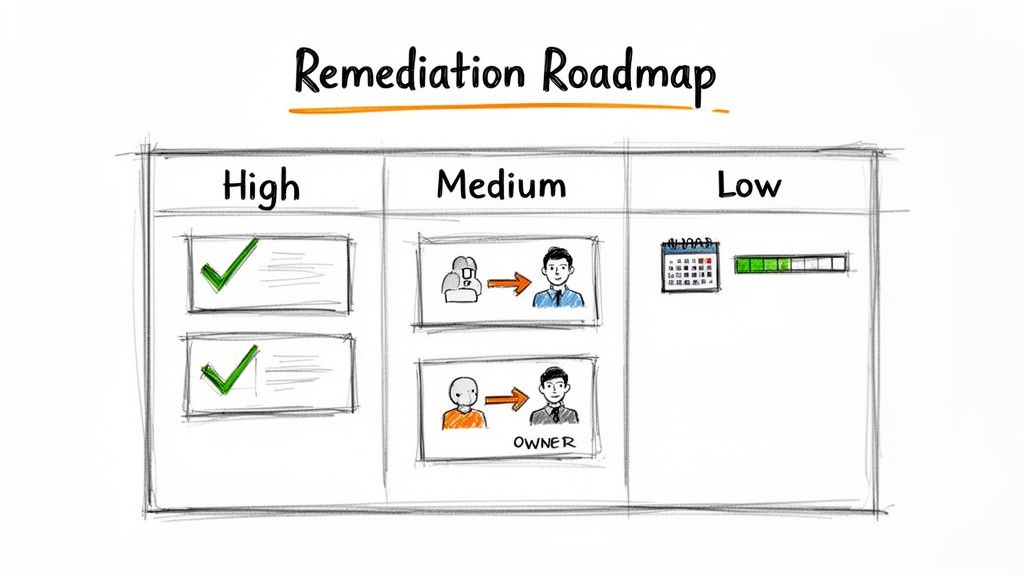
A truly powerful gap analysis report doesn't just list problems—it documents them with the precision an auditor demands. Think of each finding as its own self-contained story, giving anyone who reads it all the context they need to understand the issue, its impact, and why it absolutely has to be addressed.
This level of structured documentation is what separates an evidence-ready analysis from a simple to-do list.
Frame Each Finding for Maximum Clarity
To make your findings truly actionable, every single gap needs to be documented in a consistent way. This brings clarity to the chaos and makes it much easier to compare and prioritize what to tackle first. Without this structure, you just end up with a confusing list that paralyzes decision-making.
I've found this simple framework works wonders for every gap you document:
- Control Requirement: State the exact clause or control from the framework. For example, "ISO 27001 Annex A.12.1.2 - Protection against Malware."
- Observed Gap: Describe precisely what’s missing or wrong. Be specific: "The endpoint protection policy does not mandate automated, daily malware signature updates across all company-owned laptops."
- Associated Risk: Explain the "so what?"—the potential fallout from this gap. This could be anything from "Increased vulnerability to zero-day ransomware attacks" to "Guaranteed major non-conformity during our upcoming audit."
- Supporting Evidence: This is your proof. Link directly to the document, screenshot, or source that confirms the gap exists. This is non-negotiable for audit readiness.
This approach immediately elevates the conversation from "We have a problem" to "Here is the exact problem, here is the proof, and here is the risk we're accepting by not fixing it."
Smart Prioritization: Your Key to Success
Once all your gaps are documented, you'll probably be staring at a pretty long list. Don't panic. The biggest mistake you can make is trying to fix everything at once—it's a surefire recipe for burnout and failure. Smart remediation is all about prioritization.
A remediation plan that treats all gaps as equally important is a plan that fails. Prioritization is not just a best practice; it is the essential mechanism that turns a list of findings into a strategic, achievable project.
To prioritize effectively, you need a system. Scoring each gap based on a few key factors turns a subjective debate into an objective, logical plan of attack.
I always recommend a simple Risk-Effort Matrix to get started:
| Priority Level | Risk Level | Implementation Cost/Effort | Example Scenario |
|---|---|---|---|
| High | Critical | Low | Updating a single policy document to meet a major GDPR requirement. |
| Medium | High | High | Implementing a new company-wide security information and event management (SIEM) system. |
| Low | Low | Low | Correcting a minor procedural inconsistency in a non-critical internal workflow. |
This method is brilliant because it instantly highlights your "quick wins"—the high-risk, low-effort items. These should be at the absolute top of your list. It also helps you strategically budget and plan for those bigger, more expensive projects that tackle significant risks but will take more time to complete.
Ditch the Spreadsheet: Use a Collaborative Platform
Let's be honest: trying to manage a complex remediation plan on a scattered spreadsheet is a nightmare. The days for that are long gone. Modern collaborative platforms are built specifically to bring this entire process into a single, shared workspace where accountability thrives.
With the right platform, you can:
- Assign Ownership: Every single task needs a name next to it. No exceptions.
- Set Deadlines: Assign realistic timelines to keep the momentum going.
- Track Progress: Get a real-time view of what's "To Do," "In Progress," and "Completed."
- Centralize Communication: Let team members discuss issues, ask questions, and share updates right where the work is happening.
This collaborative approach stops remediation from being a set of disconnected tasks and turns it into a transparent, coordinated mission. Everyone knows exactly what they need to do, when it's due, and how their piece of the puzzle helps the company get one step closer to compliance.
Building a Sustainable Continuous Compliance Cycle
Getting through your remediation plan feels like crossing a finish line, but it’s really just the beginning. A gap analysis shouldn't be a one-and-done project. Instead, think of it as the first step in a living, breathing cycle of continuous compliance. The real goal is to get your organization out of the frantic pre-audit scramble and into a state of perpetual readiness.
This means weaving compliance activities right into your team's daily work. When you get this right, compliance stops being a reactive, high-stress event and becomes a proactive, predictable habit. You're building a system where controls are always being monitored and you always know where you stand.
From Project to Program: The Operational Shift
The first move is to operationalize your remediation plan. That plan was your roadmap to fix the immediate problems, but now it’s time to integrate those solutions deep into your organization's DNA. This isn't just about closing tickets in a project tracker; it's about making sure the fixes actually stick for the long haul.
Let's say your analysis found a hole in your employee onboarding process—new hires weren't getting security training. The quick fix is to train the people who just started. The sustainable fix is to permanently update the HR onboarding workflow, making security training mandatory for every new employee, complete with automated tracking to prove it was done.
A successful gap analysis doesn't just fix today's problems. It builds the systems and processes that prevent those same problems from ever happening again. This is how you create a true culture of compliance.
This shift in thinking requires you to treat compliance as an ongoing program, not a temporary project with a start and end date. This means assigning permanent owners for key controls, scheduling regular check-ins, and making compliance metrics a standard part of your team's performance reviews.
Implement a Monitor and Review Cadence
Once you've implemented the initial fixes, you need a system to make sure they stay effective. Compliance isn’t static; it drifts as your business changes, new tools are adopted, and regulations are updated. A structured schedule for monitoring and reviewing your controls is your best defense against this slow, silent drift.
I've seen organizations have a lot of success by establishing a clear, multi-tiered review schedule. You don't need to do a full-blown gap analysis every month, but you do need systematic checkpoints for your key controls.
Here’s a practical cadence you can put into practice:
- Quarterly Control Checks: Ask control owners to perform a quick self-assessment on their areas of responsibility. This is a lightweight gut check to confirm that the right processes are still being followed.
- Semi-Annual Mini-Audits: Conduct targeted internal audits on the high-risk areas you found in your initial analysis. This deeper dive helps you catch any emerging issues before they snowball into major problems.
- Annual Full Gap Analysis: Once a year, re-run the comprehensive gap analysis. This ensures you’ve captured any big changes to the business or the regulatory landscape from the last 12 months.
This approach keeps compliance top of mind without creating audit fatigue. The big annual audit starts to feel less like a monumental event and more like just another checkpoint.
The Role of Technology in Continuous Compliance
Let's be honest: trying to manage this kind of continuous cycle with spreadsheets and calendar reminders is a recipe for failure. It's just too much to track manually. This is where modern GRC platforms and specialized tools like AI Gap Analysis become your most valuable players.
Technology provides the backbone for a truly sustainable compliance program in a few key ways:
- Real-Time Updates: When you update a policy, you can upload the new version, and an AI-powered platform can instantly re-analyze your evidence against it. This gives you immediate feedback on how a small change impacts your overall posture.
- Centralized Evidence: A continuous cycle requires a single source of truth. A dedicated platform keeps all your evidence—policies, procedures, screenshots, logs—in one organized, version-controlled repository, ready for your next review.
- Efficient Re-Analysis: Instead of starting your annual review from scratch, you simply refresh your evidence and have the platform run the analysis again. This turns what used to be a months-long project into something you can knock out in a matter of days.
By embracing this continuous improvement loop, you pull your organization out of a state of periodic compliance and into one of constant audit readiness. You build resilience into your operations, foster a genuine culture of compliance, and transform what was once a major business risk into a powerful strategic asset.
Common Questions About Gap Analysis
Even with a solid plan, a few questions always come up when you're in the thick of a gap analysis. It’s a detailed process, and the small details can make or break the quality of your results. This section is all about tackling the most common questions we hear from teams getting their feet wet with their first real gap analysis.
Think of this as your quick reference for those "what if" moments. I'll give you some direct, practical answers to help you move forward with confidence, sidestep the usual traps, and deliver an assessment that's truly ready for an auditor's scrutiny.
What Are the Most Common Mistakes to Avoid?
One of the biggest blunders I see is poor scoping. Teams either try to boil the ocean with an analysis that's way too broad, or they go so narrow that the findings are meaningless. Either way, it's a huge waste of time and effort. Another classic mistake is not gathering enough evidence, which just gives you a fuzzy, inaccurate picture of where you really stand.
On top of that, many organizations just fail to get buy-in from the right people across the business. If you don't have stakeholders from other departments on your side, good luck gathering evidence or getting anyone to actually implement the fixes you recommend.
A critical error I see all the time is treating the gap analysis like a simple checklist. The real insight comes from understanding the risk behind each gap, not just ticking a box because a control is missing.
And maybe the most common failure of all? Not creating a real, actionable remediation plan. So many teams do the hard work of finding the gaps, but then the report just gathers dust on a digital shelf. Nothing changes.
How Long Does a Typical Gap Analysis Take?
Honestly, it all comes down to the scope of the project and how you tackle it. If you're going the old-school, manual route for a hefty framework like ISO 27001, you could easily be looking at 6 to 12 months of work. That's a ton of interviews, sifting through documents, and wrestling with spreadsheets.
But the new AI-powered platforms have completely changed the game. By automating the really grindy parts—like analyzing evidence, mapping it to controls, and flagging gaps—teams can shrink those timelines in a big way. We're now seeing the core assessment work get done in just a few days, which can cut the total project time by as much as 80%.
Can I Perform a Gap Analysis Myself or Do I Need a Consultant?
You can absolutely run a gap analysis internally. In fact, modern tools are built to empower you to do just that. Platforms designed for compliance give internal teams, like GRC managers or security analysts, a structured way to conduct a thorough assessment without immediately calling in expensive consultants.
Doing it yourself often leads to a much deeper understanding of your own controls and processes. But for companies that still want an expert eye, some services offer a hybrid model. This gives you the best of both worlds: you use the speed of an AI platform for the initial heavy lifting and then have a consultant come in to review and validate the findings.
What Should a Final Gap Analysis Report Include?
A great final report isn't just a list of what's broken; it's a strategic guide for getting things fixed. It should always kick off with an executive summary that gives leadership the 30,000-foot view of the key findings and what they mean for the business.
The report also needs to clearly spell out the project's scope and objectives for context. Then you get to the heart of it: the detailed list of every gap you found. For each one, you absolutely must include:
- The specific control requirement that isn't being met.
- A clear description of the current state and where it falls short.
- An assessment of the associated business risk.
- A prioritized remediation plan with concrete actions, assigned owners, and deadlines.
And here’s the most important part: every single finding has to be directly linked back to its supporting evidence. That’s what makes the report solid, defensible, and genuinely audit-ready.
Ready to turn your compliance workflow from a months-long marathon into a sprint? With AI Gap Analysis, you can get audit-ready findings in days, not months. Upload your documents, and let our AI agent deliver clear, evidence-linked answers that you can verify instantly. Start your journey to continuous compliance today.