ai for regulatory complianceregtech solutionscompliance automationiso 27001 auditai governance
Unlock ai for regulatory compliance with AI-Powered Automated Audits
Discover how ai for regulatory compliance transforms audits into automated workflows, guiding practical implementation and faster governance.
January 26, 202621 min readSpecter
For anyone on a compliance team, the world can feel like a mountain of paperwork, spreadsheets, and policy documents that just keeps growing. The old way of doing things—manually checking everything—is slow, full of potential for human error, and just can't keep up with the constant flood of new regulations. This is where AI for regulatory compliance steps in, offering a way to move from a reactive, "check-the-box" mentality to a more proactive, strategic approach.
Why Manual Compliance Just Isn't Cutting It Anymore

Think about what it takes to get ready for an ISO 27001 audit. You’re manually cross-referencing hundreds of security policies, procedures, and log files. An auditor asks for proof that a specific control is being met, and suddenly your team is on a frantic, multi-day scavenger hunt through shared drives, hoping they can find the one document that will satisfy the request.
This painful, document-heavy dance is the day-to-day reality for so many companies, and it creates massive bottlenecks.
But this traditional approach isn’t just slow; it’s incredibly risky. We’re all human, and mistakes are bound to happen during manual reviews. Those small errors can lead to missed compliance gaps, inconsistent evidence, and a nagging feeling of uncertainty. As rules get more complicated and intertwined, the sheer volume of work becomes completely overwhelming.
The True Cost of Manual Processes
The problem with doing everything by hand goes way beyond just lost hours. The ripple effects can be felt across the entire organization.
- Increased Audit Risk: If you can't find the right evidence or it's inaccurate, you’re looking at audit findings. This means expensive fixes and a hit to your company's reputation.
- Reactive Posture: Teams end up stuck in a cycle of playing catch-up, only scrambling to get ready when an audit is on the calendar instead of managing compliance proactively all year long.
- Limited Strategic Value: Your most skilled compliance experts are spending their days on administrative busywork. They have no time left for high-value tasks like analyzing risks or making processes better.
This inefficiency is exactly why the industry is moving so quickly toward smart automation. The global RegTech market, which includes AI-powered compliance tools, is on track to hit USD 19.5 billion by 2026. This explosive growth confirms what many of us already know: we desperately need better tools to handle the scale and complexity of today's regulatory world. You can dive deeper into this trend in the full RegTech market analysis.
The core challenge isn’t a lack of effort; it's a lack of leverage. Manual methods force teams to work harder, not smarter, creating a cycle of burnout and recurring audit stress.
A New Approach with AI
Now, imagine a different scenario. Instead of a human sifting through documents for days, an AI-powered platform can absorb your entire library of policies, procedures, and evidence in minutes. It acts like a tireless assistant that reads every page, understands the context, and instantly maps your existing controls to the exact regulatory requirements they satisfy.
This shift changes the entire game. The compliance function is no longer just a cost center buried in administrative tasks; it becomes a strategic partner. By automating the most tedious parts of finding evidence and spotting gaps, AI for regulatory compliance helps businesses finally get ahead of their obligations. Audit readiness becomes an ongoing, manageable process instead of a once-a-year fire drill.
How AI Transforms Everyday Compliance Tasks
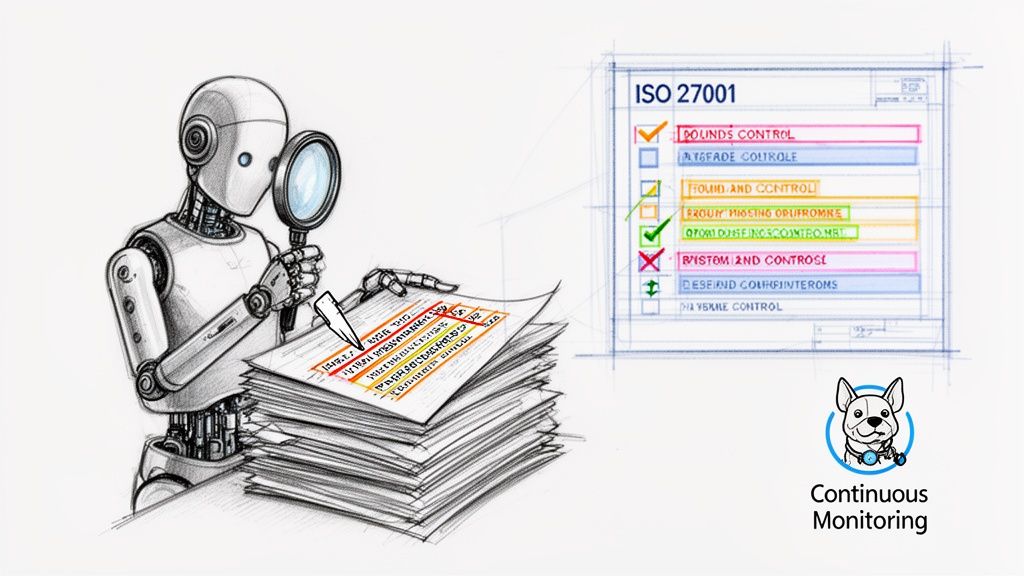
While the idea of AI can seem a bit abstract, its real-world impact on regulatory compliance is anything but. Think of it as a powerful force multiplier for your team. It takes on the repetitive, soul-crushing tasks that bog down skilled professionals, freeing them up to focus on high-level strategy and analysis instead of manual grunt work.
So, let's cut through the buzzwords and look at four core workflows where AI for regulatory compliance is making a tangible difference right now.
Uncovering Evidence in Minutes, Not Weeks
Ever had an auditor ask for proof of a specific control, sending your team on a frantic scavenger hunt? The traditional approach feels like searching for a single sentence buried in a library of thousands of books. It can take days, or even weeks, sifting through policy documents, system logs, and old procedure manuals to find that one crucial statement.
AI completely flips this script. It acts like a superhuman research assistant, reading and understanding your entire document repository in minutes. Thanks to Natural Language Processing (NLP), it grasps the context behind both the regulatory requirement and your internal documentation. Ask it for evidence, and it instantly pinpoints the relevant paragraph, giving you a direct citation. A week-long headache becomes a task that takes mere seconds.
Performing Instant Gap Analysis
Imagine you're building a house with a complex blueprint, like ISO 27001. The old way of doing a gap analysis is to manually compare every single one of your company's policies against each requirement in the framework. It's painstakingly slow, ridiculously prone to human error, and it’s way too easy to miss subtle but critical gaps.
An AI-powered gap analysis, on the other hand, is like having an expert overlay your controls directly onto the blueprint. It digitally maps everything described in your documents to the framework's requirements.
In an instant, the AI highlights every missing or incomplete control, generating a prioritized list of gaps that need your attention. This gives teams a crystal-clear picture of their compliance posture immediately, without the months of manual cross-referencing.
Enabling Continuous Compliance Monitoring
Compliance isn’t a one-and-done project; it’s a constant state. But manual monitoring often forces teams into a reactive cycle, where controls are only checked in the mad rush before an audit. This periodic approach leaves the company exposed for most of the year.
This is where AI steps in as a vigilant watchdog. It constantly scans your internal controls, access logs, and system configurations for any deviation from established policies. If a setting gets changed that violates a security control, or a new HR policy accidentally contradicts a privacy regulation, the AI flags it in real-time. This shifts your team from doing occasional spot-checks to maintaining a state of perpetual audit readiness. For a deeper dive, check out our guide on modern approaches to compliance and risk assessment.
Generating Audit-Ready Reports Automatically
After all the hard work, compiling the final audit report is often the last painful hurdle. It means gathering all the scattered pieces of evidence, formatting them perfectly, and making sure every claim is backed up with a solid citation. This manual assembly is not only tedious but also a prime opportunity for mistakes.
AI automates this entire workflow. Once the evidence has been identified and the gaps analyzed, the platform can put together comprehensive, audit-ready reports on its own. These aren't just simple summaries; they include:
- Direct citations that link every finding back to the source document.
- Deep links that an auditor can click to go straight to the specific page or paragraph.
- Consistent, professional formatting that meets industry standards.
This level of automation eliminates the administrative drag of audit prep and delivers a polished, verifiable report that builds immediate trust with auditors.
To really see the difference AI makes, it helps to put the old and new methods side-by-side.
Manual vs. AI-Powered Compliance: A Task-Based Comparison
The table below breaks down just how much of an impact AI can have on the daily grind of compliance work. It's a shift from long, manual cycles to immediate, data-driven action.
| Compliance Task | The Traditional Manual Method | The Modern AI-Powered Method |
|---|---|---|
| Evidence Discovery | Days or weeks of manually searching through documents, shared drives, and emails for proof. | Seconds to minutes for an AI to scan all documents and return the exact evidence with citations. |
| Gap Analysis | Weeks to months of cross-referencing policies against framework requirements using spreadsheets. | Hours to generate a complete gap analysis report, mapping all existing controls to the framework. |
| Continuous Monitoring | Periodic, manual spot-checks performed quarterly or annually, leaving significant blind spots. | Real-time, automated monitoring that flags policy deviations or control failures as they happen. |
| Audit Reporting | Days of manually compiling, formatting, and citing evidence to create a final audit report. | Minutes to automatically generate a fully cited, professionally formatted, and audit-ready report. |
As you can see, the contrast is stark. AI doesn't just make these tasks faster; it makes them more accurate, reliable, and far less reliant on heroic, last-minute efforts from the compliance team.
Navigating AI Governance and Global Rules
Bringing AI into your compliance workflow is a lot more involved than just installing new software. Think of it less like a tool and more like a new team member—one that learns from data and whose decisions have real-world consequences. This is precisely why AI governance has become such a hot topic for every compliance professional out there.
Without a solid governance plan, even the sharpest AI can introduce serious risks. You have to be able to answer some fundamental questions with confidence. How did the AI reach that conclusion? What data did it learn from? Can I stand in front of an auditor and prove its process is fair and unbiased?
These aren’t just abstract questions for a data scientist. They get to the very heart of maintaining auditability and trust in your entire compliance program.
The Pillars of Responsible AI Governance
To get this right, compliance teams need to focus on a few core principles. These pillars are what separate a reliable, transparent AI partner from an inscrutable black box.
- Model Explainability: This is all about being able to understand and explain how an AI makes a decision. If your AI flags a specific control as non-compliant, you need to know exactly why. A well-designed tool won't just give you an answer; it will provide clear citations pointing back to the source documents, letting a human expert quickly verify its reasoning.
- Data Privacy and Security: The AI systems you're using will inevitably handle sensitive company information. Strong governance means this data is treated with enterprise-grade security, complete with strict access controls and encryption. You have to ensure that confidential information stays protected every step of the way.
- Algorithmic Fairness: An AI model is only as good as the data it's trained on. If that data contains historical biases, the AI will learn and amplify them. Making sure your AI is fair involves a constant process of validating that its outputs are impartial and don't lead to discriminatory results.
These principles are the bedrock of any governance strategy that lets you adopt AI with your eyes wide open.
The New Global Regulatory Landscape
The conversation around AI governance has officially moved from academic theory to enforceable law. The big one is the EU AI Act, which is a genuine turning point for AI regulation. It's set for full enforcement by August 2026, and the penalties are staggering—up to €35 million or 7% of global turnover.
This risk-based framework is the world's first comprehensive, enforceable AI law, and it’s signaling the beginning of what many are calling 'serious enforcement' for AI. This isn't just a European issue, either. This global trend means compliance teams now have to juggle the EU’s rules alongside a growing patchwork of state-level regulations in the U.S. and new requirements popping up in other countries. The impact is huge: compliance costs are changing, and organizations must now build AI governance into their innovation from day one. You can get a deeper dive into this shift by exploring these insights on global regulatory trends for 2026.
This new reality means compliance managers have to be more critical and discerning than ever.
Robust AI governance isn't a roadblock to innovation. It’s the framework you need to adopt AI with confidence, giving compliance teams the power to manage this new category of risk and ensure the AI tools themselves operate within regulatory lines.
When you're looking at vendors or even internal AI projects, be ready to ask the tough questions. Don't just ask if the tool works—ask how it works. Dig into their data handling policies, their model validation processes, and their ability to produce a clear, auditable trail. This kind of proactive thinking ensures you’re not just buying a flashy feature, but a trustworthy and compliant solution. Ultimately, strong governance is what turns AI from a potential liability into a truly defensible asset.
Your Roadmap to Implementing AI in Compliance
Moving from the idea of AI to actually putting it to work can feel overwhelming. Where do you even begin? How do you pick the right tool without disrupting everything? The secret is to treat it as a strategic, step-by-step journey, not a massive, one-time overhaul.
A successful rollout of AI for regulatory compliance starts with a clear, manageable plan. You want to start small, prove the concept on a nagging, high-impact problem, and build momentum from there. This approach keeps risk low and helps you build a solid business case for expanding its use later.
The best place to start is by zeroing in on your most painful manual process. Is it the mad scramble for evidence before an ISO 27001 audit? Or maybe the weeks your team sinks into performing a gap analysis for a new regulation? Pinpoint the single biggest time-drain your team faces.
Selecting Your First Pilot Project
Once you’ve identified that pain point, you can choose a pilot project. This first test run needs to be tightly defined with a clear finish line. For example, instead of a vague goal like "improve compliance," aim for something specific, like "automating evidence collection for the ISO 27001 Annex A controls."
A focused pilot lets you test an AI solution in a controlled setting. You can measure its impact directly, see how it stacks up against your old manual methods, and get invaluable feedback from your team. This creates a powerful, data-backed story you can share with leadership when it's time to ask for a bigger budget.
A Checklist for Choosing the Right AI Tool
Let's be clear: not all AI compliance tools are built the same. When you're looking at vendors, you have to dig past the marketing fluff and focus on features that actually deliver accuracy, auditability, and security. A solid evaluation process is a must, and our internal guide on the gap assessment process provides a good framework for structuring this kind of review.
Here is a practical checklist to guide your decision:
- Citation-Backed Accuracy: Can the tool show you its work? A trustworthy AI must provide direct citations and deep links back to the source documents for every single finding. This is non-negotiable. It keeps your human experts in the driver's seat, letting them instantly verify the AI's conclusions.
- Seamless System Integration: How hard is it to get your data into the system? Look for tools with dead-simple integrations, like connectors for cloud storage like Google Drive or basic drag-and-drop file uploads. The whole point is to start getting insights in hours, not months.
- Enterprise-Grade Security: This platform will be handling your most sensitive policies and procedures. Make sure it has robust security measures, including end-to-end encryption, strict access controls, and a clear commitment to data privacy.
- Intuitive User Experience: Your team won't adopt a tool that's clunky or confusing. The interface should be clean and easy to navigate, designed for compliance professionals—not just data scientists—to use effectively from day one.
The image below breaks down the core pillars of responsible AI governance. Think of these—Data Privacy, Algorithmic Fairness, and regulatory alignment—as the foundation that any trustworthy tool must be built on.
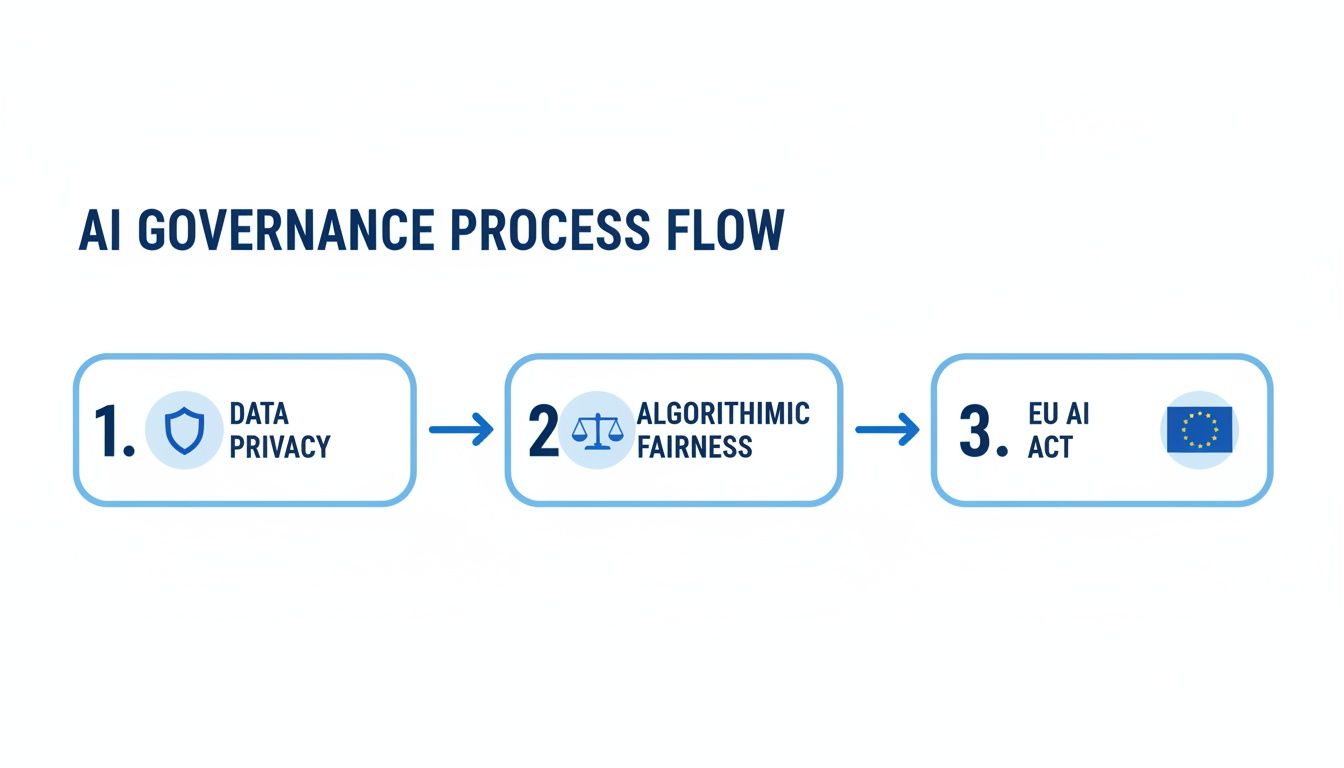
This flow underscores that a compliant AI tool has to be built on a foundation of strong governance, ensuring it operates safely and transparently within the rules you’ve established.
Defining and Measuring Success
Before you even kick off your pilot, you need to know what a win looks like. Vague goals just lead to vague results. Instead, set concrete, measurable key performance indicators (KPIs) that tie directly back to the pain point you identified.
Your success metrics should be specific and impactful. Instead of "faster audits," aim for "a 60% reduction in time spent on pre-audit evidence discovery" or "automating 100% of initial gap identification for our upcoming ISO 9001 certification."
The explosive growth of the AI governance market shows just how critical this is. The global market, valued at USD 308.3 million in 2025, is projected to hit an incredible USD 3,590.2 million by 2033. This massive jump highlights the urgent need for frameworks to manage AI responsibly, ensuring the tools you bring in can be governed, audited, and ultimately, trusted.
By following this roadmap—starting small, choosing the right tool, and defining success clearly—you can move from theory to confident action, transforming your compliance program one strategic step at a time.
How AI Speeds Up an ISO 27001 Audit
Theory is one thing, but let's look at what this actually means on the ground. Picture a mid-sized tech company—we’ll call them "Innovate Solutions"—staring down their first ISO 27001 audit. The compliance team is completely swamped. They're dealing with hundreds of documents spread across shared drives: security policies, incident response plans, access logs, and procedure manuals, all in different stages of completion.
Before AI, their audit preparation was pure manual chaos. The team would spend weeks building giant spreadsheets, painstakingly trying to map each document to specific controls in the ISO 27001 framework. If an auditor asked for evidence for control A.5.15 (Access control), it would trigger a frantic, multi-day scavenger hunt to find the exact policy document that proved they were compliant. It was slow, stressful, and easy to miss things.
This is where the story shifts. Facing another brutal audit cycle, Innovate Solutions decided to try an AI-powered compliance platform. Instead of manual sifting, they just uploaded their entire library of documentation—all their PDFs, Word docs, and text files—into the system.
From Manual Chaos to Automated Clarity
The AI agent got to work right away. In just a few minutes, it ingested and "read" every single document. This wasn't a simple keyword search. Using Natural Language Processing, the AI actually understood the context and meaning inside their dense security policies and technical procedures.
Next, the platform did the mapping automatically. It compared the content of Innovate Solutions’ documents against every single control required by ISO 27001. A task that used to take the team a month of spreadsheet hell was finished by the AI in less than an hour.
The output was an instant, comprehensive gap analysis report. But this was far from a generic checklist. For every control, the AI gave a clear "compliant" or "gap identified" status.
The real game-changer was the evidence. For each control marked as compliant, the AI generated a direct citation, pointing to the exact page, paragraph, and sentence in their own documentation that met the requirement. This "show your work" approach was the key to building trust with the auditor.
This is exactly what it looks like in practice—the AI presents its findings by clearly mapping evidence directly to compliance requirements.
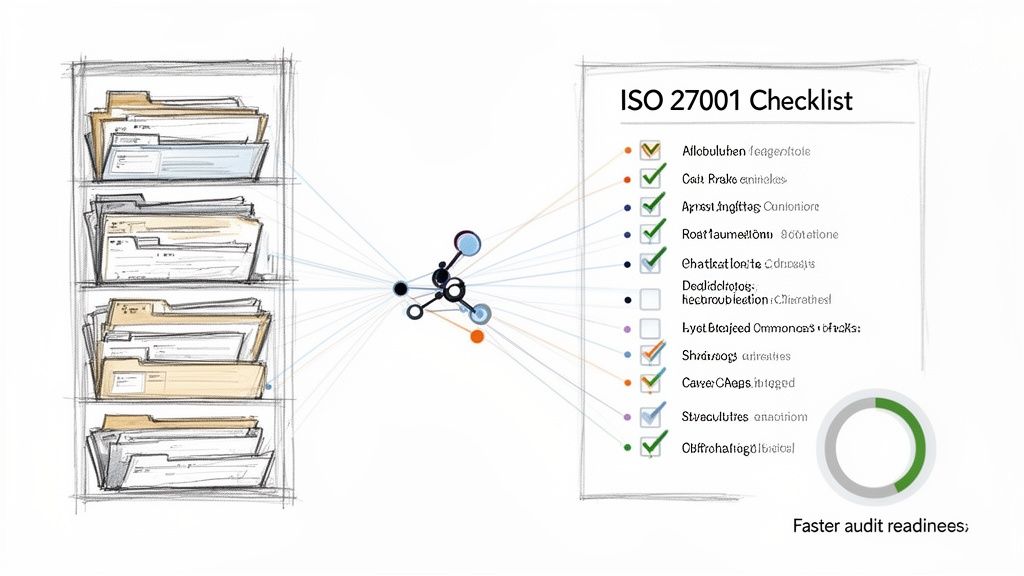
The interface makes the connection between uploaded documents and the framework’s controls immediately obvious, turning a messy manual task into a clean, verifiable report.
The Real-World Business Outcomes
The effect on Innovate Solutions' audit readiness was immediate and significant. This new approach delivered tangible results that completely changed their compliance workflow.
- A 75% Reduction in Evidence Discovery Time: Those frantic, week-long searches for evidence were gone. When the auditor asked for proof, the team could pull up the exact citation in seconds, complete with a link directly to the source document.
- A Prioritized Remediation Plan: The gap analysis didn't just point out problems; it created a focused, actionable to-do list. The team knew precisely which policies needed to be written or updated, letting them put their energy where it would have the most impact.
- A Single Source of Truth: The platform became the central hub for the entire audit. All evidence, findings, and remediation plans were in one place, accessible to the team and the auditors. This put an end to version control nightmares and made sure everyone was on the same page.
For Innovate Solutions, AI wasn't some far-off concept; it was a practical tool that solved a painful business problem. It turned their ISO 27001 audit from a dreaded fire drill into a managed, proactive process. They not only passed their audit with confidence but also built a solid foundation for staying compliant year-round.
To see how the mechanics of this work, you can dig deeper into the specifics of tech-driven ISO 27001 audits and see how they stack up against older, manual methods. This story makes the value of AI concrete by connecting the technology directly to a much better business outcome.
The Future of Smart Compliance Is Here
As we’ve seen, using AI for regulatory compliance isn't some far-off concept anymore—it's a practical tool that’s here today. We’re finally moving past the slow, error-prone reality of manual compliance work. The days of spending weeks hunting for evidence or months conducting a gap analysis are quickly coming to an end.
AI-powered tools are now delivering precise, citation-backed insights in a matter of minutes. This shift does more than just speed things up; it changes the very nature of a compliance professional's job.
By handing off the tedious, administrative tasks to AI, experts can finally focus on what people do best: thinking strategically, analyzing complex risks, and providing real business counsel. Compliance is no longer just a reactive, box-ticking exercise. It's becoming a proactive, strategic partner that builds a more resilient and trustworthy organization.
Embracing the Opportunity
It’s important to see this change as an opportunity, not a threat. The tools we’ve looked at aren’t here to replace human judgment—they’re designed to enhance it. Think of AI as a powerful assistant that does the heavy lifting of data collection and initial analysis, freeing you up to make smarter, faster decisions. The goal is to empower your team, not make it obsolete.
The real magic of AI in compliance is how it turns mountains of documents into a clear, actionable roadmap. It gives you the ability to keep up with expanding regulations without having to constantly expand your team.
This shift helps you move from frantic, last-minute audit prep to a state of continuous, year-round readiness.
Your Next Step Toward Smart Compliance
Getting started doesn't require a massive, company-wide overhaul. It’s about taking one smart, strategic step. First, pinpoint the biggest headache in your current compliance process. Is it the scramble to find evidence right before an audit? Or the mind-numbing task of mapping controls to yet another framework?
Once you’ve identified that pain point, you can look for a solution that solves it directly. For teams that want a practical way to get started with automation, a tool like AI Gap Analysis is a great entry point. It automates a critical piece of the audit puzzle and delivers immediate value without a long, complicated setup.
By taking that first step, you can begin building a smarter, more strategic, and far more effective future for compliance.
Common Questions About AI in Regulatory Compliance
Whenever you bring a new piece of technology into the fold, you’re bound to have questions. That’s especially true for something like AI for regulatory compliance. As teams start thinking about moving past manual, spreadsheet-driven processes, a few key concerns always seem to surface. Let's tackle them head-on.
How Accurate Is This Stuff, Really?
This is usually the first and most important question. The honest answer? It all comes down to how the AI was built. While no system is ever going to be 100% perfect, accuracy in compliance isn't just about finding the right answer—it’s about being able to prove how you found it. The AI has to show its work.
The best AI platforms don't operate like a mysterious black box. Instead, they build trust by providing direct citations and links right back to the source documents for every single finding. If the AI flags that a certain control is covered, it will show you the exact page and paragraph in your policy that acts as proof. This keeps a human expert in the driver's seat, allowing them to instantly verify what the AI found and ensure everything is fully auditable.
The gold standard for AI in compliance isn't just accuracy; it's transparency. A trustworthy AI makes it simple for a human to check its work, ensuring the final call always belongs to the expert.
Is AI Going to Take My Job?
Not a chance. This is a common myth that treats AI as a replacement instead of what it really is: a force multiplier for your team. Think of it less like a new hire and more like an incredibly powerful assistant for your current experts.
AI is fantastic at the grunt work that drains your team's time and energy—slogging through thousands of pages of documentation or manually matching controls to policies. It handles the low-level data gathering and analysis at a speed and scale a person just can't compete with.
By automating that work, your skilled compliance professionals are freed up to focus on what really matters:
- Tackling complex risk assessments and making strategic decisions.
- Advising the business on the real-world impact of regulatory changes.
- Handling exceptions and navigating those tricky, gray areas of compliance.
In the end, AI helps your team become more strategic, more proactive, and far more valuable to the rest of the organization.
Is It a Nightmare to Implement?
Thankfully, the days of multi-year, budget-breaking software projects are mostly behind us. Modern cloud-based platforms are built from the ground up to be simple and fast to get going. The goal is to get you results, not a new IT headache.
Getting started is often as easy as securely connecting to the document repositories you already use (like Google Drive) or just uploading your policy files. You don't need a massive IT project or months of configuration. Most teams can start seeing real, tangible insights within hours or days, not months, making the switch to an automated workflow surprisingly painless.
Ready to see how AI can completely change your audit preparation without the implementation pain? AI Gap Analysis automates evidence-ready gap assessments, turning your mountain of documents into actionable, audit-ready insights in minutes. Discover a smarter way to manage compliance at https://ai-gap-analysis.com.