February 10, 2026
automate regulatory compliancecompliance automationaudit readinessregtech solutionsISO 27001
Automate Regulatory Compliance: Practical Steps to Faster Audits
Discover practical AI-driven strategies to automate regulatory compliance and pass audits faster with less stress.
18 min readAI Gap Analysis
Staying on top of complex regulations like ISO 27001 can feel like a never-ending battle. For most teams, it means countless hours digging through disorganized documents, hunting for the exact sentence that proves compliance.
When we talk about automating regulatory compliance, we're talking about swapping that chaotic, manual scavenger hunt for smart systems. These systems can find, map, and manage your compliance evidence for you, turning the whole process from a periodic fire drill into a state of continuous, calm audit readiness.
Why Automating Regulatory Compliance Is No Longer Optional
For many GRC and quality teams, audit prep is a recurring nightmare. The cycle is painfully familiar: a mad dash through hundreds—or even thousands—of PDFs, Word docs, and spreadsheets. This evidence is usually scattered across SharePoint, Google Drive, and various local servers, making the search even harder.
This manual hunt for a specific clause or paragraph that proves you're meeting a control isn't just inefficient; it's incredibly high-risk. It’s a recipe for human error and team burnout.
Imagine this: an auditor asks for proof of your data backup policy. You know it exists somewhere, but pinpointing the exact document and page number can burn hours, if not days. This reactive, document-centric approach is simply broken, especially as regulatory demands get more and more complex.
Here's a quick look at how the old, manual way stacks up against a modern, automated workflow.
Manual Vs Automated Compliance Workflows
| Activity | Manual Approach (The Old Way) | Automated Approach (The New Way) |
|---|---|---|
| Evidence Collection | Manually searching through documents, emails, and shared drives. | AI automatically scans and extracts relevant evidence from connected sources. |
| Control Mapping | Tediously copying and pasting text into spreadsheets to link evidence to controls. | System intelligently maps evidence to multiple controls across different frameworks. |
| Gap Analysis | Relying on human review to spot missing or outdated evidence. Often done infrequently. | Continuous, real-time detection of compliance gaps with automated alerts. |
| Reporting | Spending days or weeks compiling reports by hand for audits or leadership. | Generating audit-ready reports with a single click. |
| Maintenance | A massive effort before each audit cycle; often out-of-date in between. | Always-on monitoring ensures a state of "continuous compliance." |
The table makes it clear: sticking with manual processes is like trying to win a race on foot while your competitors are in cars. It’s not just slower—it’s a completely different game.
The True Cost of Manual Compliance
The pain of doing things by hand goes way beyond just wasted time. It introduces serious business risks and operational drag that can hold back growth and leave your company vulnerable to big penalties.
The real costs are steeper than you think:
- High Risk of Non-Compliance: When you have people sifting through mountains of data, mistakes are bound to happen. One missed piece of evidence can easily lead to a negative audit finding, expensive fixes, or hefty fines.
- Inability to Scale: As your company grows and moves into new markets, the list of regulations you have to follow gets longer. Manual processes just can't keep up. You hit a compliance bottleneck that stifles progress.
- Wasted Expertise: Your most valuable compliance pros end up buried in low-level admin work—searching and copying—instead of focusing on high-impact strategic risk management. A complete waste of talent.
The fundamental problem with manual compliance is that it treats evidence as something you find right before an audit. Automation completely flips that. It treats evidence as an asset you manage continuously, so you’re always prepared.
This shift in thinking is exactly why the market is exploding. Projections show the Regulatory Compliance Automation Tools market is set to grow from $10.6 billion in 2025 to a massive $25.3 billion by 2033. It's a clear signal that the old way of managing a compliance program is on its way out.
Laying The Groundwork For Successful Automation
Before you can even think about automating compliance, you have to get a painfully honest look at where you stand right now. I’ve seen too many teams jump straight into buying a shiny new tool, hoping it will magically solve their problems. That approach is like trying to build a house without a blueprint—it’s guaranteed to fail. The first move isn’t about technology; it’s about a frank self-assessment.
Start by digging into the real pain points. Where are your people burning the most hours? Is it manually pulling screenshots for evidence? Chasing down signatures for SOP updates? Pinpoint the tasks most susceptible to human error. When you document these bottlenecks, you’re not just complaining; you’re building a rock-solid business case for automation and figuring out where to aim your efforts for the biggest and fastest win.
This diagram perfectly captures the shift from the chaotic, fire-drill-driven world of manual compliance to the calm of streamlined, audit-ready automation.
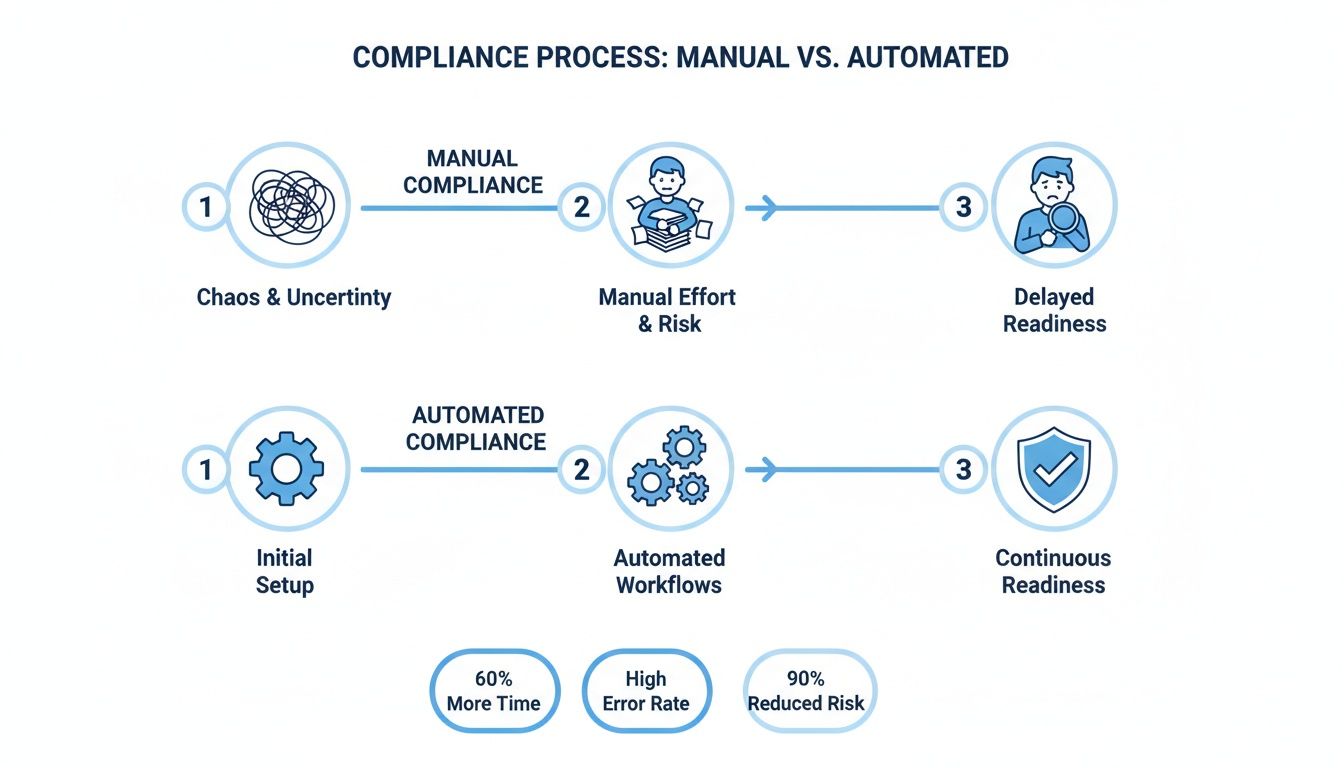
The real goal here isn't just about moving faster. It's about swapping out unpredictable manual labor for a structured, repeatable system that produces trustworthy results every single time. That’s what being "audit-ready" truly means.
Map Your Data Sources And Frameworks
Your compliance evidence is probably scattered everywhere. It's a critical, and often overlooked, step to figure out exactly where everything lives. Are your Standard Operating Procedures (SOPs) gathering digital dust in an old SharePoint site? Is your Quality Management System (QMS) a maze of folders in Google Drive?
Take the time to create a simple inventory of every single data source. This map becomes your guide when you start configuring an automation platform to pull in the right information. If you miss a key document repository, you're creating massive blind spots in your compliance posture right from the start.
Once you know where your data is, you need to decide which regulations to tackle first. It’s tempting to try and do everything at once, but a phased approach is infinitely more practical and less likely to burn out your team.
- Go After High-Stakes Frameworks: Start with the regulations that matter most. For a medical device company, that’s probably ISO 13485. For a B2B SaaS platform, it’s likely ISO 27001. Focus on where non-compliance has the most severe consequences.
- Find the Overlap: Many frameworks have shared requirements, like access control or risk management. Nailing one often gives you a huge head start on another, which is a great way to show quick wins and build momentum.
- Check the Calendar: If you have an audit for a specific standard coming up in six months, well, the decision has been made for you. That's your clear starting point.
Don't try to boil the ocean. A winning strategy is to pick one or two critical frameworks, get the automation process humming, and then expand. This approach builds confidence and gets crucial buy-in from leadership.
A Real-World Example
Let's imagine a medical device startup drowning in documentation for their Design History Files (DHFs). Evidence is a mess, spread across a half-dozen different systems, and auditors are constantly pointing out gaps in traceability between design inputs and outputs.
For this company, laying the groundwork looks like this:
- Identify the Core Problem: The real pain is the hundreds of hours spent manually assembling DHF packages and the constant fear of failing a critical FDA or ISO 13485 audit.
- Map the Data Silos: They discover key evidence lives in Confluence (for user requirements), Google Drive (for test plans), and an ancient on-premise file server (for risk analysis documents).
- Choose the First Target: They wisely decide to focus exclusively on ISO 13485, homing in on the specific clauses related to design and development controls.
This isn’t a shotgun approach; it's a targeted strike. By building this solid foundation, the company has set itself up for a much smoother transition, ensuring their first automation project solves a costly, high-stakes problem and delivers immediate value.
Unlocking Your Data: AI-Powered Evidence Extraction and Mapping
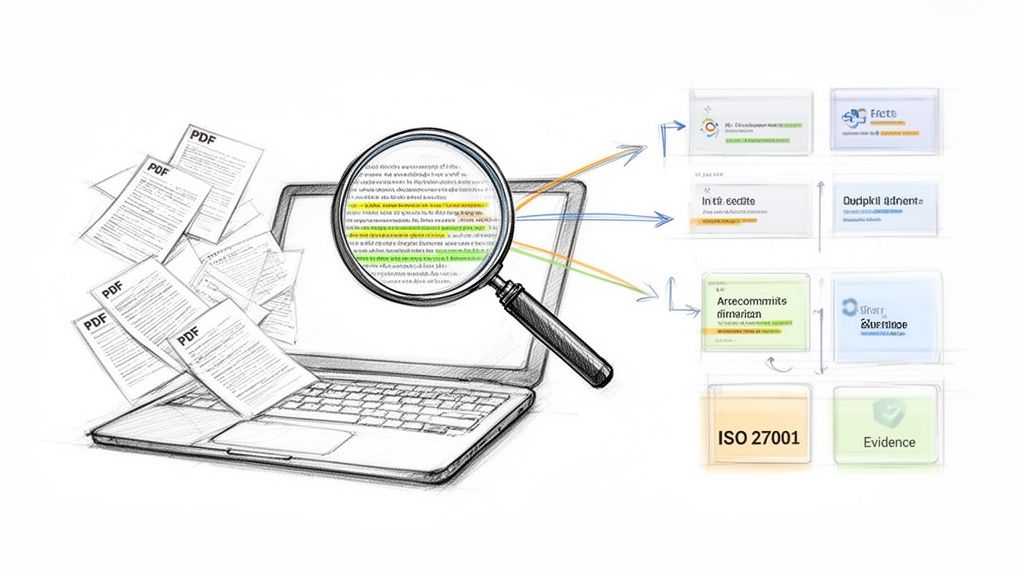
This is where the real magic happens. With a solid foundation in place, it’s time to let the AI loose on your mountains of documentation. Modern compliance platforms are built to handle enormous volumes of unstructured data—all those SOPs, security policies, and technical manuals that used to require countless hours of human review.
Instead of your team manually sifting through thousands of pages, the AI takes over the heavy lifting. It’s not just doing a simple keyword search; it’s using natural language processing (NLP) to genuinely understand the context and intent behind the words in your documents. This is what turns a chaotic mess of files into a structured, searchable library of compliance evidence.
The true breakthrough is the AI's ability to connect the dots. The system doesn't just find relevant text; it maps specific sentences and paragraphs directly to the controls in your chosen frameworks, whether that's ISO 27001, ISO 13485, or something else entirely.
Turning Unstructured Data into Audit-Ready Evidence
Let's walk through a real-world scenario. You're gearing up for an ISO 27001 audit, and the auditor asks for proof that you're complying with control A.9.2.3, which deals with access to source code. In a traditional setup, this question would kick off a mad scramble through document repositories, wikis, and old emails.
With an automated system, the experience is completely different. The AI has already digested your software development lifecycle policy, your access control logs, and your developer onboarding checklists. It instantly links a specific sentence from your policy—like, "Access to the production source code repository is restricted to senior engineering staff via role-based access control"—directly to that ISO control.
This isn't just a vague reference; it's a precise, defensible link.
- Pinpoint Citations: The AI provides a direct link to the exact page and paragraph in the original document, so there's no guesswork.
- Contextual Intelligence: It understands that "source code repository" and "role-based access control" are exactly what the auditor is looking for.
- Multi-Framework Efficiency: Better yet, that single piece of evidence might also satisfy controls in other frameworks you're tracking, like SOC 2. The system automatically makes that connection, too.
This powerful capability is what’s fueling the massive growth in the compliance software market. Projections show the industry is set to explode from USD 40.82 billion in 2026 to USD 74.12 billion by 2031. It’s no surprise that healthcare is leading the way, given its complex web of privacy and data management regulations. You can find more details on this trend in the Compliance Software Market report on mordorintelligence.com.
Calibrating the AI for Pinpoint Accuracy
An AI is a powerful tool, but it's only as smart as the instructions it's given. Getting high-quality results means you need to configure the system with care. This isn't a "set it and forget it" solution; it needs your expertise to align it with your company's unique landscape.
First, you have to define the "scope" for the AI. Tell it exactly where to look—point it to the specific SharePoint sites, Google Drive folders, or Confluence spaces that hold your compliance documentation. Just as importantly, tell it what to ignore. Excluding irrelevant folders, like marketing assets or old drafts, is crucial for preventing the AI from pulling in junk data and cluttering your results.
Pro Tip: Start small. Point the AI at a limited, well-organized set of your best documents first. Use this initial run to calibrate its understanding and double-check its mappings. This iterative approach is the best way to build trust in the system's outputs.
You'll also need to fine-tune the system by teaching it your company’s internal lingo. For example, if your team always refers to "incident response plans" as "IRPs," you can configure the AI to recognize those terms as synonyms. This small step can dramatically improve the accuracy of the evidence it finds. The goal is to create a system that thinks and speaks like one of your own compliance experts. For more on this, check out our guide on how businesses are using AI for regulatory compliance.
Setting Up Automated Gap Detection and Remediation Workflows
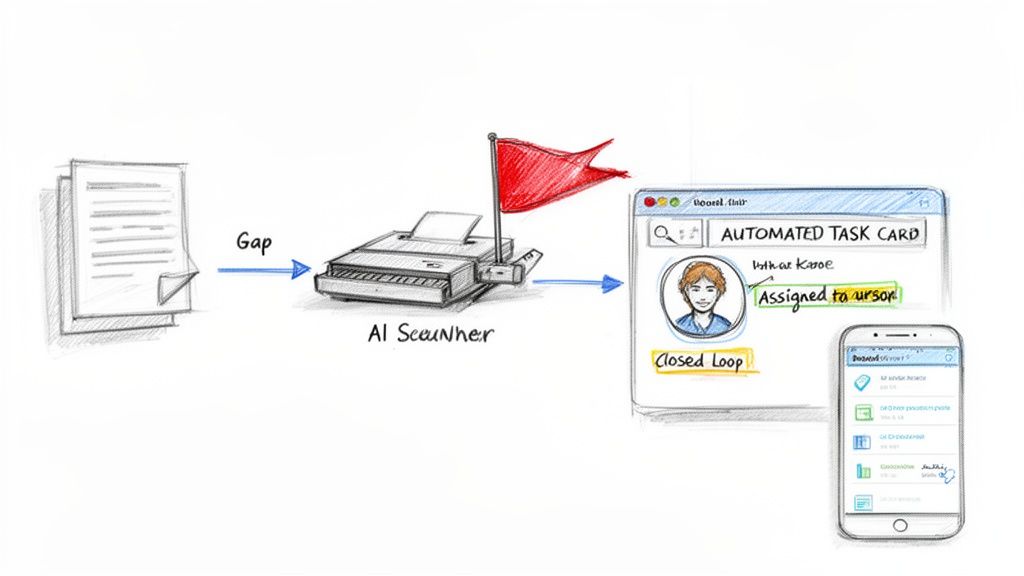
Once your evidence is mapped to controls, the real magic begins: instant, automated gap detection. This isn't just an improvement; it's a fundamental shift in how compliance is managed. Forget about those stressful, last-minute manual spot-checks. Now, you can build a system that constantly keeps an eye on your compliance posture.
The objective here is to get out of reactive mode—scrambling when an auditor finds something—and into a proactive state. You want the system to tell you something's wrong the moment it happens. This is where you define the rules of the game for what "compliant" actually looks like in your organization, forming the backbone of your efforts to automate regulatory compliance.
Configuring Rules for Automated Gap Detection
Think of these rules as your tireless digital compliance team, working around the clock. Their job is to catch the specific problems that would otherwise slip through the cracks until audit season. The system uses these rules to continuously scan your mapped evidence and immediately highlight anything that doesn't measure up.
You can get quite granular with the rules you set up to flag different kinds of gaps:
- Missing Evidence: This is the most straightforward check. The system can verify whether a required control, like ISO 27001’s A.5.15 on access control, has any evidence associated with it. If there's nothing there, it's an instant red flag.
- Outdated Evidence: By tapping into document metadata, you can set rules to catch stale information. A common one is to flag any policy or procedure that hasn't been reviewed or updated in the last 12 months.
- Insufficient Evidence: This one requires a bit more nuance. For a critical control, you might decide that one piece of evidence isn't enough. You can create a rule requiring both a policy document and a technical configuration screenshot to consider the control fully addressed.
This kind of systematic, automated monitoring is precisely why the Regulatory Compliance Management Software market is projected to grow from $12.41 billion in 2025 to $13.79 billion in 2026. Companies are realizing they need this capability to keep up.
Creating a Closed-Loop Remediation System
Identifying a gap is great, but fixing it is what actually matters. The most sophisticated automation platforms don't just point out problems—they help you solve them. They do this by creating a closed-loop system that integrates directly with the project management and ticketing tools your teams already use. This is how you bridge the gap between detection and action.
Let’s say the AI finds that your Business Continuity Plan is over a year old, which violates an internal policy. Instead of that finding getting buried in a static report, a properly configured system can automatically:
- Generate a Task: It instantly creates a ticket in a tool like Jira, Asana, or ServiceNow.
- Assign the Owner: The ticket is assigned directly to the person responsible for that policy—for instance, the Head of IT.
- Provide Context: The ticket is pre-filled with all the important details: the exact gap, the specific control it violates, and a direct link to the old document.
This closed-loop workflow transforms your compliance program from a passive monitoring system into an active, self-correcting engine. It eliminates the communication breakdown where a finding gets lost in an email or a spreadsheet, ensuring accountability and a clear audit trail for every single remediation effort.
This level of integration is what turns insights into real-world improvements. A top-tier compliance assessment software shouldn't just find issues; it should kickstart the process of resolving them, making continuous improvement a natural part of how you operate.
Achieving Continuous Audit Readiness
Getting your automation up and running is a huge win, but it’s not the end of the road. The real goal isn't just to scrape through your next audit—it's to live in a state of continuous audit readiness, where you're prepared for an inspection at a moment's notice. This final phase is all about maintaining the system you’ve built and refining the partnership between human expertise and machine efficiency.
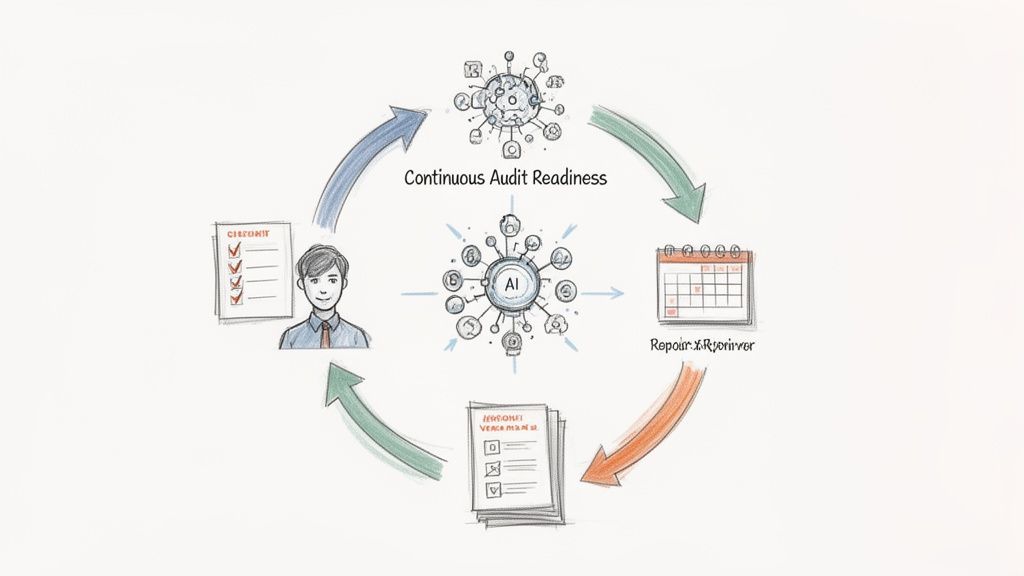
Automation doesn't make your compliance experts obsolete; it makes them more valuable. It fundamentally changes their job. They're no longer digital archaeologists, spending their days digging for evidence. Instead, they become strategic reviewers, validating the AI's findings and applying critical judgment where it matters most. This "human-in-the-loop" approach is absolutely essential for long-term success.
The Human-in-the-Loop Validation Process
The AI handles the grunt work, but you need human oversight to confirm that its outputs are not just correct, but contextually sound. Setting up clear checkpoints for this review is how you build a system you can truly trust. It's where your team’s deep institutional knowledge becomes a force multiplier for the technology.
Here’s a practical way to structure this validation workflow:
- Review AI-Generated Mappings: Your compliance managers should hold regular sessions to spot-check the evidence that the AI has mapped to specific controls. The key question they need to ask is, "Does this piece of evidence really satisfy the spirit of this control?"
- Validate Gap Severity: When the system flags a gap, an expert needs to assess its actual risk. An outdated policy might be a low-priority fix, but a missing security control on a critical system is an all-hands-on-deck situation that needs immediate escalation.
- Approve Remediation Plans: A ticket shouldn't be closed until a compliance lead signs off on the fix. This confirms the corrective action has fully resolved the initial gap, not just patched it over.
This structured review process ensures your efforts to automate regulatory compliance are guided by expert human judgment, combining the speed of machines with the wisdom of experience.
Generating On-Demand Reports and Maintaining Control
One of the best payoffs from a well-oiled automated system is the ability to generate detailed compliance reports with a few clicks. Auditors love this. It completely changes the dynamic of an audit from an adversarial interrogation into a collaborative review.
The real power of compliance automation isn't just finding evidence faster; it's the ability to prove your compliance posture instantly, on-demand, with a clear and verifiable audit trail for every single control.
To stay audit-ready, you also have to get serious about document management. Version control is non-negotiable. When a policy is updated, the automation platform must immediately ingest the new version, re-evaluate its evidence links, and properly archive the old one. This simple practice prevents the nightmare scenario of presenting outdated evidence to an auditor.
Common Pitfalls to Avoid
Even the most sophisticated systems can stumble if you’re not careful. I’ve seen companies invest heavily in automation only to have it undermined by simple mistakes. Keep an eye out for these common traps:
- Scope Creep: You add a new document repository (like a new SharePoint site or Confluence space) but forget to add it to the AI's scope, creating a massive blind spot.
- Stale Configurations: Team members change roles, but nobody updates the system's rules or user assignments, leading to alerts going to the wrong people or being missed entirely.
- Ignoring the Dashboard: Treating the system as a "set it and forget it" tool is a recipe for disaster. If no one is actively monitoring the compliance dashboard, you won't see problems until it's too late.
By actively managing your system and fully embracing the human-in-the-loop model, you can transform compliance from a series of high-stress fire drills into a calm, continuous, and integrated part of how you do business.
Got Questions About Compliance Automation? We've Got Answers.
As teams start looking into automating their compliance work, a lot of practical questions pop up. It’s a big jump to go from a world of spreadsheets and manual evidence gathering to a more automated, tech-forward approach. Let's tackle some of the most common questions we hear from people in the trenches.
How Much Babysitting Does This "Automation" Actually Need?
This is probably the number one question, and for good reason. While the tools are incredibly powerful, they don't replace your compliance experts—they just make them better at their jobs. Think of it as a "human-in-the-loop" model.
The AI is a workhorse. It can sift through thousands of documents, policies, and system logs in minutes, flagging potential evidence and suggesting connections to specific controls. But it can't understand intent or context the way a person can.
Your compliance pros are still the final arbiters. Their job shifts from being document-hunters to strategic reviewers. They're the ones who look at the evidence the AI has found and make the final call: "Yes, this procedure document genuinely satisfies the requirement for ISO 27001 control A.12.1.2." The machine finds the needle in the haystack; your expert confirms it's the right one.
What If We Use Custom or Niche Frameworks?
Absolutely. Most modern compliance automation platforms are built for flexibility. They’ll come with the big ones like ISO 27001, SOC 2, or HIPAA baked in, but the really good ones let you upload your own custom control libraries. This is a must-have feature if you're in a specialized industry or have developed your own internal governance frameworks over the years.
The AI doesn't really care where the controls came from. It's trained to understand language and map evidence to requirements. As long as you can feed it your framework, the system can get to work mapping your internal documents against it. This is what turns a generic tool into something that feels custom-built for your business.
The ability to bring your own frameworks to the table is a game-changer. It means the tool bends to your business reality, not the other way around. This ensures you have a solution that can grow with you as your compliance needs evolve.
What's the Real ROI Here? Is It Worth It?
The return on investment for compliance automation is huge, and it usually breaks down into three key areas. Getting a handle on these makes it much easier to build the business case.
-
Massive Time Savings: This is the most obvious and immediate win. We're talking about a dramatic drop in the sheer number of hours your team spends on manual, repetitive work. Teams often report saving hundreds of hours that were once lost to audit prep, digging for evidence, and building reports from scratch.
-
Dramatically Lower Risk: Automation just plain reduces mistakes. When evidence is continuously monitored, kept current, and mapped correctly, you slash the risk of a failed audit. This means avoiding hefty fines, operational disruptions, and the brand damage that comes with compliance failures.
-
Faster, More Confident Growth: This benefit is less about cost-cutting and more about enabling the business. With compliance running smoothly in the background, your organization can move faster. You can confidently pursue new certifications to enter new markets or respond to changing regulations without missing a beat. For most companies, the time savings and risk reduction alone are more than enough to justify the investment.
Ready to stop chasing documents and start building a state of continuous compliance? AI Gap Analysis uses AI to read your documents, map evidence to controls, and instantly highlight gaps, turning months of audit prep into a matter of hours.
Discover how AI Gap Analysis can transform your compliance workflow.