January 27, 2026
compliance assessment softwareGRC softwareaudit automationISO 27001 compliancerisk management
Compliance assessment software: Streamline audits and reduce risk
Learn how compliance assessment software simplifies audits, lowers risk, and helps you choose the right solution for your team.
21 min readAI Gap Analysis
Let's be real: trying to manage compliance with spreadsheets is like trying to build a house with nothing but duct tape. It's a chaotic mess of endless documents, manually tracking evidence across scattered files, and painstakingly mapping policies to dense frameworks like ISO 27001 or SOC 2.
This manual approach isn't just inefficient; it's a huge business risk. A single misplaced file or an outdated spreadsheet row can derail an entire audit, leading to painful delays, frustrated teams, and potential fines for non-compliance.
This is precisely where compliance assessment software comes in. Think of it as your command center for compliance, turning that reactive, paper-chasing scramble into a proactive, organized strategy. Instead of digging through shared drives for a specific policy from last quarter, the software keeps all your evidence in one secure, easily searchable place.
From Spreadsheet Hell to a Central Hub
Imagine trying to piece together a 1,000-piece puzzle when all the pieces are scattered across different rooms in your house. That’s what manual compliance feels like. You’ve got policies in one folder, risk assessments in another, and employee training logs buried in someone's inbox.
Compliance software brings all those puzzle pieces to one table, giving you a crystal-clear picture of your compliance posture. The immediate wins from this centralized approach are huge:
- A Single Source of Truth: This puts an end to version control nightmares. Everyone on your team is working from the same, most current documents—period.
- Find Evidence in Seconds: When an auditor asks for proof, you can pull up the exact file in seconds, not hours.
- See Everything at a Glance: Dashboards give you a real-time view of your progress against multiple frameworks, instantly flagging gaps and areas that need work.
The real magic of compliance software is its ability to build an organized, defensible audit trail. It automatically links every piece of evidence back to the specific control it satisfies, taking the guesswork and manual grind out of audit prep.
This guide will give you a clear roadmap to understanding this technology, from its core features to the real ROI it can deliver. We’ll even provide a checklist for picking the right platform and walk through workflows that show how it all works in the real world. To get a better handle on the basics, check out our guide on compliance and risk assessment, which covers how these two critical functions work together.
The goal is simple: to get your team out of reactive chaos and into a state of strategic control.
What to Expect From Modern Compliance Software
So, what really sets a powerful compliance tool apart from a glorified spreadsheet? It boils down to a handful of core features designed to take the manual grunt work off your plate, bring clarity to a complex process, and build an audit trail that can withstand scrutiny.
These aren't just bells and whistles. Each feature is built to solve a specific, nagging problem that anyone who has managed compliance manually knows all too well—think version control nightmares, endless email chains, and the frantic pre-audit scramble for evidence.
This is the chaos most teams are trying to escape: a tangled mess of spreadsheets, disconnected files, and zero visibility.
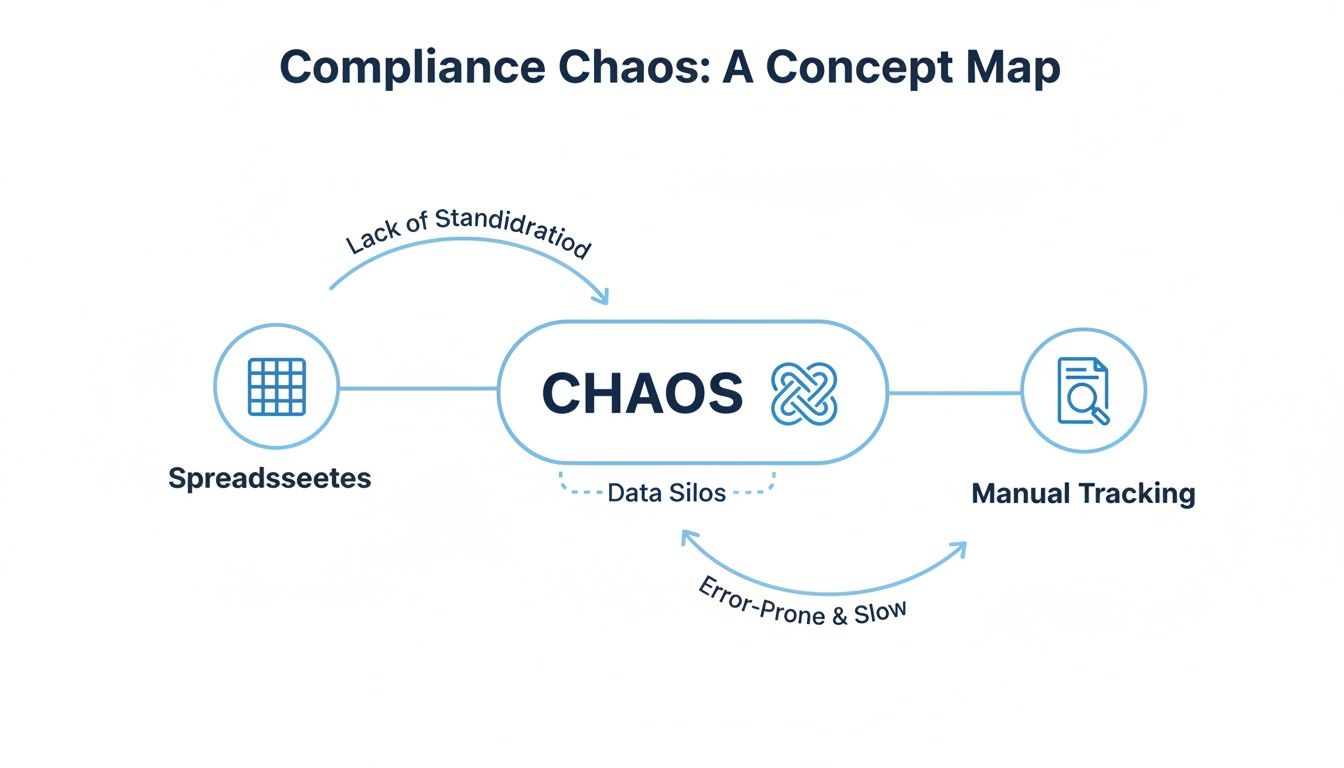
Without a central system, you're left with data silos that make it nearly impossible to maintain a single, reliable source of truth for your compliance status.
Automated Evidence Collection and Linking
Think of this feature as your own digital librarian. Instead of you manually digging through shared drives, email threads, and local folders for a specific policy or report, the software does the heavy lifting of organizing everything for you.
You can upload all your critical documents—policies, procedures, risk assessments, screenshots—into one central repository. From there, the magic happens: the platform links each piece of evidence directly to the specific compliance control it satisfies.
When an auditor asks for proof of your incident response plan, there's no frantic search. You just click the control, and the linked evidence is right there. It creates an airtight, verifiable audit trail that’s always ready.
Multi-Framework Control Mapping
Here’s a huge one. Many businesses today aren't just juggling one standard; they're dealing with ISO 27001, SOC 2, GDPR, HIPAA, and more. Managing this manually means doing the same work over and over again, since many of these frameworks have overlapping requirements.
A core function of good compliance assessment software is its ability to map a single piece of evidence to multiple frameworks at once. This is the "assess once, apply everywhere" principle brought to life.
For example, that one data encryption policy you wrote can satisfy requirements across ISO 27001, HIPAA, and GDPR. The software connects that single document to all the relevant controls, saving you dozens of hours and killing redundant work.
This intelligent mapping keeps everything consistent and drastically cuts down on the administrative headache of managing a complex web of regulations.
Real-Time Collaboration and Task Management
Compliance is absolutely a team sport, but trying to manage it with spreadsheets and email chains feels more like a frustrating, disconnected game of telephone. A must-have feature is a built-in collaborative workspace.
This changes everything, allowing teams to:
- Assign ownership directly: Tag the right person to fix a specific gap or upload a missing piece of evidence, right within the platform.
- Communicate in context: Leave comments and ask questions directly on a control or document. All communication stays organized and visible, not lost in an inbox.
- Track everything with dashboards: Anyone, from the compliance manager to the C-suite, can get a real-time view of progress, outstanding tasks, and the company's overall compliance posture.
This central hub puts an end to the confusion of "which version is the latest?" and "who's handling this?"
Seamless Integrations with Your Existing Tech Stack
Your compliance evidence doesn't live in a bubble. It’s scattered across cloud storage, project management tools, code repositories, and other systems. Good compliance software meets you where you are, integrating with the tools your team already relies on.
For instance, an integration with Google Drive or Dropbox can automatically sync your policies and procedures, ensuring the platform always has the most current versions. This eliminates manual uploads and, more importantly, reduces the risk of using outdated documents during an audit. These integrations are bridges, not barriers, connecting your compliance program directly to its sources of truth.
The demand for these connected, efficient solutions is only growing. The compliance management software market is projected to hit USD 70.69 billion by 2032, largely because 69% of organizations are struggling to keep up with regulatory complexity.
To see a direct comparison of the old way versus the new, check out the table below.
Manual Compliance vs. Compliance Assessment Software
This table breaks down how specific compliance tasks are transformed when you move from manual methods to a dedicated software solution. The difference in efficiency and risk reduction is stark.
| Compliance Task | Manual Approach (Spreadsheets & Email) | Automated Approach (Compliance Software) |
|---|---|---|
| Evidence Gathering | Manually searching shared drives, emails, and local files. Prone to version control errors. | Centralized repository with direct links from evidence to controls. Automated reminders. |
| Framework Management | Separate spreadsheets for each framework (e.g., ISO, SOC 2). Massive duplication of effort. | "Assess once, apply many." A single piece of evidence is mapped to multiple frameworks. |
| Team Collaboration | Disconnected communication via email and chat. No clear audit trail of conversations. | In-platform comments, task assignments, and notifications. All history is tracked. |
| Reporting & Visibility | Manually compiling status reports. Data is often outdated by the time it's shared. | Real-time dashboards showing compliance posture, gaps, and task progress. |
| Audit Preparation | A frantic, last-minute fire drill to collect and organize documentation for auditors. | "Always audit-ready." Auditors can be granted read-only access to a complete, organized package. |
Moving to a software-based approach isn't just about saving time; it's about building a more resilient, transparent, and defensible compliance program.
The right features don't just make compliance easier—they fundamentally change how the work gets done, shifting your team from reactive firefighters to proactive managers. To see how this gets even more powerful, check out our article on using AI for regulatory compliance.
The Real-World ROI of Automating Compliance
Let's be honest: buying new software often feels like just another expense. But when it comes to compliance assessment software, it’s not an expense—it's an investment. This isn't about adding a shiny new tool to your collection; it's a strategic move that pays for itself by turning compliance from a dreaded cost center into a source of business strength.
The most obvious win is getting your team out of the evidence-hunting business. Think about all the time wasted digging through emails, chasing down policy documents, and trying to make sense of a dozen different spreadsheets. That’s not just tedious; it's expensive, low-value work.
When you automate the grunt work, you free up your sharpest minds to focus on what actually matters—strengthening security, improving processes, and looking ahead. Instead of spending weeks just getting ready for an audit, they can use that time to make the business better. That's a direct swap of administrative busywork for high-impact results.
Slashing Costs and Boosting Efficiency
The numbers here don't lie. A manual audit preparation cycle can easily suck up hundreds of hours, pulling in people from IT, HR, and legal. By putting all your evidence in one place and automating the reporting, good compliance software can slash that prep time by up to 75%.
Here’s what that looks like in the real world:
- Manual Audit: A team of four people might spend a combined 160 hours getting ready for an ISO 27001 audit.
- Automated Audit: With a proper platform, that same task might only take 40 hours.
That’s 120 hours of expert time reclaimed from a single audit. Now, multiply that by all the frameworks you manage and how often you get audited. The savings add up fast and hit your bottom line directly.
The real financial victory isn't just about the time saved; it's about what you do with that reclaimed time. Your experts stop being expensive document librarians and become the strategic advisors they were hired to be.
Minimizing Risk and Building a Defensible Position
Beyond the time and money, there’s the enormous, sometimes hidden, value of reducing risk. No matter how careful your team is, manual processes are magnets for human error. One forgotten control or an outdated policy document is all it takes to fail an audit, leading to painful remediation, a hit to your reputation, or even hefty fines.
Compliance assessment software builds a rock-solid, defensible trail of everything you do. Every policy upload, every control test, and every task assignment is logged and timestamped. This systematic approach closes the gaps and inconsistencies that auditors love to find in manual systems.
Ultimately, this gives everyone—from your auditors to your board—real confidence in your compliance program. It’s not just about surviving the next audit. It's about building an organization that is always ready, proving your commitment to security and quality. This isn't just good defense; it's a competitive advantage that helps you win new business and build trust with the customers you already have.
How to Choose the Right Compliance Software
Picking the right compliance assessment software isn't just about buying a new tool. Think of it as bringing on a specialist to join your team—one who will be central to your entire compliance strategy. The market is crowded, but the best platform for your company is the one that fits your specific frameworks, the way your team actually works, and where you want to go in the future. It’s about cutting through the marketing noise to find the core functions that will genuinely make your life easier come audit time.
Your evaluation needs a plan. Treat it like you’re hiring for a critical role. You have to check its qualifications (does it support your frameworks?), test its skills (is it easy to use?), and look at its references (how well does it play with your other tools?). A structured approach like this ensures you're investing in a solution that solves problems, not one that creates them.
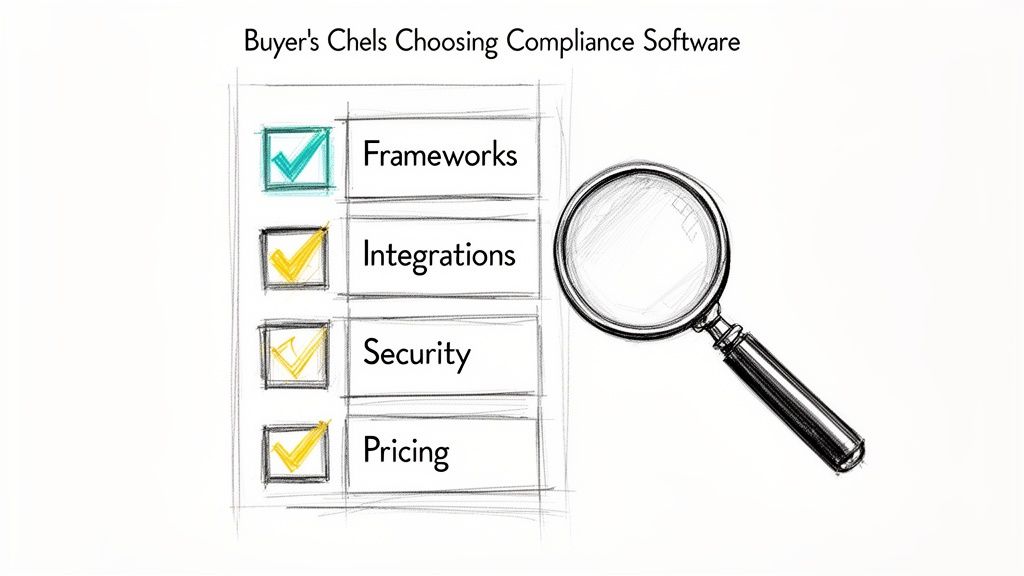
Confirm Framework and Industry Support
This is your first, non-negotiable checkpoint. Does the software actually support the standards you have to live by? A platform that’s fantastic for ISO 27001 might be a terrible fit for a medical device company wrestling with ISO 13485 or HIPAA.
Don’t just take a logo on their website as proof. You need to dig in with some pointed questions:
- Does it come with pre-built templates for our frameworks? This feature alone can save you hundreds of hours of setup.
- How does it handle multiple frameworks? The ability to map a single piece of evidence to controls across several different standards is a massive time-saver.
- Does the platform keep up with evolving standards? Frameworks don't stay static. Your software needs to evolve with them so you're not left scrambling.
This is especially true in fast-moving industries. For example, the global healthcare compliance software market is expected to hit about USD 13.18 billion by 2035, driven by the intense pressure to manage complex rules in areas like medical devices. You can read more about the growth drivers in healthcare compliance software.
Prioritize Usability and a Clean Interface
Let’s be honest: if the software is a pain to use, your team will find a way not to use it. A clean, intuitive interface isn't just a nice feature; it’s absolutely essential for getting everyone on board. The whole point is to make compliance less complicated, not to add another confusing system to the mix.
A great user experience in compliance software means your team can find what they need in three clicks or less. If you need a manual just to figure out how to upload a document, it’s a red flag.
When you're getting a demo, focus on how the platform handles simple, everyday tasks. Can you easily assign a control to a team member? Is it obvious how to leave comments and collaborate? The best test is to ask them to walk through a real-world scenario with your own documents, not their perfectly polished sales pitch.
Scrutinize Integrations and Security
Your compliance platform should slide right into your existing tech stack, not force you to build awkward workarounds. Look for native integrations with the tools your team lives in every day—things like Google Drive, Dropbox, Jira, or Slack. These connections automate how evidence is collected and cut down on the mind-numbing work of manually uploading files.
Just as important is the vendor’s own security. You're about to hand over some of your company's most sensitive information, so their security had better be rock-solid.
Don't be shy about asking for their credentials:
- Are they SOC 2 Type 2 certified?
- Do they have an ISO 27001 certification?
- What are their policies for data encryption and backups?
Never assume a vendor is secure. A company that is open and transparent about its security practices is one you can trust with your critical compliance data. By methodically working through these criteria, you can confidently select the compliance assessment software that will serve as a genuine asset to your organization.
A Step-By-Step Software Implementation Guide
Picking the right compliance assessment software is a huge win, but how you roll it out is what truly makes or breaks its value. A smooth implementation weaves the new tool into your daily operations. A chaotic one just creates headaches and empty dashboards. This guide lays out a clear roadmap to get your team up and running, so you can start seeing a real return on your investment from day one.
The real work doesn't start with the install button. It begins with solid planning and getting the right people on board. This first phase is all about creating a shared vision for what success looks like and setting expectations for everyone involved.
Phase 1: Initial Planning and Stakeholder Alignment
First things first: assemble your implementation team. This isn’t just an IT project. Your core group should include the compliance manager, a key IT contact, and people from the departments who will actually be supplying the evidence—think HR, engineering, or legal. Getting their buy-in early on prevents pushback down the road and makes sure the setup actually fits how your company operates.
Next, define what you need to accomplish right now. Are you laser-focused on an upcoming ISO 27001 audit? Or are you trying to wrangle multiple frameworks at once? Nailing down your immediate priority helps you configure the software methodically instead of getting overwhelmed by trying to do everything at once.
The single biggest pitfall in any software rollout is a lack of clear ownership and communication. Designate a single project lead who is responsible for the timeline and for keeping all stakeholders informed of progress and potential roadblocks.
Phase 2: Data Migration and Framework Configuration
With a solid plan, it’s time to get your existing compliance documents into the system. This used to be a painful, manual process, but modern SaaS platforms have made it much, much easier.
Here’s what this stage typically looks like:
- Connect Your Sources: Start by linking the software to your cloud storage—like Google Drive or Dropbox—to pull in policies, procedures, and risk assessments. This skips hours of tedious uploads.
- Organize Your Evidence: Don't just dump everything in. Create a logical folder structure inside the platform. Try grouping documents by department, framework, or control family to make them easy to find later.
- Activate Framework Templates: Select the pre-built templates for the standards you're aiming for (e.g., SOC 2, HIPAA). This instantly loads all the required controls into the system, giving you a ready-made structure to work with.
A clean, organized data migration is the foundation for everything else. If you want to dig deeper into how to structure that initial review, our guide on the gap assessment process has some great insights.
Phase 3: Team Training and Driving Adoption
Finally, you have to get your people to actually use the tool. A good training program isn’t a feature tour; it’s about solving real problems. Show your team exactly how the compliance assessment software will make their specific jobs easier, whether that's uploading a screenshot, responding to a task, or checking a dashboard for progress.
Consider starting with a small pilot group. Let them kick the tires and give you feedback before you roll it out company-wide. This lets you iron out any kinks in your training and catch potential confusion early. When people see how the tool helps them, you'll drive strong adoption and turn your new software into a go-to resource for your entire compliance program.
Compliance Software in Action: Real-World Scenarios
It’s one thing to talk about features on a checklist, but it’s another thing entirely to see compliance assessment software solve real, painful business problems. That’s where the value really clicks.
Let's walk through two common scenarios to show you exactly how this kind of tool can take a company from a state of chaotic, last-minute audit prep to a state of confident, continuous compliance. First, we’ll look at a tech startup tackling ISO 27001, and then we’ll turn to a medical device company navigating the rigorous quality standards of ISO 13485.
You'll see how specific software features are put to work to solve the unique challenges each industry faces.
Here's a look at a typical dashboard. A compliance manager can see at a glance how things are progressing for a framework like ISO 27001, including what evidence has been uploaded and what's still missing.
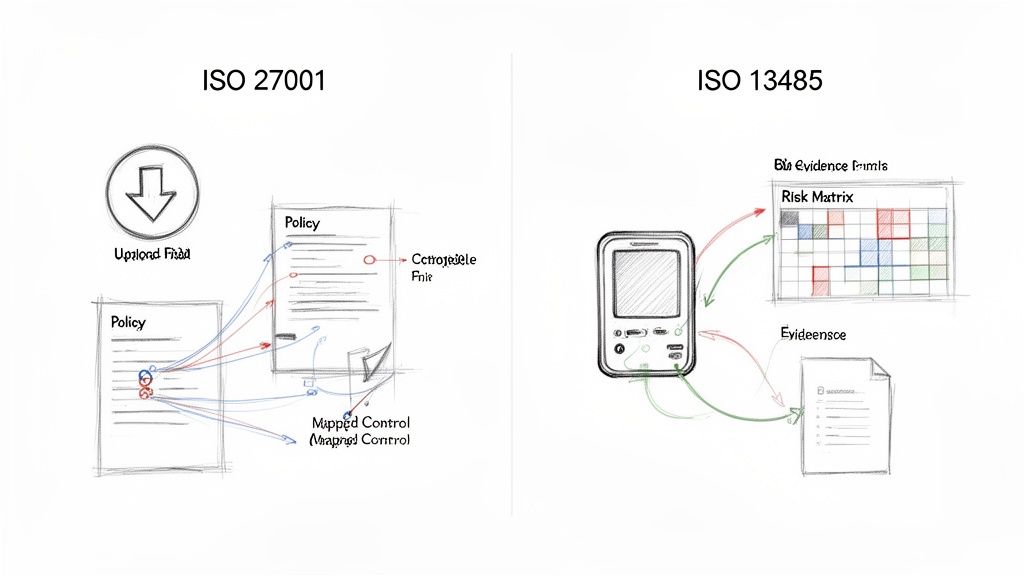
This kind of centralized view is absolutely critical. It helps you track progress, spot gaps early, and make sure every piece of required evidence is tied to the right control long before an auditor walks through the door.
Navigating ISO 27001 for a Tech Startup
Picture this: a fast-growing SaaS company lands its first huge enterprise client. Great news, right? But there’s a catch. The contract hinges on them achieving ISO 27001 certification in just six months to prove they take information security seriously.
Right now, their security team is small, and their policies are a jumble of documents scattered across Google Drive and various internal wikis. Trying to manage this with spreadsheets would be a complete nightmare. Instead, they invest in compliance assessment software.
Here’s what their journey looks like now:
- Framework Activation: First, they select the pre-built ISO 27001 template. Instantly, all 114 Annex A controls are populated, giving them a clear, structured roadmap from day one.
- Evidence Upload: They connect their Google Drive, and the software syncs critical documents like the Information Security Policy, Access Control Policy, and their Incident Response Plan. No more manual uploads.
- Automated Mapping: Instead of painstakingly cross-referencing documents to controls, they use the platform to link everything together. For instance, their single Access Control Policy gets mapped to multiple controls in section A.9 automatically.
- Gap Identification and Remediation: The dashboard immediately flags any controls that are missing evidence—these are their gaps. The security lead can then assign these gaps as tasks to team members right inside the platform, complete with deadlines and comment threads to keep everyone on the same page.
By bringing everything into one place, a daunting six-month project becomes a manageable, transparent process. When the auditor arrives, they’re given read-only access to a perfectly organized, evidence-backed package that shows a mature and well-run security program.
Mastering ISO 13485 for a Medical Device Firm
Now, let's switch gears to a medical device manufacturer. They’re preparing for an audit of their Quality Management System (QMS) under ISO 13485. In this world, the stakes are incredibly high—failure is not an option. The documentation they have to manage, like Design History Files (DHFs) and risk assessments, is incredibly dense and complex.
The quality manager uses compliance assessment software that acts as an analytical partner.
This approach is becoming the new standard. With nearly two-thirds of organizations now seeing AI as important to their compliance programs, old-school spreadsheets just can't keep up. It's pushing companies toward smarter solutions that can make sense of extensive documentation and get them audit-ready. You can learn more about these compliance trends and statistics.
The manufacturer's process becomes incredibly focused and precise:
- Document Analysis: They upload their entire Design History File—a massive technical document. The software’s AI agent gets to work, reading the whole thing to identify and pull out key evidence related to design controls, verification, and validation steps.
- Evidence-Linked Reporting: When the quality manager needs to prove they're compliant with a specific clause, like 7.3.3 Design and Development Inputs, the system provides an immediate answer. It even includes citations pointing to the exact page and paragraph in the DHF.
- Audit Readiness: This creates a living, defensible audit trail. The manager can generate a report on the fly that shows every single control, the evidence that satisfies it, and a direct link back to the source document for instant verification.
In this high-stakes field, the compliance assessment software delivers more than just efficiency. It provides an unmatched level of accuracy and confidence, ensuring the manufacturer is always prepared for regulatory scrutiny.
Your Top Compliance Software Questions, Answered
Alright, so you see the value in a dedicated compliance tool. But even so, a few practical questions probably come to mind as you start looking around. Let's tackle the big ones head-on so you can move forward with confidence.
These aren't just minor details; the answers highlight the fundamental differences between a real compliance platform and the makeshift systems you might be using now.
How Is This Different From a Project Management Tool?
It’s a fair question. You’re probably already using tools like Jira or Asana to manage tasks, so why add another platform to the mix? The short answer is that project management tools are built to track work, not to prove compliance.
They can tell you that a task is complete, but they have no idea if that task actually satisfies control AU-2(d) in NIST or A.12.4.1 in ISO 27001. A true compliance assessment software does things a PM tool simply can't:
- Control Mapping: It intelligently links one piece of evidence (like a server configuration file) to multiple controls across different frameworks. You do the work once and get credit for it everywhere it applies.
- Audit-Ready Reporting: It generates the exact reports auditors need to see, providing a crystal-clear trail from every single control straight to the supporting evidence.
- A Defensible Record: It creates a timestamped, immutable system of record. This isn't just a checklist; it's a defensible audit trail that stands up to scrutiny, something a PM tool can't provide without a mountain of manual work.
Think of it like this: a project manager keeps the train on the tracks, but compliance software provides the verified manifest that proves everything on board is exactly what and where it's supposed to be.
Is My Sensitive Data Secure on a Cloud Platform?
Absolutely. This is probably the number one concern we hear, and for good reason. Reputable vendors know they're handling your crown jewels, and their own survival depends on protecting that data. Security isn't just a feature for them—it's the foundation of their entire business.
These platforms are built on enterprise-grade cloud infrastructure and layer on multiple protections to keep your documentation locked down.
Pro Tip: Don't just take a vendor's word for it. Always ask for their security credentials. Look for certifications like SOC 2 Type 2 or ISO 27001. These aren't just badges; they are proof that an independent third party has rigorously audited their security practices and given them a stamp of approval.
These certifications confirm the provider has robust controls in place, from end-to-end data encryption to strict internal access policies, so you know your data is in safe hands.
Can This Software Handle Multiple Compliance Frameworks at Once?
Yes, and honestly, this is where these tools truly shine. The reality for most companies today is a messy web of overlapping compliance obligations. A good platform is built for this. It lets you take a single control or piece of evidence—let's say your data encryption policy—and map it to every relevant requirement across all your frameworks.
For instance, that one policy can help you tick the box for ISO 27001, GDPR, and SOC 2 all at once. This "assess once, apply many" model is a game-changer. It gets rid of the soul-crushing, redundant work that makes manual compliance such a nightmare.
Ready to see how an AI-powered platform can accelerate your audit preparation and provide instant, evidence-linked answers? AI Gap Analysis transforms your compliance documents from static PDFs into an interactive knowledge base.