February 2, 2026
data retention policydata governancecompliance managementGDPR complianceISO 27001
Your Guide to Building a Data Retention Policy
Learn to create a compliant data retention policy that protects your business. Our guide covers legal drivers, essential components, and enforcement.
21 min readAI Gap Analysis
Think of a data retention policy as your company's official game plan for its information. It sets clear, documented rules on how long every piece of data should be kept and, just as importantly, when it needs to be securely destroyed. This framework is essential for navigating the tightrope walk between legal duties, business needs, and the very real dangers of keeping sensitive data for too long.
Why a Data Retention Policy Is Your Digital Rulebook
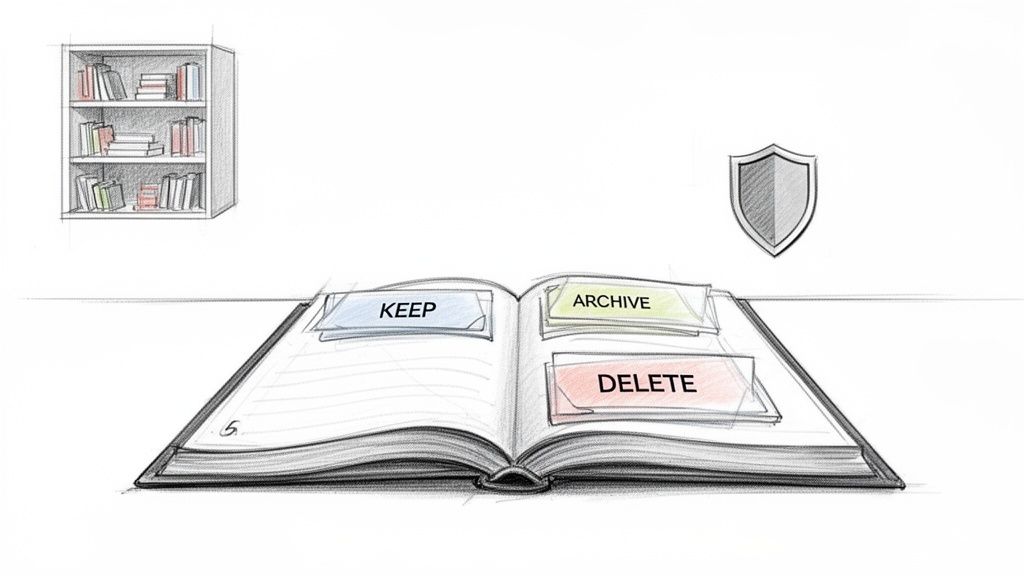
Imagine all your company's data is a massive, ever-expanding library. Without a good system, you'd quickly lose track of valuable books, while outdated ones just gather dust and take up space. A data retention policy is like a professional librarian—it brings order to the chaos by setting clear guidelines for what to keep, for how long, and when to responsibly get rid of old, irrelevant information. It’s your best defense against both legal trouble and operational mess.
And this isn't just theory. Getting data lifecycle management wrong can hit your bottom line, hard. In 2025, for instance, GDPR regulators in Europe handed out an eye-watering $2.3 billion in fines, a jump of 38% from the year before. This spike shows that data retention is no longer a back-office task; it's a frontline compliance issue where mistakes cost millions.
Balancing Risk and Value
The real trick is finding that perfect balance between holding onto data for its value and getting rid of it to reduce risk. Many organizations fall into the trap of hoarding everything "just in case," but that's a dangerous habit.
- Bigger Legal Target: In any lawsuit, every piece of data you have is fair game for discovery. The more you keep, the larger your legal attack surface becomes.
- Bloated Storage Costs: Every file, useful or not, costs money to store. Hoarding drives up operational expenses without adding any real value.
- Higher Stakes in a Breach: The more sensitive data you're sitting on, the more devastating a security breach will be for your business and your customers.
A well-crafted policy addresses these risks head-on. It creates a systematic, defensible process for data disposal, ensuring you're not just deleting things on a whim but are following a documented and compliant plan. This methodical approach is a critical piece of any solid information security policy.
From Compliance Burden to Business Asset
When done right, a data retention policy stops being a chore and becomes a real business advantage. It gives your team clarity and consistency, empowering everyone to handle information with confidence. More than that, it proves to regulators, partners, and customers that you take your role as a data steward seriously.
By defining the lifecycle for every piece of information—from creation to secure destruction—a data retention policy moves an organization from a state of digital hoarding to one of intentional, secure, and compliant information governance.
This policy isn't a document you write once and file away. It's a living guide that needs to evolve with new regulations and changing business priorities. It’s what keeps your organization resilient, efficient, and protected in a world full of data-related risks.
Navigating The Legal Landscape Of Data Retention
Your data retention policy doesn't exist in a vacuum. It's not just some internal document you create and file away; it's a direct response to a tangled web of laws and regulations. These legal drivers are the single biggest factor telling you how long you must keep certain types of information. Getting this right is a cornerstone of your entire data strategy.
Let's be clear: failing to line up your policy with these rules isn't a small slip-up. It can trigger massive fines, drag you into court, and seriously damage your company's reputation. Every law sets a non-negotiable minimum for your retention schedules, covering everything from employee files to customer transaction records.
Major Regulations Shaping Your Policy
A handful of major regulations have a huge say in how companies handle data retention. Getting a handle on their core requirements is the first real step toward building a policy that holds up under scrutiny.
Here are a few of the heavy hitters you absolutely need to know:
-
General Data Protection Regulation (GDPR): This is the big one out of the European Union. GDPR is built on principles like data minimization and storage limitation. In plain English, it says you can't keep personal data for longer than you absolutely need it for a specific, stated purpose. You have to be able to justify why you're holding onto every piece of personal data.
-
Health Insurance Portability and Accountability Act (HIPAA): In the U.S., HIPAA is the law of the land for Protected Health Information (PHI). It's very specific, requiring healthcare providers and their partners to keep records—like their own internal policies and procedures—for at least six years from the date they were created or last used, whichever is later.
-
Sarbanes-Oxley Act (SOX): Passed to combat corporate fraud, SOX gets really strict about financial records and business communications. For example, all audit-related documents have to be kept for seven years. And if you knowingly destroy records to block a federal investigation, you're looking at serious criminal charges.
These aren't just suggestions. They are mandates that dictate concrete timelines in your data retention policy. A company that falls under SOX, for instance, has to make sure its email archiving system is set up to keep relevant messages for that full seven-year period, no exceptions.
Below is a quick-glance table summarizing how some of these major regulations impact data retention practices.
Key Regulations and Their Impact on Data Retention
| Regulation | Geographic Scope | Key Retention Requirement Example | Impacted Data Types |
|---|---|---|---|
| GDPR | European Union | Personal data kept "no longer than is necessary." | Personal data, customer information, employee records. |
| HIPAA | United States | Policies and procedures must be retained for 6 years. | Protected Health Information (PHI), patient records. |
| SOX | United States | Audit work papers must be retained for 7 years. | Financial records, audit documents, corporate emails. |
| CCPA/CPRA | California, USA | Retention period must be "reasonably necessary." | California residents' personal information. |
This table just scratches the surface, but it shows how different laws create specific, legally-binding obligations for different kinds of data.
The Challenge Of Global Compliance
For any business operating internationally, things get complicated fast. You're suddenly dealing with a patchwork of global laws where retention rules can change dramatically from one country to the next. What keeps you compliant in the United States might get you in hot water in Brazil or Japan.
This is why having a centralized, well-documented policy is so critical. The global push for stronger data privacy laws isn't slowing down. As of January 2025, 144 countries have put national data privacy laws in place, which now cover 82% of the world's population—that’s about 6.64 billion people. This trend, often following the GDPR's lead, makes a solid retention strategy a non-negotiable for any global business. You can discover more insights about global data protection trends and how they affect companies.
Think of your data retention policy as your company's official promise to handle data legally and ethically. In a global market, it’s the master key that unlocks compliance across borders, keeping you out of legal trouble and building trust with customers everywhere.
Without one unified approach, you risk creating isolated, inconsistent practices that leave you exposed. A strong, globally-aware policy is the only way to ensure you’re meeting your obligations in every single market you operate in.
The Core Components of a Powerful Policy
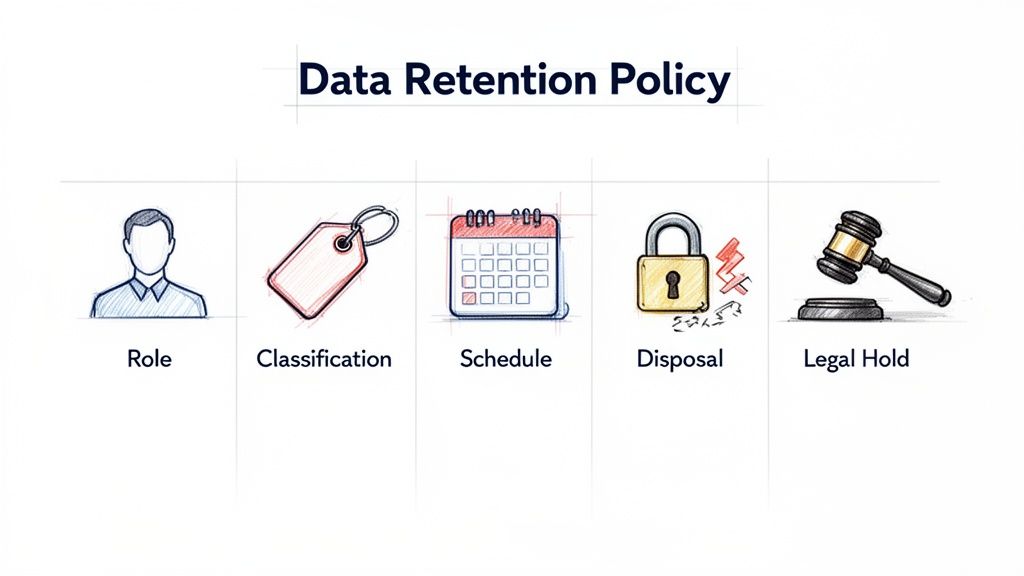
A genuinely effective data retention policy isn't just another document filed away on a server. It's a living, breathing blueprint for how your organization manages its information from creation to destruction. To work in the real world, it has to be clear, actionable, and easy for everyone to understand and follow.
Think of it like building a house. You wouldn't just start pouring concrete without a detailed plan for the foundation, framing, plumbing, and electrical work. Each piece is critical for the final structure to be safe and sound. Your policy needs that same kind of solid structure to hold up under regulatory scrutiny and actually help your business.
Purpose and Scope Statement
Every great policy kicks off by answering two simple questions: "why?" and "what?" The Purpose and Scope Statement is basically your policy's mission statement. It needs to spell out why you have this policy in the first place—to meet legal requirements, cut down on risk, or manage storage costs—and what information and systems it actually covers.
This section sets the stage for everything else. It draws the lines, making it crystal clear which types of data, which departments, and even which geographic locations fall under the rules. A good example would be stating the policy applies to all electronic and physical records created by employees across your North American and European offices.
Defined Roles and Responsibilities
A policy without clear ownership is just words on a page. You have to assign specific accountability for every part of the data retention process. If you leave it ambiguous, you’re just asking for trouble, because critical tasks will inevitably fall through the cracks when nobody knows who's supposed to handle them.
This part of the policy answers the all-important question: "Who does what?" It should name specific roles and spell out their duties.
- Data Owners: These are usually department heads responsible for the data their teams create and use daily.
- IT Administrators: They’re the ones on the ground, handling the technical side of things, like setting up automated deletion rules in your systems.
- Legal/Compliance Officer: This person makes sure the policy stays in line with all relevant laws and takes the lead on things like legal holds.
- All Employees: Everyone has a part to play, and they are responsible for knowing the policy and following it in their day-to-day work.
Data Classification Framework
Let’s be honest: not all data is created equal. A customer's credit card number isn't the same as a marketing flyer. Trying to apply one single retention rule to everything is not only inefficient, it's a recipe for non-compliance. A data classification framework is your system for sorting information based on how sensitive it is, its value to the business, and any legal strings attached.
This lets you apply the right rules to the right data. A common framework might look something like this:
- Public: Information that can be shared freely.
- Internal: General business data that shouldn't be shared outside the company.
- Confidential: Sensitive information, like employee records, that could cause harm if it got out.
- Restricted: Your most sensitive data—think PII, financial records, or trade secrets—that needs the tightest possible controls.
This classification system is what drives your retention schedule. If you want to go deeper on this, our guide on building a data classification policy is a great resource.
Procedures for Disposal and Exceptions
Finally, your policy has to get into the "how." It needs to lay out the exact procedures for securely getting rid of data once its time is up. And this is about more than just dragging a file to the trash bin. You need to define secure disposal methods, like cryptographic erasure for digital files or physical shredding for hard drives, to ensure that deleted data stays deleted.
A data retention policy's strength is measured not by how well it stores data, but by how defensibly it disposes of it. Secure, documented disposal is the final, critical step in the data lifecycle.
Just as important are the rules for handling exceptions. The most common one you'll run into is a legal hold, which is an order to freeze specific data and preserve it because of a potential lawsuit. Your policy must have a clear, step-by-step process for putting a legal hold in place, managing it, and eventually lifting it so that crucial evidence is never accidentally destroyed. This is what turns your policy from a document into a practical tool for managing risk.
How to Build Your Data Retention Schedule
Think of your data retention policy as the overall strategy—the "what" and "why" of managing your data. The data retention schedule is where the rubber meets the road. It's the practical, hands-on playbook that details exactly how long you need to keep specific types of information.
This schedule is the core of your entire policy. It’s a detailed timetable that outlines the lifecycle for every kind of data your organization touches. Without it, your policy is just a set of abstract principles. The schedule makes those principles actionable, giving your teams clear instructions on what to keep, for how long, and when to let it go.
Mapping Data to Timelines
Creating a solid schedule always starts with an inventory. You can't manage what you don't know you have. The first step is to figure out exactly what data you're collecting, where it’s stored, and which department is responsible for it.
Once you have that data map, you can start assigning retention periods. This isn't a job for one person or even one department. It’s a team sport. Your legal counsel will understand the regulatory requirements, while your department heads know how long they need certain data to actually run the business. Getting them all in a room (or a video call) is the only way to build a schedule that’s both compliant and realistic.
Let's look at a few real-world examples to see how this plays out:
- Human Resources: You might only need to hold onto a rejected job application for one year to meet employment regulations. But for someone you hired, you’ll need to keep their payroll records for seven years or even longer after they leave, thanks to tax and labor laws.
- Finance: A routine vendor invoice might be fine to keep for three to five years for standard accounting. Tax filing documents, on the other hand, are a different story—the IRS requires you to keep those for at least seven years.
- Customer Data: As long as a customer's account is active, you hold onto their data. But what happens when they leave? You should have a process to delete their personal info within a set timeframe, like 90 days, unless a specific law forces you to keep it longer.
Justifying Every Retention Period
A truly defensible retention schedule does more than just list timelines. It explains the reason for each one. This justification is your proof to auditors or regulators that you’re not just picking numbers out of thin air.
For every entry in your schedule, you need to document the specific legal statute (e.g., "SOX Section 802") or the concrete business reason (e.g., "Needed for ongoing project management") driving that retention period. This creates a clear audit trail and shows you’ve done your homework.
A data retention schedule isn't just a list of dates. It's a documented story explaining why you keep what you keep, proving your organization is a responsible steward of its information.
This level of detail is your best defense. If you're ever challenged on why you kept or deleted something, you can point directly to the rule that guided your decision. It transforms a potentially stressful audit into a simple check-the-box exercise.
Sample Data Retention Schedule Template
To give you a clearer picture, here’s a simple template you can adapt for your own organization. It’s a great starting point for making sure you’ve covered all your bases.
This table shows how to break down different types of data and document the key information needed for a compliant and practical schedule.
| Data Category (e.g., HR, Finance) | Specific Data Type (e.g., Employee Contract) | Retention Period | Trigger for Retention Start | Legal/Business Justification (e.g., Labor Law, SOX) |
|---|---|---|---|---|
| HR | Employee Contracts | 7 years post-employment | Employee termination date | Labor Law Compliance |
| Finance | Tax Filings | 7 years | End of fiscal year | IRS Regulations |
| Sales | Customer Contracts | 6 years post-termination | Contract expiration date | Statute of Limitations |
| IT | System Access Logs | 1 year | Date of log creation | Security Incident Response |
| Marketing | Email Campaign Lists | 2 years post-consent | Date of last interaction | GDPR/CCPA Compliance |
By using a structured template like this, you can methodically work through all your data categories. This process helps you build a comprehensive framework that fits your unique legal obligations and business needs, turning your data retention policy from a static document into a dynamic and powerful tool for managing risk.
Putting Your Policy Into Practice
A data retention policy is a fantastic tool, but it’s completely useless sitting in a folder on a shared drive. A policy on paper is just a plan; a policy in practice is what actually protects you. This is the moment of truth—moving from a document to daily operations is where your organization’s real commitment to data governance gets tested. It’s a process that needs a smart, structured approach, mixing human buy-in with smart technology.
Don't mistake this for just another IT project. Implementing a retention policy is a culture change for the whole company. It needs clear communication from the top, visible support from leadership, and practical tools that make doing the right thing the easiest thing for everyone.
Secure Executive Buy-In and Communicate Clearly
Before you train a single employee or configure any software, your policy needs powerful advocates in the C-suite. Executive buy-in is the rocket fuel for a successful rollout. When leaders vocally support and enforce the policy, they send a clear message: managing our data properly is a core business priority, not just another compliance chore.
Once you have that backing, it's time to talk. You have to translate the formal, legalese of the policy into plain English that every department can act on.
- For Sales: Explain exactly how this impacts their CRM data and the emails they send to prospects.
- For HR: Lay out the specific timelines for keeping employee files, from old resumes to current payroll records.
- For Marketing: Clarify the rules around campaign data and how long you need to hold onto user consent forms.
This kind of tailored communication helps everyone understand how the data retention policy connects to their day-to-day work. It turns them from passive bystanders into active participants.
Train Your Team and Automate Enforcement
Good training turns your employees into your first and best line of defense. The goal isn't just to make people aware that a policy exists; it's to make sure they understand their specific responsibilities in making it work. Training should be practical, ongoing, and built around real-world scenarios they'll actually face.
But even the best-trained people make mistakes. That’s why the most effective strategies pair human education with solid technical automation. Modern IT systems can be set up to enforce your retention rules automatically, which dramatically cuts down on the risk of human error.
Automating data disposal based on your official schedules is the single best way to make sure the policy is followed consistently. It shifts the burden from people having to remember to delete things to a system where compliance happens by default.
This is where your IT team really shines. They'll need to configure your systems to act on the retention schedule without manual intervention. Think about setting up email archives to automatically purge messages after seven years, or configuring your cloud storage to delete dormant project files once their retention period is up. This kind of automation is what turns your policy from a set of guidelines into a living, breathing program.
Establish a Cycle of Audits and Reviews
A data retention policy is never really "done." It's a living program that has to adapt to new regulations, different technologies, and changes in your business. To keep it sharp and effective, you need to build a continuous cycle of monitoring, auditing, and reviewing.
Regular audits are your reality check. They confirm that the policy is actually being followed correctly across all departments and systems. These spot-checks help you find gaps, fix compliance issues, and collect proof that your controls are working—something you'll be very grateful for during an external audit.
Beyond that, schedule a formal review of the entire policy at least once a year, or whenever something big changes (like a new privacy law or a company acquisition). This ensures your framework stays current with both your legal obligations and your business reality, turning it from a one-off project into a sustainable part of your company's governance strategy.
How to Verify Your Policy Actually Works (And Prove It to Auditors)
Getting ready for an ISO 27001 or SOC 2 audit often feels like a massive, high-stakes scavenger hunt. Compliance teams can burn weeks, sometimes months, sifting through documents to find hard evidence that the company is actually following its own data retention policy. It’s a slow, painful process that’s wide open to human error.
Think about it. An auditor asks a seemingly simple question: "Show me proof your vendors are complying with your data deletion requirements." For most companies, this kicks off a mad scramble through countless contracts, service-level agreements, and email chains. It's a manual slog that can take days to complete.
From Manual Spot-Checks to AI-Powered Discovery
This is where a smarter approach changes everything. Instead of relying on manual spot-checks and hoping for the best, you can use AI-powered gap analysis to handle the heavy lifting of evidence discovery. Think of it as a tireless compliance analyst that can scan all of your documentation in minutes, not weeks.
This technology works by connecting the dots between the specific statements in your data retention policy and the evidence required by compliance frameworks. The AI actually reads and understands the content, pinpointing where your documents back up your policy and—just as importantly—where you have gaps.
The process of putting a policy into action follows a logical flow, moving from high-level strategy to automated enforcement.
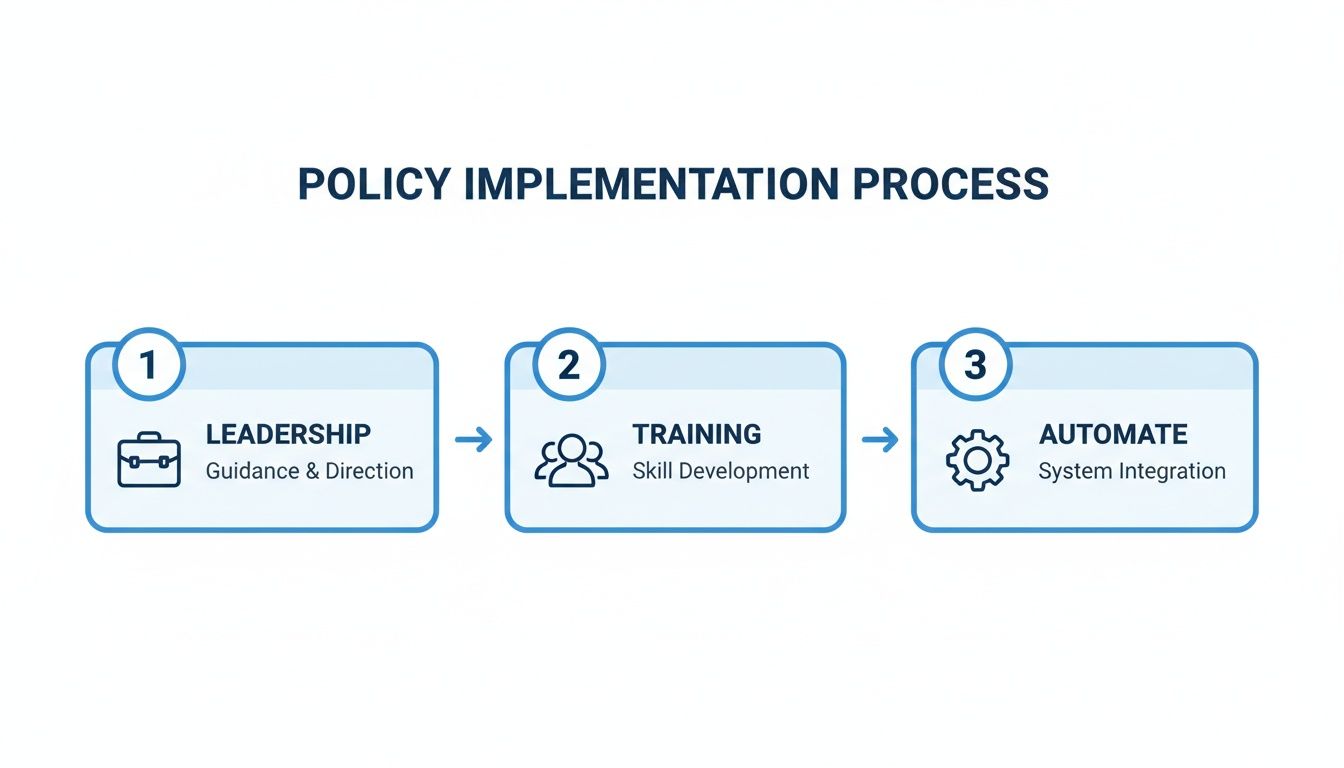
This visual breaks it down nicely: successful policy execution starts with leadership buy-in, flows through team training, and lands on automation as the final, crucial step to make it all stick.
Making Audit Evidence Verifiable in an Instant
The real magic of this automation is how it delivers instant, verifiable proof. When the AI finds a piece of evidence—say, a clause in a vendor contract confirming data will be wiped after 90 days—it doesn't just note its existence. It gives you a direct link to the exact page and paragraph.
By shifting from a reactive, manual scramble to a proactive, automated system, AI-powered analysis helps you build a culture of continuous compliance. It replaces "we think we do this" with "here's the proof."
Suddenly, you have an ironclad audit trail. There are no more vague answers or "trust me" moments with auditors. You have a clear, evidence-backed answer for every control, saving your team hundreds of hours and building a much stronger, more transparent relationship with auditors. If you want to dig deeper, you can learn more about how compliance assessment software is fundamentally changing the audit game.
Got Questions? Let's Talk Data Retention
Even the most buttoned-up data retention policy can leave room for questions. When you're in the trenches, managing data day-to-day, a lot of practical "what ifs" come up. Let's walk through some of the most common questions people ask to make sure your program stays effective and compliant.
One of the first things that trips people up is the difference between archiving and deleting data. It's easy to get them mixed up, but they serve very different purposes.
Think of archiving like moving old project files from your desk into a secure, off-site storage unit. You don't need them for your daily work anymore, so clearing them out speeds things up. But you're not throwing them away—they’re kept safe in case you need to reference them for legal or business reasons down the road.
Deletion, on the other hand, is the paper shredder. It’s the permanent, irreversible destruction of data. Once a file hits the end of its retention period and has no legal or business value left, it's gone for good. Your policy needs to be crystal clear about the procedures for both, so everyone knows exactly what to do and when.
How Often Should We Be Looking at This Policy?
A data retention policy isn't a "set it and forget it" kind of thing. The business world and the regulatory landscape are always shifting. At a bare minimum, you should be doing a full-blown review of your policy at least annually. This yearly check-up keeps it in sync with your operations and any small legal updates.
But sometimes, you can't wait for the annual review. Certain events should trigger an immediate policy huddle. These are the big ones:
- Major Regulatory Changes: A new privacy law passes? Time for a review.
- Significant Business Events: If you merge with another company, get acquired, or expand into a new country, you’ve got new data and new rules to deal with.
- New Technology Adoption: Moving to a new cloud provider or rolling out a company-wide CRM? You need to rethink how that data is stored and managed under your policy.
Staying on top of this keeps your policy from becoming an outdated document that no one can actually follow.
What Happens When a Legal Hold Is Issued?
This is where things get serious. A legal hold is essentially a giant pause button on your retention schedule. It’s a formal order to preserve specific information because a lawsuit is either happening or very likely to happen.
A legal hold temporarily freezes all disposal activities for specific data. Even if a file's destruction date has passed according to your schedule, it must be preserved. Destroying it could be seen as destroying evidence, and that comes with hefty penalties.
Your policy must have a clear, documented process for what happens when a legal hold is issued, how it’s managed, and when it can be lifted. This process is your lifeline. It ensures you can react quickly to legal demands without making a catastrophic mistake like spoliation of evidence. Without a solid plan, a simple legal issue can quickly spiral into a major compliance disaster.
At AI Gap Analysis, we automate the painful, manual work of finding evidence for audits. Our platform instantly verifies that your policies are actually being followed in practice. We can turn weeks of tedious searching into a fast, reliable, and audit-ready process. See how we can streamline your compliance assessments at https://ai-gap-analysis.com.