February 7, 2026
how to conduct a gap analysiscompliance auditgap analysis processquality managementISO compliance
How to Conduct a Gap Analysis for Compliance and Quality
Learn how to conduct a gap analysis with our practical guide. We cover scoping, evidence collection, and turning findings into an audit-ready plan.
22 min readAI Gap Analysis
At its core, a gap analysis is a straightforward exercise. You pick a target—like getting your ISO 27001 certification—then you gather up all the documentation on your current processes. The final step is to meticulously compare what you’re doing now against what the standard says you should be doing.
It’s a structured way of answering three fundamental questions: Where are we now? Where do we want to be? And how do we close the gap?
Why Gap Analysis Is Your Most Critical Compliance Tool
In compliance and quality management, a gap analysis is much more than just another box to check. It's the bedrock of a successful audit and a healthy operational framework. This is the process that turns dense, abstract regulatory language into a concrete, step-by-step plan for your team.
Without one, you’re flying blind. You're just hoping that your current security policies and procedures happen to line up with the hundreds of controls in a complex framework.
This kind of proactive work is what separates a mature compliance program from a chaotic, reactive one. Instead of scrambling to fix problems an auditor flags during a high-stakes review, you’re finding and fixing those issues months ahead of time. You get to address them on your own terms.
Skipping this step is a huge gamble, and the stakes are high:
- Failed Audits: Auditors are paid to find inconsistencies. A good gap analysis lets you find and fix them first.
- Costly Fines: Regulatory non-compliance can trigger penalties that make the investment in a gap analysis look tiny by comparison.
- Wasted Resources: I’ve seen teams spend months preparing for an audit, but because they never did a proper gap analysis, they focused their energy on all the wrong things.
- Lost Market Opportunities: For many businesses, certifications like ISO 9001 are table stakes. Failing an audit can mean getting locked out of major contracts.
The Shift From Manual To Automated Workflows
Not too long ago, a gap analysis meant one thing: spreadsheets. Lots and lots of spreadsheets. A compliance manager would spend weeks, sometimes months, manually cross-referencing company policies against hundreds of individual controls. It was a tedious, exhausting process that was incredibly prone to human error.
Thankfully, we've moved past that.
A structured gap analysis—starting with documenting current processes, benchmarking against ISO requirements, and prioritizing fixes—can slash audit preparation time by up to 50%. This process is essential for navigating complex standards amid growing AI adoption. Read more about the AI market trends from Cognitive Market Research.
This move toward smarter workflows has been a game-changer. For instance, in the medical device world, it’s common for quality managers to run a gap analysis to map existing procedures against ISO 13485 requirements. In my experience, these initial reviews often reveal critical mismatches in up to 70% of the controls.
Modern tools automate the most painful parts—the evidence collection, the control mapping—and let the experts do what they do best: analyze the findings, build a strategy, and guide the remediation work. This is the only way to build a compliance program that can actually keep up with regulations today.
This guide will walk you through exactly how to get it done, whether you’re sticking to the old-school methods or ready to embrace automation.
Manual vs. AI-Powered Gap Analysis at a Glance
To see the difference in action, it helps to put the two approaches side-by-side. The traditional manual process is thorough but slow, while AI-driven platforms accelerate the entire workflow, from evidence collection to final reporting.
| Aspect | Manual Gap Analysis | AI-Powered Gap Analysis (e.g., AI Gap Analysis platform) |
|---|---|---|
| Evidence Collection | Manually gathering documents, screenshots, and policies from various systems. | Automatically ingests and indexes documents from connected systems (e.g., Confluence, SharePoint). |
| Control Mapping | Reading each requirement and manually searching for corresponding evidence. | AI maps evidence to controls instantly, highlighting direct matches and potential gaps. |
| Time Investment | Weeks or months of intensive, repetitive work for the compliance team. | Hours or days. Initial analysis can be completed in under an hour. |
| Accuracy & Consistency | Highly susceptible to human error, missed evidence, and inconsistent interpretation. | Extremely high accuracy, objective analysis, and consistent application of standards. |
| Reporting | Manually compiling findings, scores, and remediation tasks into a spreadsheet or report. | Generates audit-ready reports, heatmaps, and prioritized remediation plans automatically. |
| Team Focus | Team spends ~80% of time on data gathering and ~20% on analysis and strategy. | Team spends ~20% of time on setup and ~80% on strategic analysis and remediation. |
Ultimately, while the goal is the same—identify and close compliance gaps—the journey is fundamentally different. AI-powered tools free up your most valuable resource: the expertise of your compliance and quality professionals.
Getting Started: Laying the Groundwork for Your Gap Analysis
Before you can even think about finding gaps, you need to draw a map. A clearly defined scope is your best defense against a project that balloons out of control, eating up time and resources without giving you clear answers. Think of it as setting the rules of engagement.
This isn't about adding bureaucratic hurdles; it's about focus. It makes sure everyone involved knows exactly what’s being measured, why, and who owns each piece of the puzzle. Skipping this part is like starting a road trip without a destination—you’ll just burn gas and end up lost.
First Things First: Define Your Scope and Pick a Framework
The first question you have to answer is, "What are we actually measuring against?" You need to lock in the specific standard, regulation, or framework that represents where you want to be. This could be something as broad as a quality management system or a very specific industry rule.
Your choice of framework will shape every single step that follows, from the evidence you gather to the people you pull in.
- A Med-Tech Startup might be aiming for ISO 13485 certification to get into the European market. In that case, the scope would be tightly focused on processes tied to the medical device lifecycle—design, development, post-market surveillance, and so on.
- A SaaS Company facing a big enterprise client audit would probably focus on ISO 27001, zeroing in on the Annex A controls for information security. Their scope would likely cover engineering, IT, and HR.
A word of advice: don't try to boil the ocean. If you’re new to this, it's far smarter to pick a narrow, high-impact area—like one critical business process or a single certification—and nail it. A win here builds the momentum and credibility you'll need for bigger projects down the road.
Once you’ve picked your framework, you have to be crystal clear about which parts of the business are in-scope. Is this for all global offices or just headquarters? Does it cover every product, or just the one launching next quarter? Nail these details down now to avoid a lot of confusion and wasted work later.
Assemble Your A-Team: Why This Isn't a Solo Mission
A gap analysis is not a one-person show run out of the compliance department. To get a real, honest look at your current state, you absolutely need input from the people on the ground doing the work every single day. Putting together a cross-functional team isn’t just a nice-to-have; it's essential.
You need people who can give you accurate information and—just as important—help you implement the fixes later.
An Example Team for an ISO 13485 Gap Analysis:
- Quality Manager (The Lead): Owns the whole process, knows the standard inside and out, and keeps the project moving.
- Lead Engineer or Product Manager: They’ll have the evidence from the design and development history files (DHF).
- Manufacturing Lead: This person can speak to production controls, work instructions, and device history records (DHR).
- Regulatory Affairs Specialist: Makes sure your interpretation of the standard will actually hold up during submissions.
- IT Systems Admin: Pulls evidence related to data integrity, security, and any electronic records.
This team-based approach gives you more than just a theoretical view from a dusty policy binder; it gives you a real-world picture of how things actually work. It also builds buy-in from the get-go, which makes the remediation phase a whole lot smoother. When people help find the problem, they’re much more invested in being part of the solution. This is how you run a gap analysis that actually leads to meaningful change.
From Evidence Piles to Actionable Insights
Alright, you’ve defined your scope and rallied the team. Now for the real work: turning a mountain of documentation into a clear, actionable list of compliance gaps. This is where the rubber meets the road, where you connect the dots between your day-to-day operations and the specific clauses of a standard.
Traditionally, this meant someone—usually a stressed-out quality manager—would spend weeks locked in a room with stacks of binders and a colossal spreadsheet. They’d manually sift through policies, procedures, work instructions, and training logs, painstakingly matching sentences to individual framework requirements. It’s a slow, tedious grind that’s incredibly prone to human error.
Whether you're using that trusty old spreadsheet or a more modern tool, the core process doesn't change. You have to gather your evidence and then systematically map it against the framework's controls.
Gathering and Organizing Your Evidence
First things first: you need to round up all the documentation that proves you're doing what you say you're doing. This evidence is the foundation of your entire analysis. An auditor isn't going to take your word for it; they need to see the proof in black and white.
Think of it like you're a detective building a case. What documents, records, and system outputs demonstrate that your processes are actually working? Your evidence will typically fall into a few key categories:
- Policies and Procedures: These are your high-level governance documents—think Quality Manuals or an Information Security Policy.
- Work Instructions and SOPs: The nitty-gritty, step-by-step guides for specific tasks, like your procedure for handling a customer complaint or managing a software change.
- System Records and Logs: This is the hard data from your tools—access control logs from your IT systems, calibration records for manufacturing equipment, you name it.
- Training and Competency Records: Proof that your team knows how to follow the procedures and is qualified for their roles.
For a quality manager prepping for an ISO 13485 audit, this means pulling the Design History File (DHF) for a medical device and the Device History Records (DHR) to show that every single unit was built to spec.
My Advice From the Trenches: Don't skip this step: create a central repository for all your evidence from day one. A shared drive, a SharePoint site, whatever—just get it all in one place. It will save you from version control nightmares and endless searching later on.
Mapping Evidence to Framework Controls
With your evidence collected, the mapping marathon begins. This is, without a doubt, the most grueling part of a manual gap analysis. You have to take every single requirement from your framework—like ISO 27001 Annex A control A.5.1, "Policies for information security"—and hunt down the specific sentence in your policy documents that satisfies it.
You'll read your Information Security Policy, confirm it's been approved by management and shared with staff, and then document that link in your spreadsheet. Now, just repeat that for the other 113 controls. Simple, right?
The real headache is that a single procedure might tick the box for ten different controls, while one complex control might need evidence from five different documents. Trying to manage those many-to-many relationships in a spreadsheet is a recipe for disaster.
This process flow shows how critical the setup phase is. Getting the scope, frameworks, and team training right from the start makes everything that follows run smoother.
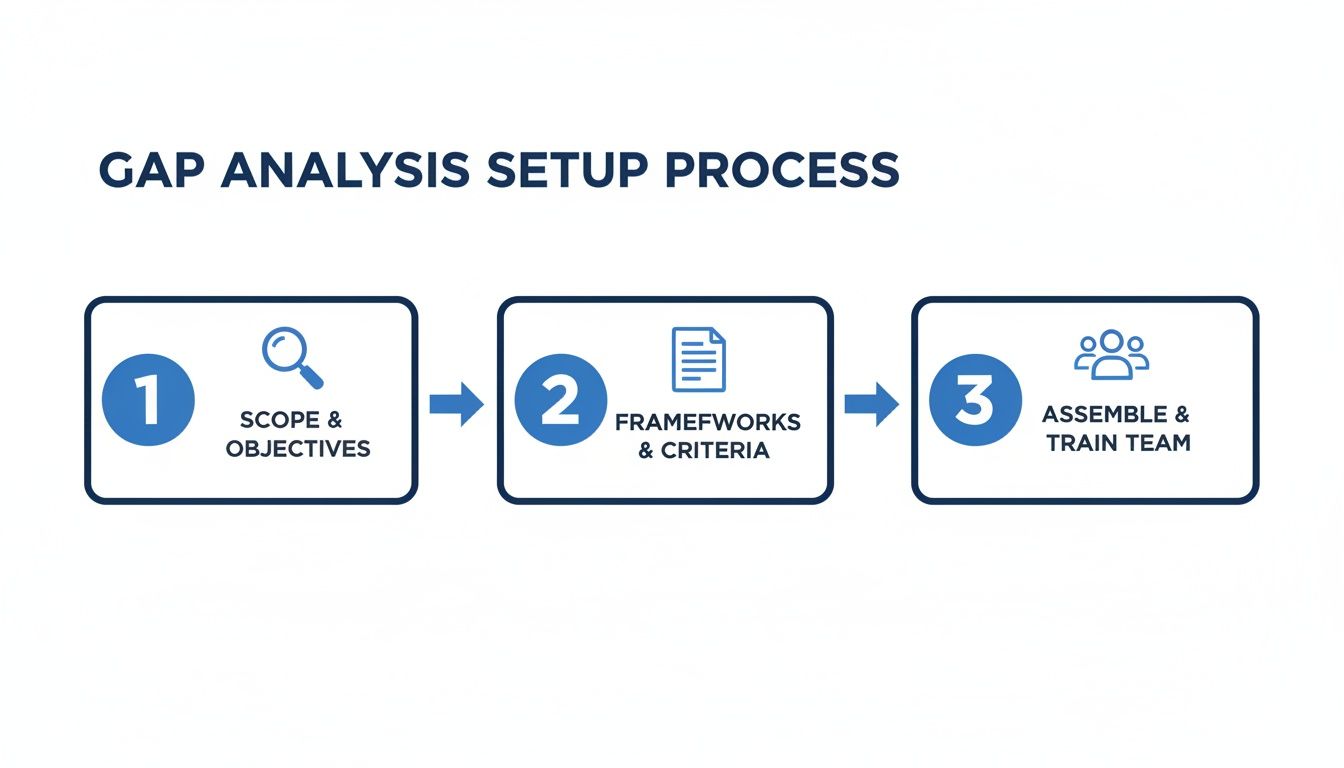
A solid foundation built on a clear scope and a well-prepped team is non-negotiable for a successful analysis.
How AI Changes the Mapping Game
This is where things get interesting. Modern platforms completely flip the script on the manual mapping process. Instead of spending days reading, you can just bulk-upload all your evidence documents. An AI agent then reads, digests, and indexes the content of every single file for you.
Suddenly, the workflow is entirely different. The nightmare of manually sifting through compliance docs is over. The AI scans all your evidence, automatically compares it against your chosen frameworks, and flags discrepancies with direct links to the source text. What once took weeks of painstaking review now takes a few hours.
In the medtech world, for example, we know that issues with ISO 13485 document control show up in around 55% of initial assessments. Yet, AI-powered platforms can pinpoint these gaps with 95% citation accuracy. The impact of this technology is being felt everywhere; you can find more on the broader trends from industry reports like this one from GM Insights.
What used to be a weeks-long slog of reading and cross-referencing is now a robust first draft generated in minutes. This doesn't take the expert out of the equation—it elevates them. Your job shifts from low-value data entry to high-value analysis. You verify the AI's findings, add your expert context, and make the final judgment call. It’s a "human-in-the-loop" model that gives you the speed of automation without sacrificing the critical nuance that only a human expert can provide.
Turning Findings Into an Actionable Remediation Plan
Alright, you've done the heavy lifting and identified the gaps. That's a huge step, but it’s really only halftime. The real game-changer is what you do next. A list of findings is just a list of problems; a prioritized remediation plan is your roadmap to a clean audit.
This is the point where raw data gets turned into a strategic action plan. You absolutely need a system to decide what to fix first, how to fix it, and who’s on the hook to get it done. If you skip this, even the most detailed analysis will lose steam and fall flat.
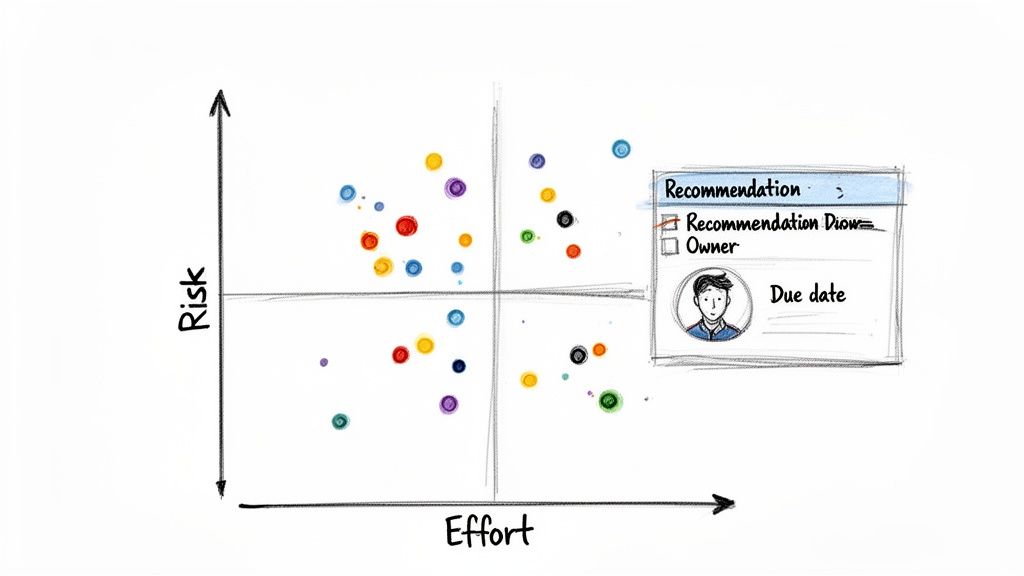
The mission is to move from a simple list of "what's broken" to a concrete set of "what we're going to do about it." This means scoring each finding, writing crystal-clear recommendations, and building in some serious accountability.
Scoring and Prioritizing Your Findings
Let's be real: not all gaps carry the same weight. A missing signature on an old training record is a problem, sure, but it’s not in the same universe as having no risk assessment procedure for a Class II medical device. You can't boil the ocean, so you need a logical way to prioritize.
A simple but incredibly effective tool here is a scoring matrix. It helps you evaluate each finding based on a few key factors, pulling subjectivity out of the equation so your team can focus on what actually threatens the business.
Here’s what I’ve found works best for a practical scoring matrix:
- Risk Level (High, Medium, Low): What’s the worst-case scenario if this gap isn’t addressed? A high-risk issue could lead to patient harm, a massive data breach, or eye-watering regulatory fines.
- Compliance Impact (Critical, Major, Minor): How likely is this gap to cause a failed audit or a major non-conformance? A critical gap is a direct, undeniable violation of a standard's requirement.
- Remediation Effort (High, Medium, Low): Honestly, how much time, money, and people-power will it take to fix this? A low-effort fix might just be a documentation tweak, while a high-effort one could mean rolling out a whole new software system.
Using this approach, a finding like "no formal risk management process" would easily score as High Risk, Critical Compliance Impact, and probably High Effort. On the flip side, something like an "outdated work instruction for a non-critical process" might be Low Risk, Minor Compliance Impact, and Low Effort.
Suddenly, the path forward is obvious. You have to attack the high-risk, critical-impact items first, even if they're a heavy lift.
Here's my rule of thumb: If an auditor would stop everything to dig deeper into an issue, it’s a high-priority item. Those are the showstoppers that can completely derail your certification.
Writing Clear Recommendations and Assigning Ownership
Once you’ve got your prioritized list, every single gap needs a clear, actionable recommendation tied to it. Vague notes like "improve documentation" are completely useless. A great recommendation is specific, actionable, and something you can actually verify is complete.
For each gap, you need to create a remediation task that includes three key things:
- A Concise Description: What exactly needs to be done? Don't write "Fix risk assessment." Instead, be specific: "Develop and implement a new Risk Management Procedure compliant with ISO 14971, Section 4."
- A Clear Owner: Who is the one person accountable for seeing this through? Assigning tasks to a whole department just creates confusion. Give it to a name, not a team.
- A Realistic Due Date: When does this have to be finished? This builds in urgency and makes it possible to manage the project effectively.
That second point—assigning a specific owner—is the most crucial part of this whole process. It transforms a theoretical plan into somebody's actual job. Accountability is what drives remediation forward.
Fostering Collaboration and Tracking Progress
Not too long ago, remediation plans lived and died in messy spreadsheets. We tracked progress through endless email threads and status update meetings, making it nearly impossible to get a real-time picture of where things stood.
Thankfully, we've moved on. A centralized platform is non-negotiable for effective collaboration today. When you run your gap analysis in a modern tool, the remediation plan is woven directly into the workflow.
This approach gives you a few massive advantages:
- Centralized Communication: Team members can drop comments right on the findings, ask questions, and attach evidence as they complete the work. Everything lives in one place, creating a single source of truth.
- Real-Time Visibility: As a project lead, you can see the status of every single task at a glance—what's on track, what’s lagging, and where the roadblocks are. No more chasing people for updates.
- An Audit-Ready Trail: This entire process—from flagging the gap to documenting the fix—creates a transparent, time-stamped record that is gold during an audit. You can show an auditor not just that you fixed a problem, but exactly how and when you did it.
This kind of collaborative environment completely changes the dynamic. Remediation stops being a siloed, top-down chore and becomes a transparent team effort.
Creating Audit-Ready Reports That Get Results
You’ve done the heavy lifting—the gap analysis is complete, findings are scored, and a remediation plan is starting to come together. Now for the final, and arguably most crucial, piece of the puzzle: packaging all that intelligence into a report that actually drives action and stands up to auditor scrutiny.
A truly effective report is far more than a summary of findings. It’s a strategic document that clearly communicates risk, helps leadership make informed decisions, and becomes the official record of your compliance efforts. Remember, you're writing for different people. Your executive team needs the high-level snapshot of risks and resources, while auditors (both internal and external) need to see the granular details and a rock-solid evidence trail.
A great report does both.
Building the Core Components of Your Report
The best reports I've seen are structured to guide the reader logically, starting with the big picture and then drilling down into the nitty-gritty. Think of it as telling a story that begins with why we did this and ends with how we're going to fix it.
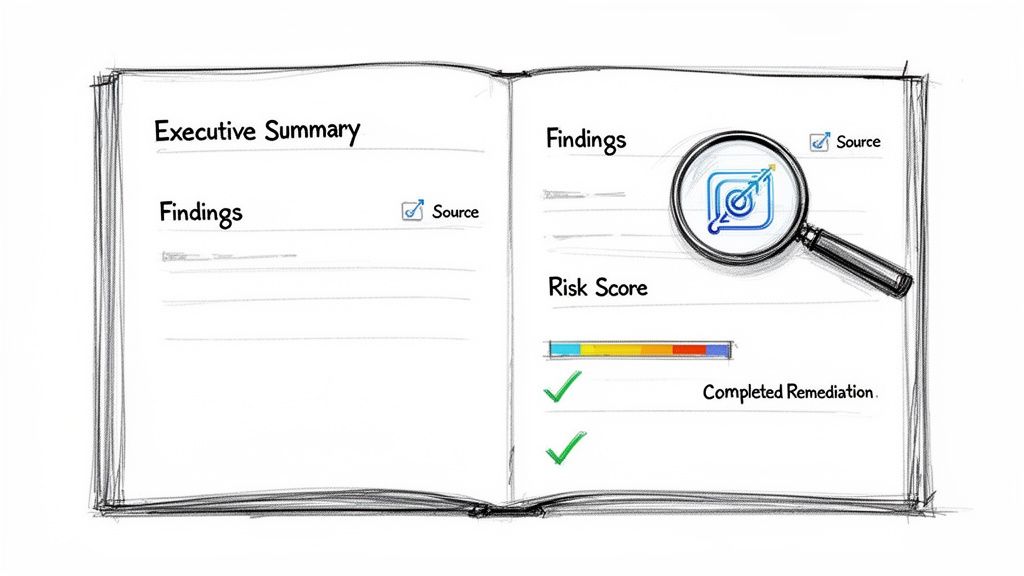
At a minimum, your report needs these non-negotiable sections:
- Executive Summary: Honestly, this is the page that gets the most attention. It needs to be a crisp, one-page overview of the key findings, the most significant risks you uncovered, and your overall compliance health. A C-level leader should be able to grasp the situation in under five minutes.
- Scope and Objectives: Right up front, clearly define the boundaries of your analysis. What framework were you assessing (e.g., ISO 27001, SOC 2)? Which business units, processes, and locations were in scope? This sets the context and prevents any confusion about what the report does and doesn't cover.
- Detailed Findings: This is the meat of the report. For every single gap you identified, you need to list it out plainly. Include its risk score, the potential compliance impact, and a clear reference to the specific control it violates. No room for ambiguity here.
- Prioritized Remediation Plan: This is where you turn findings into action. For each gap, spell out the recommended fix, assign a clear owner, and set a target due date. This shows auditors you’re not just identifying problems—you have a concrete plan to solve them.
The Power of Evidence-Linked Reporting
We’ve all been there. You're in an audit, and the auditor points to a finding in your beautiful PDF report and says, "Show me the proof for Finding 3.2." Suddenly, you're scrambling through shared drives and email chains, and every second that ticks by chips away at the credibility you’ve worked so hard to build.
This is where modern compliance tools completely change the game. When your gap analysis platform can generate answers that are directly linked to the source evidence, your report transforms from a static document into a living, breathing resource.
The gold standard for any audit-ready report is verifiability. Every conclusion and every finding should be instantly traceable back to its source evidence with a single click. This builds immense trust with auditors and eliminates any back-and-forth.
Imagine an auditor questioning a control. Instead of a frantic search, you just click a link embedded right there in the report. They’re instantly taken to the exact page and paragraph in a policy document that proves the gap exists. This simple capability turns your report from a mere summary into an interactive, trustworthy audit tool.
It also makes the audit itself go so much faster. You can resolve questions in seconds, not hours. For more on getting your ducks in a row, our audit readiness checklist is a great resource.
This shift means reporting is no longer a painful, manual exercise in copy-pasting. It becomes a powerful, automated output of the real analysis work, ensuring that when the audit finally comes, your team is confident, prepared, and ready to go.
Accelerating Compliance With AI-Powered Tools
Let's be honest, the traditional gap analysis process can be a real slog. From scoping all the way to remediation, it’s a manual, time-intensive effort. But that’s changing. Modern AI platforms are now automating the most tedious parts of the workflow, letting your experts focus on high-level strategy instead of drowning in spreadsheets and documents.
Think about what it would mean to skip weeks of manual document review. With the right tools, you can now bulk-upload hundreds of your organization's PDFs, policies, SOPs, and work instructions at once. The AI gets to work reading, understanding, and indexing everything, essentially building a searchable, intelligent knowledge base of your compliance evidence in a matter of minutes.
Human-in-the-Loop Automation
This isn't about pushing your experts out of the picture; it’s about making them more effective. The most powerful platforms operate on a "human in the loop" model, which creates a smart partnership between your team and the technology.
The AI does the heavy lifting—like generating an initial analysis and pinpointing the exact citations in your documents—but your compliance professionals always have the final say. They’re the ones who verify the AI's findings, add crucial context that only a seasoned expert would know, and ultimately approve the results. You get the speed of automation without losing the nuanced judgment that's absolutely critical for compliance.
Gap analysis is no longer just a checklist; it's a strategic weapon. AI platforms now automate evidence-ready assessments for ISO compliance, helping bridge the talent and regulation gaps that loom even as the AI market surges. You can explore more about this bull market and its risks in this report from the Futurum Group.
What to Look for in an AI Platform
The best tools are designed to fit right into your existing workflow. A great AI gap analysis platform doesn't just analyze documents; it makes the entire process smoother, faster, and more accurate.
| Feature | Benefit for Your Team |
|---|---|
| Bulk Document Upload | Eliminates the need to manually review hundreds of files one by one. |
| Evidence Auto-Discovery | The AI automatically finds and cites relevant evidence for each control. |
| Direct Citations | Provides direct links to the specific page and paragraph in your evidence. |
| Human-in-the-Loop Review | Ensures your experts retain full control and can verify every finding. |
| Seamless Integrations | Connects to tools like Google Drive or Matrix Requirements for easy evidence gathering. |
| Pre-built Frameworks | Comes loaded with common standards like ISO 27001, MDR, etc. |
These features combine to give you a system that not only accelerates the analysis but also produces stronger, more defensible audit findings.
What's more, this technology is no longer out of reach. With more accessible pricing models, even smaller teams can get their hands on the kind of powerful automation that used to be reserved for massive enterprises.
By bringing these tools into your process, you can conduct a gap analysis with greater speed and accuracy than ever before. It transforms a task most teams dread into a genuine competitive advantage. To see how this applies more broadly, you might be interested in our guide on using AI for regulatory compliance.
Have a Question About Gap Analysis? You're Not Alone.
Even with the best-laid plans, teams often run into the same practical questions when they're about to kick off a gap analysis. Let's tackle some of the most common ones head-on so you can move forward with confidence.
How Often Do We Really Need to Do This?
This is probably the number one question I get. While there’s no universal, one-size-fits-all answer, a solid best practice is to perform a gap analysis annually.
You should also plan on one whenever a major change happens. Think of things like:
- Implementing a critical new software system (like an eQMS or ERP).
- A significant shift in your company's operations or structure.
- Major updates to a key regulation or standard you're audited against.
What if We Don't Have an In-House Expert on [Insert Framework Here]?
It's a common scenario. Your team is great at what they do, but they aren't necessarily deep subject matter experts on every single clause of ISO 13485 or the latest FDA guidance. A manual analysis can feel like an impossible mountain to climb in these situations.
Don't worry, you have a couple of really good options:
- Bring in a consultant: An external expert can be invaluable for that first big analysis. They bring the necessary framework knowledge and a fresh, unbiased perspective. Think of it as an investment that not only gets the job done but also helps upskill your own team for the future.
- Lean on AI-powered tools: This is where modern compliance platforms really shine. The best ones have frameworks built right in, acting as a digital co-pilot that guides you through the process. They automate the heavy lifting of control mapping and evidence collection, so your team can focus on the high-value work of validating the results.
The real goal isn't to instantly become a world-renowned expert in every standard. It's about building a reliable, repeatable process to get accurate answers, whether that means bringing in an expert or using smart technology.
What Tools Should We Use? Spreadsheets or Something Else?
For a very small, one-off analysis, you might be able to get by with a meticulously organized spreadsheet. But if you're dealing with complex frameworks, multiple regulations, or preparing for recurring audits, that approach quickly falls apart.
For anything more than a basic check, a dedicated platform that automates evidence collection and reporting is no longer a "nice-to-have"—it's essential. It not only saves a staggering amount of time but also drastically cuts down on the risk of human error that can creep into manual processes.
Ready to stop wrestling with spreadsheets and speed up your compliance workflow? AI Gap Analysis automates the most tedious parts of the process, turning your documents into audit-ready findings in minutes. See how it works at https://ai-gap-analysis.com.